49 works in this view — arrow keys or swipe to move between them.
Dance in Art
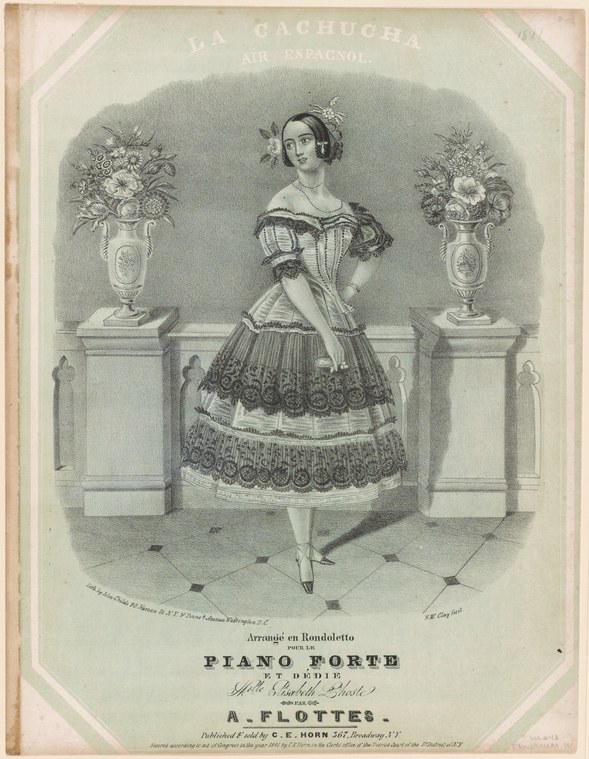
La cachucha, air espagnol
Unknown artist
- Collection:
- Prints depicting dance
- Source:
- New York Public Library
- Rights:
- Public domain — free to use, share and adapt.
- Recorded as:
- Public Domain
The cachucha was one of the first truly international dance crazes, and Fanny Elssler's interpretation of it rivalled the fame of pointe-shoe ballet. This print provides visual evidence of how the dance was styled, dressed, and promoted to middle-class audiences, and it shows that theatrical dance imagery was commodified and circulated as everyday objects—music covers, annuals, parlour prints. For historians of dance, gender, and visual culture, it is a rare document of how professional stage movement was translated into a visual language for the home.
What you are looking at
A young woman in mid-19th-century ballroom dress stands alone in an elegant interior, posed as if mid-dance. She wears a white off-shoulder corsage with dark trim and an expansive skirt composed of multiple tiers of ruffled fabric with decorative scalloped edging—the signature silhouette of the 1830s–40s. Her posture is upright and graceful, with one arm extended and the other at her side, suggesting the moment of a turn or travelling step. Flanking her are two classical urns overflowing with flowers, set upon pedestals on either side of the composition, establishing an idealized, theatrical setting rather than an actual ballroom. The figure is centrally positioned within a vignette framed by an ornamental border, and the background is rendered in soft tones that emphasize the dancer against a neutral ground. The engraving technique creates delicate gradations of light across the fabric, emphasizing the volume and texture of the skirt—the technical heart of this image.
The dancing
The dancer stands in an open, upright frame with elongated posture and one arm extended in what appears to be a travelling step or turn. Her weight appears lightly distributed, suggesting the effortless elevation associated with Romantic-era ballet technique, though her dress is that of a ballroom dancer or opera dancer, not a stage ballerina in point shoes. The extended arm and turned-out position of the supporting leg are consistent with the ballet vocabulary of the period, but executed within a social dance context. She is alone in the frame, the sole focus of attention.
The dance depicted
This is a print of *La Cachucha*, a Spanish-inflected theatrical dance that became an international sensation when performed by the Romantic ballet dancer Fanny Elssler in the 1830s. The work is credited on the print itself as an "arrangement en Rondoletto" for piano by A. Flottes, indicating this is a music-and-dance publication—a common genre pairing in 19th-century popular print culture. The cachucha was a stylized, theatrical version of a Spanish regional dance, danced in soft shoes (not pointe) with a characteristic upright posture, rhythmic footwork, and dramatic arm gestures. Elssler's interpretation, shown here, was genteel and controlled rather than overtly passionate, fitting the Romantic ballet aesthetic that privileged ethereality over virtuosity. The figure depicted embodies the idealized dancer-as-ornament of mid-19th-century taste.
How it was made
This is a steel or copper engraving, as evidenced by the fine hatching, the precision of the line work, and the characteristic vignette format. The technique allowed for mass production and wide circulation—such prints were affordable commodities sold separately or bound into musical scores and theatrical annuals. The engraver has used tonal gradation and cross-hatching to create volume and fabric texture, particularly in the rendering of the skirt, which dominates the visual interest. The print's credit line—"Published & sold by C.E. HORN, 367 Broadway, N.Y." and printer information at the base—confirms this as a commercial music-shop publication, likely from the 1840s, intended for domestic use and amateur performance.
About this work
This engraving documents a pivotal moment in 19th-century dance: the craze for *La Cachucha* following Fanny Elssler's debut in the role. It is both a stage image and a commercial product, bridging professional theatre and domestic music-making. The print captures not only the dancer's pose but also the silhouette that defined Romantic femininity—the enormous gathered skirt, the bare shoulders, the graceful extension. As a music-shop publication, it served audiences who wanted to own and perform the dance's music; the image of the dancer was inseparable from the musical composition. The work sits at the intersection of Romantic ballet, Spanish character dance, and popular visual culture, representing the moment when theatrical dance became mass entertainment.
How to look at it
Observe the posture first: the dancer's upright carriage and extended arm are not the fluid, rounded épaulement of classical ballet, but rather the controlled, angular presentation of character dance. The ruffled skirt, despite its volume, is clearly meant to move—the engraver has rendered it not as static fabric but as if caught in motion, with the scalloped edges suggesting the patterns created by a turning movement. The architectural setting, with the flowering urns, is entirely theatrical: this is not a ballroom portrait but a stage vision of a stage dancer. The vignette format, framed like a cameo, elevates the figure into art while the commercial credit line at the bottom anchors it firmly in the marketplace. Notice also the delicate rendering of the corsage and the bare shoulder—the idealized femininity of the era is on full display.
The artist
The print is unsigned as an engraver, but it credits A. Flottes as the arranger of the music and C.E. Horn as the publisher. Horn was a prominent New York music publisher and merchant of the mid-19th century, known for issuing theatrical and popular music with accompanying engravings. The engraving itself is competent commercial work, clearly produced by a specialist in theatrical imagery. The identity of the engraver remains unknown from the print itself.
The period
The 1830s and 1840s were the apex of Romantic ballet, an era when ethereal femininity, exotic locales, and supernatural subjects dominated European and American stages. Within this context, Spanish character dances held a particular appeal: they offered drama and passion while remaining technically 'readable' to audiences trained on classical vocabulary. Fanny Elssler was Marie Taglioni's great rival, and where Taglioni embodied the otherworldly sylph, Elssler claimed the role of the sensual, earthly dancer. The cachucha, with its rhythmic footwork and Spanish costume, represented this alternative aesthetic. Simultaneously, the music-publishing industry was booming in American cities, with publishers like Horn capitalizing on theatrical crazes by issuing arrangements of popular melodies alongside engraved portraits of famous performers. This print is a product of that commercial machinery.
Where it lives
This engraving is held in the New York Public Library's collection of prints depicting dance. The imprint and credit line identify it as published by C.E. Horn, a Broadway music merchant, suggesting it was originally sold as a separate print or included in a bound musical score or theatrical annual. Its presence in the NYPL collection reflects the institution's focus on documenting theatrical culture and popular entertainment in 19th-century New York.
Dance in this work
Questions about this work
Who was Fanny Elssler and why was the cachucha so famous?
Fanny Elssler (1810–1884) was an Austrian dancer who became one of the greatest stars of Romantic ballet. She rivalled the more ethereal Marie Taglioni by embodying a different ideal: earthly, sensual, technically dazzling. The cachucha, a Spanish regional dance she performed in the ballet of the same name (premiered 1836), became her signature role and sparked a transatlantic craze. Audiences adored it for its combination of grace, rhythmic vitality, and exotic Spanish flavour.
Is this a ballet or a social dance?
It is both and neither. The cachucha as performed on stage was a theatrical character dance—a stylized, staged version of a Spanish folk dance, performed by professional dancers in the context of a theatrical work. It was not a classical ballet (no pointe shoes, different aesthetic), but it was not a social dance either, though social dances of the period were influenced by it and dance masters taught it as a fashionable parlour step.
What does 'Arrangé en Rondoletto' mean?
It indicates that A. Flottes has arranged the cachucha's music in the form of a rondoletto, a short, light instrumental form popular for domestic piano playing. This print was likely issued with or as part of sheet music, allowing amateur musicians to play the tune at home while the engraving provided a visual image of the celebrated dance and dancer.
Why are there urns of flowers on either side of the dancer?
The urns are a conventional element of theatrical and idealized portraiture, signifying elegance, refinement, and classical taste. They are not part of an actual stage set but rather a framing device that elevates the dancer into a work of art—similar to how portrait prints of the era included architectural or natural elements to enhance the sitter's status.
More dance artwork





