49 works in this view — arrow keys or swipe to move between them.
Dance in Art
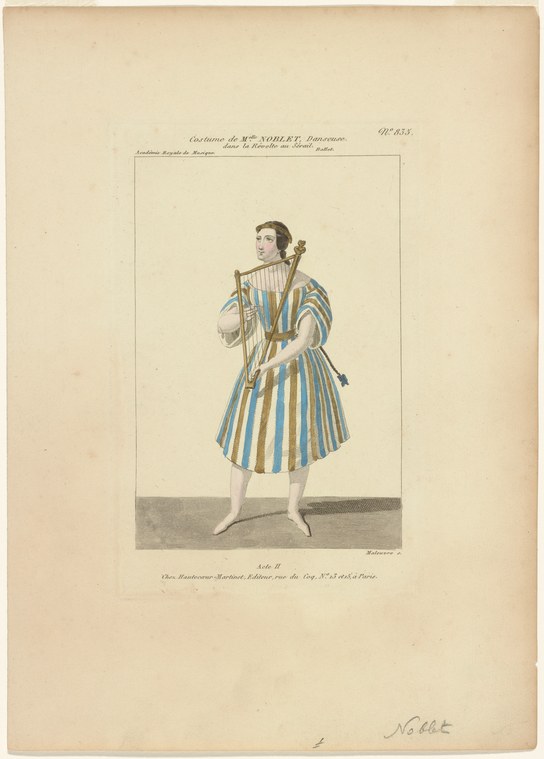
Costume de Melle Noblet, danseuse, dans La révolte au sérail, ballet, act II, Académie royale de musique
Unknown artist
- Collection:
- Prints depicting dance
- Source:
- New York Public Library
- Rights:
- Public domain — free to use, share and adapt.
- Recorded as:
- Public Domain
This is primary visual evidence of how a major 19th-century ballerina dressed on stage and how the Romantic ballet engaged with exotic costume as spectacle. The image confirms the centrality of costume and hand properties to the dramatic identity of characters in narrative ballet, even for principal dancers.
What you are looking at
A single female dancer is shown in three-quarter view against a plain background, wearing a striking costume of vertical blue and cream stripes. The striped skirt is voluminous and falls to mid-calf, contrasting with fitted sleeves and a close-fitting bodice. She holds a large ornamental harp or similar stringed instrument vertically against her body with both hands. Her posture is upright and formal, with her weight evenly distributed and her gaze directed outward. The figure is rendered in hand-colored engraving with careful attention to the costume's pattern and the instrument's gilded detail. The composition isolates the dancer against white paper, presenting a costume study rather than a narrative scene.
The dancing
The dancer stands in an erect, dignified pose with squared shoulders and both arms engaged with the instrument. Her arms are extended but not dramatically—the left arm curves naturally around the harp's body while the right hand meets it at mid-height. Her legs are visible from hip to foot in a neutral stance; there is no suggestion of a specific step or weight shift. The positioning suggests a moment of display or presentation rather than active movement through space.
The dance depicted
This is a costume record for Mademoiselle Noblet, a Romantic-era ballerina documented here as she appeared in Act II of *La révolte au sérail* (The Revolt in the Seraglio), a ballet performed at the Paris Opéra. The presence of an ornamental harp as a hand property is unusual in theatrical dance and likely reflects the Oriental or Turkish theme of the ballet's narrative. Noblet was a major performer of the 1830s-40s, and this image records her costume and the literal props she carried on stage.
How it was made
This is a hand-colored engraving, a reproductive print technique standard for costume documentation in this period. The engraving allows fine linear detail in the striping and the harp's ornamental work, while selective hand coloring in blue and flesh tones completes the effect. Such prints were produced for distribution to theaters and dancers, serving as records of successful costumes and as promotional images circulated among the theater-going public. The technique was ideal for achieving crisp precision in pattern and was far more economical than painted designs.
About this work
This work is a costume plate documenting a specific performer in a specific historical ballet production. It belongs to the tradition of 19th-century theatrical ephemera—prints made to preserve and circulate knowledge of stage dress and design. Mademoiselle Noblet was a significant ballerina of her time, and this image captures the exotic theatricality of Romantic-era ballet, which favored Oriental and fantastical settings. The work is historically valuable as evidence of how dancers were costumed and how they were advertised to the public.
How to look at it
Attend first to the costume itself—the bold striping, the voluminous skirt, the gilded harp—which is the primary subject. The dancer's pose is static and formal, a presentation stance rather than a moment of dancing. This reflects the function of the image: to show the costume clearly and completely, not to suggest motion or choreography. The inscription at the top identifies the performer and the ballet, making this a form of advertisement as much as documentation.
The artist
The artist is not recorded. Costume plates of this type were produced by commercial engraving workshops in Paris, typically working from sketches by theater costume designers. Such prints were usually unsigned or credited only to the publisher. The work belongs to a large body of Parisian theatrical ephemera produced for the Opera and other venues.
The period
This image dates to the height of the Romantic ballet era (1830s–1840s), when the Paris Opéra was the center of European dance innovation. Romantic ballet celebrated exotic narratives, supernatural themes, and the visual display of the female dancer in ornate costume. The Ottoman and Oriental settings were fashionable in European theater and visual culture of the period, reflecting both imperial fascination and theatrical fantasy. Costume documentation in engraved form was a standard commercial practice, allowing theaters to record successful designs and dancers to preserve their professional image.
Where it lives
This print is held in the New York Public Library's collection of prints depicting dance. Such theatrical prints were widely distributed and collected during the 19th century and are now held in major libraries and museums across Europe and North America.
Dance in this work
Questions about this work
Was Mademoiselle Noblet a famous dancer?
Yes. Noblet was a principal ballerina at the Paris Opéra during the 1830s–1840s, the era of Romantic ballet. She danced in major works of the period and was a celebrated performer in her time, though she is less well-known today than some of her contemporaries.
What is *La révolte au sérail*?
This was a ballet (or ballet-opera) performed at the Paris Opéra, featuring an Ottoman or Oriental setting. The title translates as 'The Revolt in the Seraglio.' The exotic setting was typical of Romantic ballet, which often drew on fantasy narratives and distant or fantastical locales.
Why does a ballerina carry a harp?
The harp is a theatrical hand property, part of her character costume in the ballet's narrative. In the exotic setting of *La révolte au sérail*, such instruments were used as visual signifiers of the Oriental or fantastical world being portrayed.
How were costume prints used?
These engravings were distributed to theaters, dancers, and the public as records of successful costume designs and famous performers. They served as promotional images, memory aids, and design references for future productions. They were a standard form of theatrical ephemera in the 19th century.
More dance artwork





