49 works in this view — arrow keys or swipe to move between them.
Dance in Art
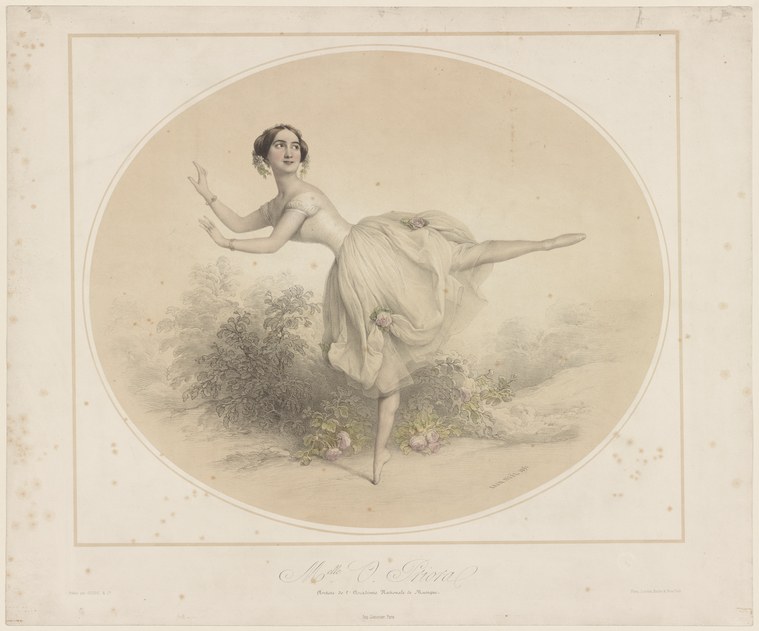
Melle. O. Priora, artiste de l'Académie nationale de musique
Unknown artist
- Collection:
- Prints depicting dance
- Source:
- New York Public Library
- Rights:
- Public domain — free to use, share and adapt.
- Recorded as:
- Public Domain
This print is a direct visual record of how Romantic ballet was danced and promoted in its era, preserving not only the technique and costume but the *aesthetic philosophy* of weightlessness and spiritual expression that defined the movement. For historians and dancers, it offers evidence of how the Romantic ideal was translated into bodily practice, and it documents the role of commercial theatrical prints in constructing celebrity and disseminating performance culture across Europe.
What you are looking at
A young woman in a flowing white gown and bare shoulders is captured mid-leap against a soft, neutral background. Her body is suspended in an exuberant elevation, with her left leg extended high and her right leg bent beneath her, both arms raised in a graceful, expressive gesture. She gazes upward with parted lips, her dark hair arranged in ringlets typical of mid-19th-century styling. Below her, anchoring the composition, is a naturalistic sketch of flowering shrubs and ground vegetation rendered in delicate gray tones. The entire scene is contained within a circular vignette frame, mounted on a larger rectangular sheet with a double-ruled border. The technique is a skillfully executed combination of lithographic stone and hand-coloring, giving the work a soft, ethereal quality characteristic of theatrical promotional prints of the period.
The dancing
The dancer's body demonstrates the weightlessness and verticality prized in Romantic ballet: she occupies space in a high, sustained jump with her supporting leg fully extended and her free leg drawn up, creating a line of continuous elevation. Her arms frame her face and body in a lyrical, unforced manner—neither the rigid port de bras of classical technique nor a gymnastic pose, but an emotional expression through the body. Her torso is upright and centered, and her face follows the line of her gaze upward, a unified articulation of head, spine, and limbs that suggests the Romantic aesthetic of weightlessness and spirituality.
The dance depicted
This is almost certainly a depiction of Romantic ballet as danced in the 1840s–1850s, the era of *La Sylphide*, *Giselle*, and the reign of the dancer-muse. The title attributes the work to Melle. O. Priora, identified as an artist of the Académie Nationale de Musique (the Paris Opéra), suggesting this is a promotional or commemorative print of a well-known performer. The pose—a sustained jump with expressive arm gesture and ethereal quality—is characteristic of the vocabulary of Romantic ballet, which emphasized the illusion of weightlessness, emotion expressed through the body, and a fusion of classical technique with Romantic sensibility. The artist has captured the *esprit* of the Romantic leap rather than a specific technical codification.
How it was made
This is a lithographic print, hand-colored with watercolor or gouache. The soft tonal modeling, the way the figure emerges from the pale ground, and the delicate rendering of the vegetation are typical of mid-19th-century theatrical lithography, a process that allowed for rapid production and wide distribution of images of celebrated dancers. The vignette format and decorative framing suggest this was a commercial product—likely a souvenir, a promotional image for a performance, or a collector's print issued by a Paris printmaker. The combination of lithographic drawing with hand-coloring made each print individually finished, allowing for variation and ensuring the work retained its artistic refinement despite its reproducibility.
About this work
This is a hand-colored lithographic print commemorating or promoting a performance by Melle. O. Priora, a dancer of the Paris Opéra, in the Romantic ballet era of the mid-19th century. The print captures the essential vocabulary of Romantic ballet through a single, suspended moment: a young woman in flight, her body weightless and expressive, her face turned upward in an ecstatic gaze. The work belongs to a rich tradition of theatrical promotion and celebrity culture in the 1840s–1850s, when lithography made high-quality images of famous dancers available to audiences and collectors. It is both a technical record of how Romantic ballet looked—the silhouette, the costume, the port de bras—and an emotional document of what Romantic ballet aimed to express: the transcendence of the body through dance.
How to look at it
Look at the moment the artist chose: not the preparation, not the landing, but the apex of the jump, the moment of maximum suspension. This choice—to freeze the body at its most weightless—is the key to understanding Romantic ballet's visual project. Notice how the artist has avoided the mechanical or demonstrative; the leap does not display technical prowess but rather seems to express an inner state, an upward gaze of longing or rapture. The soft, diffused background and the naturalistic vegetation ground the figure in a poetic rather than theatrical space. Finally, observe how the costume—the simple white gown, the bare shoulders, the minimal ornamentation—allowed the body and its line to read clearly, a functional choice that became an aesthetic ideal.
The artist
The artist is not recorded in the catalogue, but the print was issued by the Paris Opéra and Melle. O. Priora herself was a named artist of the Académie Nationale de Musique. The execution suggests the hand of a skilled lithographic draftsperson working in the mid-19th-century Parisian theatrical print industry—a craft sector that produced thousands of images of dancers, singers, and actors for sale to the public. Such prints were often unsigned or attributed only by publisher, and many have been lost or remain unattributed.
The period
This print dates to the height of the Romantic ballet era (approximately 1840s–1860s), when the Paris Opéra was the center of European dance and when ballet had become deeply associated with the Romantic movement in visual art and literature—an emphasis on emotion, the supernatural, and the transcendence of the physical through aesthetic refinement. This was the era of *La Sylphide* (1832) and *Giselle* (1841), when the female dancer in a white tutu became the iconic image of ballet itself, and when the ethereal, weightless leap became the visual signature of the art form. Lithographic prints of celebrated dancers were a major form of entertainment and commerce, distributed across Europe and circulating among theater-goers, print collectors, and the culturally ambitious bourgeoisie.
Where it lives
This work is held in the Prints collection of the New York Public Library, part of a larger body of theatrical prints and dance imagery from the 19th century. It is a commercial lithographic print, likely one of many issued by a Parisian publisher or the Opéra itself, and its circulation was broad—such prints were sold in music and print shops across Paris and exported throughout Europe.
Dance in this work
Questions about this work
Who was Melle. O. Priora?
Priora is identified in the print as an artist (danseuse) of the Académie Nationale de Musique, the official name of the Paris Opéra. Beyond this, little is known; she is not a figure of major historical prominence. The title suggests she was a known performer of sufficient rank to warrant a commemorative or promotional print, a common practice for celebrated dancers of the era.
What style of dance is shown?
This is Romantic ballet, the dominant style of theatrical dance in mid-19th-century Europe. The suspended leap, the ethereal quality, the expressive arm gesture, and the white gown are all hallmarks of Romantic ballet as it was danced in the 1840s–1860s. This was the era before the codification of pure classical technique (Cecchetti method) and the virtuosic vocabulary of late-19th-century ballet.
How was this print made?
It is a hand-colored lithograph. The image was drawn on a lithographic stone, printed, and then each impression was individually colored by hand with watercolor or gouache. This process allowed for rapid production while retaining individual artistic finish, making such prints relatively affordable and widely available to theater audiences.
Why is she jumping?
The leap (or *élevé*) was central to Romantic ballet's vocabulary and philosophy. It created the illusion of weightlessness and transcendence that the Romantic movement prized. Rather than a display of strength, the leap was meant to express emotion and a sense of being lifted beyond the physical world—a spiritual or supernatural quality. This print captures that ideal.
More dance artwork





