49 works in this view — arrow keys or swipe to move between them.
Dance in Art
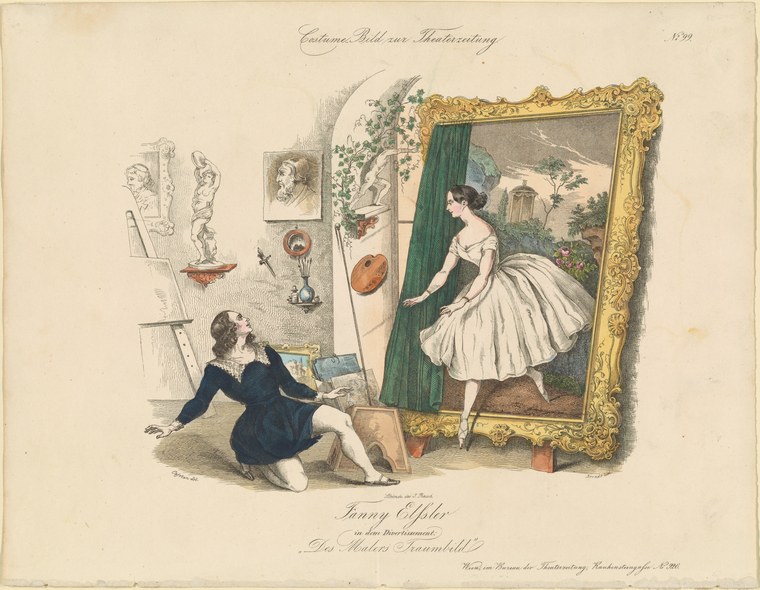
Fanny Elssler in dem Divertissement: "Des Malers Traumbild"
Unknown artist
- Collection:
- Prints depicting dance
- Source:
- New York Public Library
- Rights:
- Public domain — free to use, share and adapt.
- Recorded as:
- Public Domain
Fanny Elssler was one of the defining figures of Romantic ballet, and this image documents how she was marketed and mythologized to the public. The work reveals that Romantic ballet was not primarily about narrative or character dance, but about the visual spectacle of the female body in motion—and the ideal of that body at rest. For historians of dance and image, this print shows how the dancer was positioned as a muse for the visual artist, transforming the performance into an object of fine art contemplation.
What you are looking at
A woman in a dark dress kneels before a large gilded-framed painting, gazing up at it with rapt attention. Within the painting, a ballerina in a voluminous white tulle skirt and pale pointe shoes stands en relevé against a Romantic landscape backdrop with classical ruins and verdant foliage. The framed painting is the dominant element, hung prominently in the composition. Around the kneeling woman are scattered the apparatus of artistic practice and connoisseurship: shelves holding busts and statuettes, framed portrait sketches pinned to the wall, a palette, brushes, and various objects suggesting both the painter's studio and the collector's cabinet. The overall effect is of a woman—likely representing the painter or artist—experiencing a kind of aesthetic rapture or inspiration before an ideal vision of the dancer.
The dancing
The kneeling woman's body is turned toward the painting, her gaze upward in a pose of reverence or longing that reads almost devotional. Her posture is off-balance, weight shifted forward, one leg extended behind her—a gesture of informal intimacy with the work before her rather than formal study. The ballerina within the painting is captured in a moment of stillness en relevé, her arms open in a graceful port de bras, her torso erect and elongated, the immense skirt suggesting a moment of suspension between movements. The two figures are visually linked by the woman's gaze and by the framing device, but they exist in different registers: one is flesh, the other is the idealized representation.
The dance depicted
This is a work about Romantic-era ballet, specifically depicting Fanny Elssler, one of the era's most celebrated ballerinas. The inscription identifies the image as 'Fanny Elssler in dem Divertissement: "Des Malers Traumbild"' (The Painter's Dream), suggesting a theatrical divertissement or choreographed interlude in which Elssler performed. The painting within the print shows the aesthetic ideal of the Romantic ballerina: ethereal, weightless, poised in a landscape that belongs to fantasy rather than the stage. The subject is not the dance itself, but rather the relationship between the male gaze of artistic creation and the female dancer as muse or inspiration. Elssler's body is rendered as an object of aesthetic contemplation rather than a subject in dramatic action.
How it was made
This is a hand-colored engraving or print, executed in the 19th-century manner for theatrical promotion and popular circulation. The fineness of the line-work in the background elements, the delicate cross-hatching for shading, and the precise detail of the costume suggest engraving rather than lithography. The hand-coloring—evident in the warm tones of the gilt frame, the vivid white of the tulle skirt, and the pale flesh tones—is applied over the printed image and would have made this an expensive item for a wider audience. The technique allows for the creation of a layered composition with sharp detail in the foreground figures and more impressionistic rendering of the studio interior, creating depth and focus.
About this work
This is a 19th-century promotional print celebrating Fanny Elssler's performance in a theatrical divertissement called 'The Painter's Dream.' The work is a meditation on the Romantic ballet aesthetic and the relationship between artistic vision and the dancer's body. Rather than depicting an action or narrative moment in the dance itself, the artist has created a meta-theatrical image: a woman (herself an artist or connoisseur) gazes in rapture at a painted image of the ideal Romantic ballerina. The print captures a specific historical moment in dance culture—the era when the ballerina became the primary subject of ballet, the dancer's body idealized as weightless, ethereal, and otherworldly. The framing device and the scattered studio paraphernalia anchor the work in 19th-century artistic practice and suggest something about how Romantic ballet was consumed: as a high art form worthy of aesthetic reverence and artistic recreation.
How to look at it
The viewer should first notice the structure of the composition: the woman in dark dress is positioned as a surrogate for the spectator, her gaze directing ours into the framed painting. The moment chosen is one of stillness and suspense rather than dynamic action—the ballerina is poised, en relevé, in a landscape that reads as a dream or fantasy rather than a theatrical stage. The contrast between the dark, cluttered, masculine space of the studio (with its busts and sketches) and the pale, ethereal, feminized landscape within the frame is crucial to understanding the work's meaning. The print's title, 'The Painter's Dream,' invites us to see the ballerina not as a performer but as the vision that animates artistic creation itself.
The artist
The artist is unrecorded in the catalogue, but the work bears the hallmarks of 19th-century theatrical print production—likely created by a printmaker working for a theatrical publisher or print house in Vienna or another major European center. The inscription 'Verlag von Brauer u. Schneider' (publishing house) and reference to an artist signature suggest this was a commercial production, created to capitalize on Elssler's fame. Such prints were sold to theatergoers, collectors, and the emerging middle-class audience for ballet as both souvenirs and works of art in their own right.
The period
This work dates to the Romantic era of ballet, roughly 1830–1860, when the ballerina emerged as the central figure in European dance. Fanny Elssler achieved her greatest fame in the 1830s–1840s, touring Europe and America and becoming an international celebrity. The Romantic period saw a shift away from the courtly dances of earlier centuries toward a theatrical, virtuosic art form centered on the female dancer's body. The aesthetic ideal of Romanticism—the ethereal, the otherworldly, the dreamlike—found perfect expression in the ballerina's pointed feet, weightless movement, and ethereal costumes. This print captures that aesthetic in the moment of artistic inspiration, suggesting that the painter himself is overwhelmed by the vision of the ideal dancer.
Where it lives
This print is held in the New York Public Library's collection of dance-related prints and ephemera. It is a 19th-century commercial theatrical print, likely produced in Vienna or another German-speaking center, printed and colored for sale to the theater-going public and collectors of theatrical memorabilia.
Dance in this work
Questions about this work
Who was Fanny Elssler and why does she appear in so many 19th-century prints?
Elssler was an Austrian ballerina and one of the most celebrated performers of the Romantic era, active from the 1820s through the 1850s. She achieved international fame through her virtuosity, technical skill, and dramatic presence. Her popularity made her a subject for printmakers, painters, and sculptors. Unlike some of her contemporaries, she was also known for incorporating national dances (such as the cachucha) into her performances, which broadened her appeal.
What is a 'divertissement' and what does 'The Painter's Dream' suggest about Elssler's performances?
A divertissement is a short, non-narrative choreographed interlude, often performed as part of a longer ballet or opera. The title 'The Painter's Dream' suggests that this was a character piece in which Elssler performed a fantasy or allegorical role—perhaps as a vision of ideal beauty or artistic inspiration. The work emphasizes the aesthetic and visual dimensions of ballet rather than dramatic narrative.
Why is the ballerina in the painting shown with that enormous skirt, and what does it tell us about Romantic ballet?
The voluminous tulle skirt, called a tutu, became the signature costume of Romantic ballet and was designed to emphasize the line of the leg and create the illusion of weightlessness and ethereality. The skirt's fullness and the dancer's en relevé position (rising onto the tips of the pointe shoes) were meant to suggest flight, otherworldliness, and transcendence—key aesthetic values of Romanticism in the 1830s–1840s.
Is this a realistic depiction of how Elssler actually danced, or is it an idealized vision?
This is decidedly idealized. The print depicts Elssler as a muse or vision rather than as a performer in action. The landscape setting and the ethereal quality of the image are products of the artist's imagination and of Romantic aesthetic conventions. Contemporary accounts and other sources suggest that Elssler was known for more grounded, earthbound movement than some of her Romantic contemporaries, making this image a stylization rather than a documentary record.
More dance artwork





