49 works in this view — arrow keys or swipe to move between them.
Dance in Art
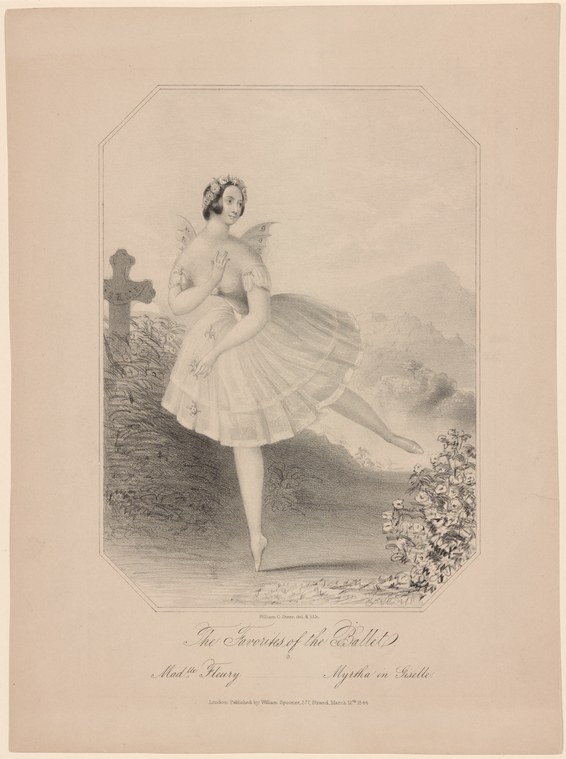
Madlle. Fleury, Myrtha in Giselle
Unknown artist
- Collection:
- Prints depicting dance
- Source:
- New York Public Library
- Rights:
- Public domain — free to use, share and adapt.
- Recorded as:
- Public Domain
Myrtha is a crucial secondary role in Giselle—commanding, otherworldly, often performed by senior dancers—and this image records how she was presented to the London public. The image is rare evidence of mid-19th-century romantic-ballet costume and silhouette, and of the way wings, the tutu, and the pointe shoe combined to create the illusion of the supernatural on stage. For historians of dance, this print is an invaluable visual document of how the role was understood and marketed, and of the technical and aesthetic vocabulary that defined romantic ballet.
What you are looking at
A young female dancer is shown in a moment of suspended elegance within a romantic landscape. She stands en pointe on her right leg, her left leg extended behind her in an attitude derrière, her body angled gracefully to the left. Her wings are visible—a theatrical attribute marking her as a supernatural being. She wears a white romantic tutu with layers of gauzy fabric falling to mid-calf, the skirt caught mid-movement with visible volume and flow. Her hair is styled up, adorned with what appears to be a small crown or coronet. The background recedes into soft atmospheric depth, with a stone cross visible to the left—a Gothic or funerary element—and flowering vines or ivy at the right margin. The composition is framed within a decorative octagonal border, a convention of theatrical portraiture of the period.
The dancing
The dancer's weight is fully transferred to her supporting leg, knee bent in the soft yielding plié characteristic of romantic movement. The extended leg holds a clear line en attitude, with the foot pointed and lifted, the supporting arm held low and forward while the other arm curves upward in the open épaulement of the period. The pose conveys both stillness and the illusion of movement; the tutu's volume and the dancer's tilt suggest she has just completed or is suspended in turning. There is one figure only, isolated against the landscape.
The dance depicted
This is a theatrical advertisement for a romantic ballet, most likely Giselle, given the title's identification of the dancer (Mlle. Fleury) as Myrtha—the Queen of the Wilis in Act II. The image captures the otherworldly character as she appears in the supernatural scenes: ethereal, weightless, adorned with wings. The romantic tutu, pointe shoes, and gravity-defying attitude are the visual vocabulary of romantic ballet. However, the presence of Myrtha in this pose is unconventional; she is usually depicted in commanding positions of authority over the Wilis corps. This image instead emphasizes the lyrical beauty of the role and the dancer, a choice more common in single-figure theatrical prints of the era, which prioritized elegance over narrative context.
How it was made
This is an engraving or etching, likely a lithographic reproduction given the softness of the line and the tonal gradations in the background. From the image alone, it appears to be made by direct engraving on metal plate, with the finest lines defining the dancer's form and drapery while stippled and parallel hatching create shadow and depth. The decorative border and the printed text below indicate this is a published theatrical souvenir—an advertisement for the performance and the dancer. Such prints circulated widely and were affordable enough to reach middle-class audiences and dancers themselves, making them important evidence of how roles were marketed and remembered.
About this work
This is a mid-19th-century theatrical print celebrating Mlle. Fleury's performance as Myrtha in Giselle, one of the cornerstone roles of romantic ballet. The image exemplifies how the romantic ballet was promoted to the public: through elegant, accessible prints that emphasized the dancer's beauty and the supernatural visual spectacle of the ballet. The print belongs to a large corpus of single-figure dancer portraits from this era, produced to sell performances and to immortalize celebrated dancers in the roles that defined them. It is also documentary evidence of the costume, pointe work, and movement aesthetic of romantic-era ballet as understood by both the artist and the audience.
How to look at it
Observe the dancer's single supporting leg and the clarity of the pointe work—the engraver has taken care to show the foot en pointe and the supporting knee in plié, which would have been technically impressive to a mid-19th-century eye. Notice the wings and the otherworldly setting (the cross, the flowering plants) which establish her character as Myrtha, the supernatural queen, not a mortal maiden. The artist has frozen a moment of lyrical stillness rather than dramatic action, emphasizing the dancer's line and the romantic ideal of weightless, ethereal movement. The octagonal border and printed credits below ground this in theatrical commerce—this is a souvenir, an advertisement, a piece of fan culture.
The artist
The artist is not recorded in the catalogue. The print bears the imprint 'London, Published by William Spooner, 377 Strand, 3 New Buildings,' indicating it was produced commercially in London during the height of the romantic ballet's popularity. The style and technique suggest a professional theatre engraver of considerable skill, likely working from a sketch or painting made during performance or rehearsal. Many such prints were produced anonymously or under the publisher's name rather than the engraver's.
The period
This print dates to the era of romantic ballet, when Giselle (first choreographed by Jean Coralli and Jules Perrot in Paris, 1841) was in active performance across Europe. By mid-century, London had embraced romantic ballet, and celebrated dancers like Cerito, Taglioni, and others had performed there. The supernatural subject matter—the Wilis, or spirits of dead maidens—was central to romantic ballet's aesthetic, which prized otherworldly beauty, ethereal movement, and the female dancer as the locus of poetic imagination. The print reflects the period's appetite for theatrical portraiture and for celebrating individual dancers in their celebrated roles. The octagonal framing device was common in European theatrical prints of the 1840s–1860s.
Where it lives
This print is held by the New York Public Library as part of the Prints depicting dance collection. It is a published theatrical souvenir and advertisement, not a unique work; similar copies would have been distributed commercially in London and sold to theatre audiences and to dancers themselves.
Dance in this work
Questions about this work
Who was Mlle. Fleury?
A mid-19th-century dancer celebrated enough in London to warrant a published theatrical portrait. She is not widely documented in dance histories, suggesting she was a London-based performer of local prominence rather than an international star. The print itself is often the primary surviving evidence of such dancers' careers.
What are those wings?
They identify her as a supernatural being—in Giselle, Myrtha is the Queen of the Wilis, the spirits of young women who died before their wedding day. Wings and diaphanous costume were the visual language by which romantic ballet communicated otherworldliness to the audience.
Why is she on pointe?
By the 1840s, pointe work had become standard in romantic ballet, associated with weightlessness, elevation, and ethereal beauty. It was also technically difficult and celebrated as a sign of a dancer's accomplishment. The print emphasizes the pointe work as both technically impressive and aesthetically essential to the role.
Is this from an actual performance, or a studio portrait?
Likely neither directly. The print was probably made from a sketch or painting created in the theatre or studio, then professionally engraved for commercial distribution. The decorative border and text indicate it was made for sale, not as a unique record of a specific performance.
More dance artwork





