49 works in this view — arrow keys or swipe to move between them.
Dance in Art
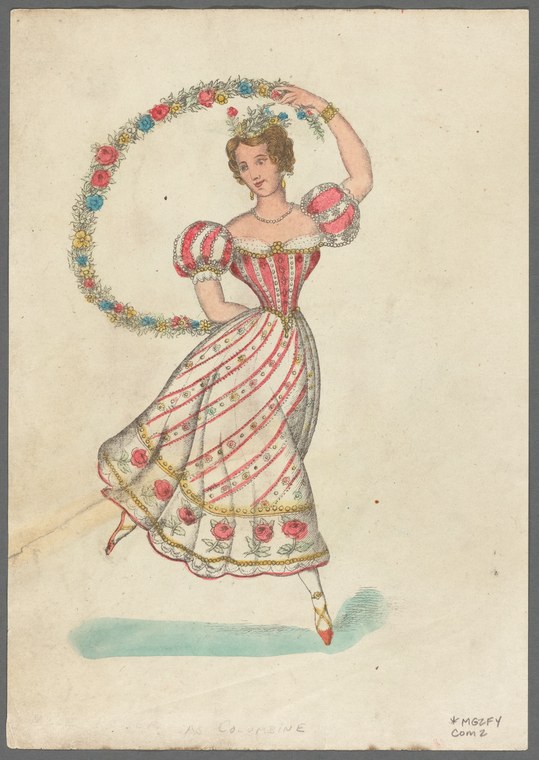
Robert Honner as Harlequin. On the verso is a female figure, possibly Columbine
Unknown artist
- Collection:
- Prints depicting dance
- Source:
- New York Public Library
- Rights:
- Public domain — free to use, share and adapt.
- Recorded as:
- Public Domain
This engraving is rare documentation of male Romantic ballet technique and an identified performer; most surviving images of this era focus on female dancers. The image shows that male dancers executed the same sustained, elevated vocabulary as their female counterparts, challenging assumptions about the simplicity or secondary status of male roles in nineteenth-century ballet. For historians and dancers, it provides visual evidence of how elevation, épaulement, and port de bras were actually performed in this period.
What you are looking at
A hand-colored engraving depicting a single figure in dynamic motion against a plain cream background. The dancer wears a striking red and white striped corseted bodice with voluminous sleeves, paired with a layered skirt elaborately decorated with red rosettes and gold trim along the hem. The skirt is caught mid-swirl, lifted and floating around the figure's legs in a diagonal sweep across the composition. The dancer holds an ornamental garland of roses and forget-me-nots arched overhead in one raised arm, while the other arm extends outward for balance. The pose is characterized by lightness and elevation—the figure appears to be on demi-pointe or in the air, with one leg extended backward. The figure has fair hair styled in ringlets typical of the mid-nineteenth century. A small blue brushstroke at the base suggests a shadow or stage floor. The inscription 'YMOERY / COM'Z' appears in the lower right corner.
The dancing
A single dancer captured in a moment of sustained elevation or traveling movement, with the weight supported on one leg while the other extends back in a lifted position characteristic of Romantic ballet vocabulary. The raised arm holding the floral garland frames the figure's head, while the opposite arm is extended outward—a pose suggesting the épaulement and port de bras of classical ballet training. The torso is held upright despite the apparent momentum, and the leg line is clean and extended. The figure's apparent weightlessness and the precision of the limb placement suggest the artist had direct knowledge of ballet technique.
The dance depicted
This depicts a solo from Romantic ballet, most likely a character or divertissement piece from a mid-nineteenth-century production. The costuming—the striped corseted bodice, the ornamental skirt with applied decoration, the floral garland—suggests a pastoral or festive scenario rather than a classical mythological role. The technical vocabulary visible in the pose (sustained elevation, extended leg line, controlled épaulement) is characteristic of ballet d'action from the 1840s–1850s. The figure identified in the title as 'Robert Honner as Harlequin' suggests this may be a pantomime-ballet hybrid or a character role adapted from commedia dell'arte traditions, though the costume and technique shown are distinctly Romantic-era ballet rather than harlequinade pantomime proper.
How it was made
A hand-colored engraving on wove paper, executed with fine detail work visible in the drapery lines and facial features. The engraver has used delicate parallel hatching for shading on the limbs and face, while the striping of the bodice is rendered with precise parallel lines. Hand-coloring in watercolor or gouache has been applied afterward—the reds are particularly vivid, and the blue shadow at the base was brushed in loosely. This technique of engraving with hand-coloring was standard for theatrical portraiture and dance documentation in the 1840s–1850s, allowing for both fine detail and color information in a reproducible format suitable for circulation among theater patrons and collectors of dance imagery.
About this work
This is a portrait engraving documenting a specific theatrical performance: a male dancer, Robert Honner, in a Romantic-era ballet role designated as Harlequin. The work combines the precision of ballet technique with the visual language of theatrical character costume, capturing a moment of technically demanding movement—a sustained elevation with controlled épaulement—frozen mid-performance. It belongs to a significant body of mid-nineteenth-century dance prints that served to document, promote, and memorialize performances; such images were collected by theater-goers and served as evidence of dancing bodies and technique for audiences who could not attend live performances.
The work is particularly valuable as a record of male Romantic ballet—a repertoire and technical vocabulary often underrepresented in dance history, which has tended to focus on female stars and the ballerina. The inscription on the verso references a female figure, possibly Columbine, suggesting this may have been part of a larger theatrical suite or narrative sequence. Honner is known to have been a performer in London's theatrical world in the mid-nineteenth century, and this print documents the aesthetic and technical conventions of that period's dance.
How to look at it
The artist has chosen to capture the moment of greatest elevation and extension in the movement—the instant when the dancer appears most weightless and the line of the leg is most fully revealed. This freeze-frame approach, common to all theatrical portraiture of the period, prioritizes technical display and ethereality over the narrative or emotional content of the role. Notice the precision of the arm position and the carriage of the torso: even in a moment of apparent flight, the dancer maintains the upright spine and controlled épaulement that distinguish ballet from other dance forms. The floral garland frames and stabilizes the composition while functioning as a costume element that speaks to the fairy-tale or pastoral narrative.
The artist
The artist is not recorded. The signature or inscription 'YMOERY / COM'Z' in the lower right does not match any known engravers of theatrical prints from this period; it may be a misreading, a mark by the colorist, or the surname of an otherwise undocumented practitioner. The style and execution are consistent with the workshop output of London theatrical print-makers of the 1840s–1850s, a period in which hand-colored engraved portraits of dancers and actors were produced in commercial quantities for sale to theater patrons.
The period
This work dates to the height of Romantic ballet in Europe, when the ethereal, otherworldly aesthetic of works like La Sylphide (1832) and Giselle (1841) dominated the stage. In this period, male dancers occupied an ambiguous position: they were essential as partners and for comic or character roles (including harlequinade traditions adapted into ballet), but critical and popular attention focused overwhelmingly on the ballerina. The engraved theatrical portrait was a major medium for circulating images of celebrated performers and for allowing wider audiences—particularly women—to consume dance imagery. London's theaters were centers of dance innovation during this era, with the King's Theatre in the Haymarket and Drury Lane hosting the leading dancers and choreographers of Europe.
Where it lives
The work is held in the New York Public Library's collection of prints depicting dance. It is catalogued as part of a body of theatrical portraiture from the nineteenth century; the verso reference to 'Columbine' suggests it may have been originally bound or stored as part of a larger series or portfolio of related theatrical prints.
Dance in this work
Questions about this work
Who was Robert Honner?
Robert Honner was a male dancer active in London's theaters during the mid-nineteenth century. Beyond his appearance in this print, detailed biographical information is scarce, which is not unusual for male dancers of the period—contemporary records and criticism focused far more intently on female stars. His role here as 'Harlequin' suggests he danced in character and pantomime-ballet roles as well as classical ballet.
What does the garland mean?
The floral garland—roses and forget-me-nots—is a costume element signaling a pastoral, festive, or romantic narrative context. In mid-nineteenth-century ballet, flowers and garlands were used to evoke natural beauty, springtime, and the ethereal worlds of fairies and sylphs. It may also reference theatrical traditions of floral crowning or May-day festivals.
Why is a male dancer in such an ornate costume?
Character and pantomime roles in Romantic-era ballet often featured elaborate costuming regardless of the dancer's gender. Harlequinade traditions, derived from commedia dell'arte, frequently involved colorful, decorative costumes. Male dancers also performed in pastoral, comic, and national character roles that called for vivid, detailed dress distinct from classical ballet's more restrained aesthetic.
How do we know this is ballet and not another form of dance?
The technical vocabulary visible in the pose—the sustained elevation, the extended and controlled leg line, the épaulement of the arms, the upright torso carriage—are all specific to ballet training and practice. The costume, while ornate, follows the silhouette and construction of nineteenth-century ballet dress. The hand-colored engraving format was standard for documenting theatrical dance of this period.
More dance artwork





