49 works in this view — arrow keys or swipe to move between them.
Dance in Art
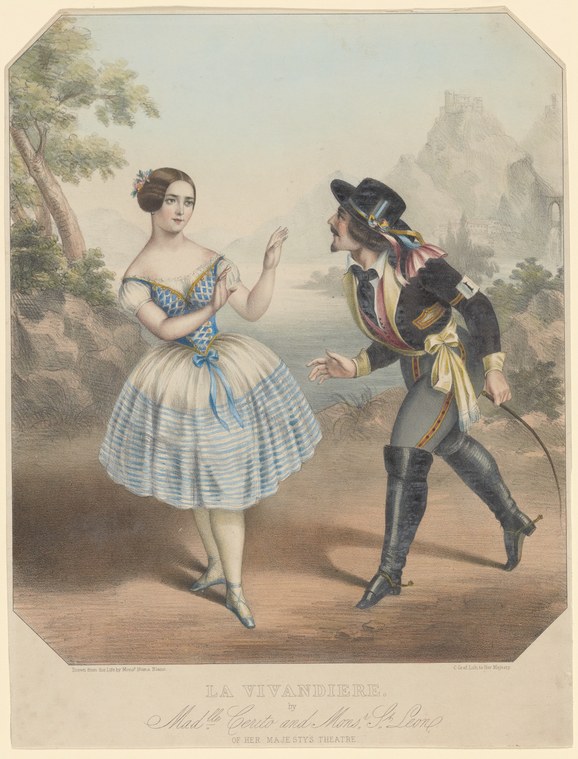
La vivandière by Madlle. Cerito [sic] and Monsr. St. Leon of Her Majesty's Theatre
Unknown artist
- Collection:
- Prints depicting dance
- Source:
- New York Public Library
- Rights:
- Public domain — free to use, share and adapt.
- Recorded as:
- Public Domain
Cerito and Saint-Léon were among the most celebrated ballet dancers of their generation, and this print preserves their forms and the movement vocabulary of mid-19th-century Romantic ballet. For historians, this image documents both the classical balletic posture and the dramatic pantomime gestures central to the ballet-pantomime form—a hybrid genre now largely lost to living practice. The work also demonstrates how lithographic prints functioned as the primary media through which dance was circulated and consumed by the Victorian public, and how ballet was understood as narrative spectacle rather than pure movement.
What you are looking at
A woman in a pale blue and white striped dress with a fitted bodice and full skirt stands on a rocky path in a mountainous landscape, her body turned three-quarter to the viewer. She wears her hair pinned up and gestures with her right hand raised in a refined, almost dismissive pose, while her left arm hangs at her side. A man in military dress—black tailcoat with gold braiding, sword at his side, plumed bicorne hat—approaches her from the left, leaning forward with eager gestures as if pleading or courting. The setting is Romantic theatrical scenery: rocky outcrops frame the foreground, a castle or fortress crowns a distant peak, and atmospheric haze suggests a dramatic landscape. The figures are rendered in the chromolithographic style typical of Victorian theatre prints, with soft gradations of color and fine detail work. The composition captures a moment of romantic tension: the woman poised, composed, slightly withdrawn, while the man appeals to her.
The dancing
The woman stands in a classical balletic posture with an elongated neck and lifted upper body, her weight subtly shifted, one leg bearing her weight while the other is gracefully positioned. Her raised hand is expressive but controlled, suggesting refinement and social propriety rather than raw emotion. The man is bent forward at the waist in a supplicating gesture, his body language urgent and ardent. Both figures are positioned to engage with the viewer as much as with each other—a theatrical convention—rather than lost in intimate interaction. Their relative heights and the distance between them create a narrative of social hierarchy or emotional distance being negotiated.
The dance depicted
This depicts a scene from *La Vivandière* (The Cantinière), a ballet-pantomime first choreographed by Joseph Mazilier to music by Adolphe Adam in 1844. The work combines military comedy and romantic drama, centering on Vivandière (a female camp follower of the French army) and her romantic entanglements. The printed title names Mademoiselle Cerito and Monsieur Saint-Léon as performers, identifying this as a record of a specific production at Her Majesty's Theatre in London, likely from the 1840s–1850s. The image captures not a moment of active dance but a scene of dramatic pantomime—the narrative heart of romantic ballet of the period. The woman's balletic posture and the theatrical staging indicate this is ballet-pantomime rather than dramatic theatre, a form in which plot and character were advanced through stylized movement, gesture, and classical technique.
How it was made
This is a hand-colored chromolithographic print, a commercial medium designed for mass reproduction and circulation as theatrical memorabilia. The bright, saturated colors and luminous quality—particularly the pale blue of the dress and the atmospheric effects of the distant landscape—are characteristic of mid-Victorian lithographic printing, which allowed for color layering and fine detail in a way that older engraving techniques could not easily achieve. The print was distributed to theater-goers and collectors as a souvenir, documenting both the choreography and the celebrated performers of the moment. This technique made images of dance accessible to audiences far beyond London and established visual conventions for representing theatrical dance that would persist for decades.
About this work
This is a theatrical memento of a famous scene from *La Vivandière*, one of the most successful ballets of the Romantic era, documenting a performance by the renowned dancer Fanny Cerito and her partner Arthur Saint-Léon at London's Her Majesty's Theatre. The print captures not technique but narrative—the moment of courtship and emotional negotiation that gave Romantic ballet its dramatic weight. It is a primary document of how ballet was understood and marketed in the mid-19th century: as a combination of classical movement, theatrical spectacle, and emotional storytelling, performed by celebrated soloists whose names and faces were known to the public. The work sits at the intersection of dance history, theatrical history, and the history of popular visual culture, showing how lithographic printing made dance an object of collecting and memory.
How to look at it
Look at the geometry of the two bodies: the woman is vertical, composed, and framed by the landscape; the man is diagonal, urgent, and reaching. The artist has frozen the moment of approach and hesitation—not physical contact but emotional negotiation. Notice the woman's raised hand: it is neither a gesture of rejection nor acceptance, but of social performance—a classical pantomimic gesture. The theatrical framing of the landscape, with its castle and peaks, is not realistic but is a backdrop designed to amplify the emotional stakes of the encounter. The color—the pale dress against the muted earth tones and stormy sky—makes the woman the visual center, drawing the eye to her posture and expression. This is a moment of narrative ballet, where story is told through posed tableaux and expressive gesture rather than through sustained movement sequences.
The artist
The artist is not recorded, but the print was produced by a commercial London theatre-print publisher. Such prints were typically created from drawings by artists who attended performances and worked from memory, description, or sketches, often in consultation with the theatres themselves. The unsigned, mass-produced nature of the work reflects the commercial entertainment print industry of mid-Victorian London, where speed and recognizability mattered more than individual artistic signature. The quality of execution and detail suggest a competent theatrical illustrator working within established conventions for representing ballet.
The period
The 1840s–1850s were the height of the Romantic ballet era in Europe, when ballet had shifted decisively toward narrative, spectacle, and the supernatural or exotic. *La Vivandière* (1844) was part of a wave of ballets that blended the technical virtuosity of the classical vocabulary with dramatic storytelling and atmospheric scenery. The work was particularly popular in London, where French ballet was celebrated but also adapted and Anglicized for local audiences. Lithographic printing was at its peak as a medium for theatrical publicity; photography had not yet displaced the hand-colored print as the primary means of documenting and distributing images of famous performers. The image captures a moment when ballet was among the most fashionable entertainments of urban culture, and when the names and faces of dancers like Cerito were as recognizable as modern film stars.
Where it lives
The print is held in the New York Public Library's collection of prints depicting dance. It is identified as a theatrical souvenir from a performance at Her Majesty's Theatre, London, with the names of Cerito and Saint-Léon indicating the specific dancers and likely production period. Such prints were commercial products sold at theatres and to collectors of theatrical memorabilia.
Dance in this work
Questions about this work
Who were Cerito and Saint-Léon?
Fanny Cerito (1817–1909) was an Italian-born dancer of exceptional technical gifts, celebrated for her brilliance in both Romantic and classical roles. Arthur Saint-Léon (1821–1870) was a French dancer, choreographer, and violinist who partnered frequently with Cerito and later became a prominent choreographer in his own right. Both were among the most famous dancers of the mid-19th century.
What is La Vivandière about?
The ballet follows the romantic and comic adventures of a vivandière (a woman who sold provisions to soldiers) attached to a French military regiment. The plot involves military comedy, romantic entanglements, and magical or spectacular elements. It was one of the most performed ballets of the 19th century, combining the spectacle and machinery of grand opera with classical ballet technique.
Why is this a lithograph rather than a photograph?
In the 1840s–1850s, color photography did not yet exist. Commercial theatre prints were made by lithography, a process that allowed artists to render color, detail, and theatrical lighting effects in ways that contemporary photography could not achieve. Hand-colored lithographs were the standard medium for theatrical publicity and documentation.
How can you tell this is ballet and not dramatic theatre?
The woman's posture—the lifted carriage, the pointed foot position, the elongated line of the body—is balletic rather than naturalistic. The theatrical framing with atmospheric landscape, the formal composition, and the narrative pantomime gesture all identify this as ballet-pantomime, a form that combined classical technique with dramatic storytelling.
More dance artwork





