49 works in this view — arrow keys or swipe to move between them.
Dance in Art
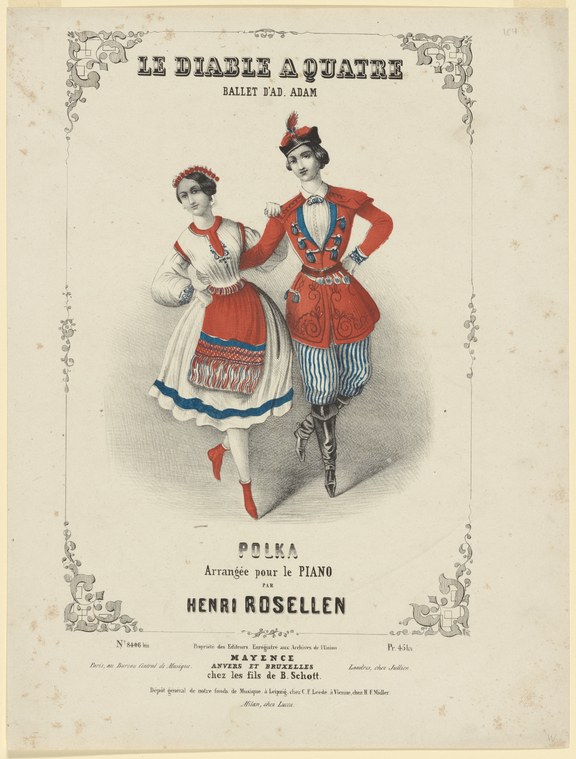
Le diable à quatre, ballet d'Ad. Adam, polka arrangée pour le piano par Henri Rosellen
Unknown artist
- Collection:
- Prints depicting dance
- Source:
- New York Public Library
- Rights:
- Public domain — free to use, share and adapt.
- Recorded as:
- Public Domain
This object shows how ballet audiences experienced and remembered dance outside the theater—through printed music covers that depicted characters and moments in an idealized, accessible form. It is evidence of the polka's intersection with theatrical dance during its peak popularity, and of how professional composers and arrangers like Rosellen made high theatrical work available to amateur pianists and dancers. For costume historians and scholars of nineteenth-century visual culture, it preserves specific detail about male and female dance costume during the Romantic era.
What you are looking at
This is a lithographic cover page for a piano arrangement of a polka from Adolphe Adam's ballet *Le Diable à Quatre*. Two dancers are depicted in a moment of social dance, positioned dynamically across the composition. On the left stands a woman in a white peasant dress with a decorative blue-and-red embroidered panel across the front, short puffed sleeves, and red ankle boots; she holds a small basket or bundle in one hand and turns toward her partner. On the right is a man in a striking red tunic with blue-and-white striped tights, a plumed hat, and boots, striking a characteristic pose with one arm akimbo and the other extended. Both figures are rendered in a romanticized style typical of mid-nineteenth-century theatrical prints, with careful attention to the vivid costumes and the moment of social interaction. The ornamental border frames the composition in the classical style of Victorian theatrical ephemera, and the typography emphasizes the ballet's title and the arranger's name.
The dancing
The woman adopts a balletic posture with her body slightly inclined toward her partner, one leg bent in a suggestive step or pivot, her upper body graceful and controlled. The man strikes a theatrical pose characteristic of male dancers of the Romantic era—chest forward, weight on one leg, the free leg extended or lifted, suggesting both nobility and playfulness. Their spatial relationship suggests active courtship or flirtation; they are turned toward one another despite being separated across the composition. The costumes and bearing indicate trained theatrical dancers rather than folk performers, despite the rustic dress.
The dance depicted
*Le Diable à Quatre* was a popular French ballet-pantomime choreographed to Adolphe Adam's score, first performed in 1845. This print documents the survival of that work in domestic music-making through piano arrangements by professional musicians like Henri Rosellen, who made operatic and ballet scores accessible to middle-class households. The polka designation suggests that the arrangement captured or adapted a section of the ballet for the enormously popular polka craze of the 1840s–1850s. The peasant and demon-or-devil-character costumes indicate a scene from the ballet's plot involving the supernatural or carnivalesque elements common to mid-century ballet-pantomime. While this is not a representation of ballet technique per se, it documents how theatrical dance entered popular culture through printed music and how romantic and comic ballet subjects were merchandised.
How it was made
This is a color lithograph, a process that allowed rapid printing and affordable distribution of theatrical imagery. The hand-coloring in red, blue, and flesh tones over the lithographic base creates a rich, appealing image suitable for display or as a cover for sheet music. Lithography's capacity to render fluid lines and subtle gradation makes it ideal for capturing the movement and costume detail that would attract purchasers of theatrical music. The print's condition—aged paper with visible foxing—indicates long circulation and actual use as sheet-music cover rather than as a formal art object.
About this work
This is a theatrical print advertising a piano arrangement of music from *Le Diable à Quatre*, a mid-nineteenth-century French ballet. It captures a moment of social dance between two characters, presenting them as idealized romantic and comic figures in costume. The work is typical of how ballet and theatrical spectacle were commercialized through printed music in the nineteenth century, creating an intermediary form between the staged dance and domestic consumption. The lithograph's vivid costumes and theatrical poses document both the visual language of mid-century ballet and the market for theatrical imagery in an era before photograph-based promotion.
How to look at it
Notice the careful rendering of the costumes: the woman's embroidered folk dress and the man's flamboyant tunic and striped tights are historically specific markers of character and social class within the ballet's narrative. The artist has chosen a moment of energetic greeting or flirtation, with both figures caught in dynamic poses rather than in a formal ballroom frame. The lithographic process allows the eye to follow the flowing lines of their silhouettes and the bright accents of color that would have caught attention in a sheet-music display. The theatrical poses and idealized proportions are characteristic of how dance was presented to the non-theater audience—as spectacle and narrative rather than as technical demonstration.
The artist
Henri Rosellen (1811–1876) was a French pianist and composer who specialized in arrangements and reductions of operatic and ballet scores for domestic use. He was prolific in making fashionable theatrical works accessible to the Victorian drawing room, and his name on sheet-music covers was a mark of professional musicianship and reliability. While the lithographer of this cover is not recorded, such theatrical prints were produced by commercial music publishers in Paris and London, often by teams of artists specializing in this genre.
The period
The 1840s–1850s saw the height of the polka as a social dance phenomenon across Europe and North America, and composers and arrangers rapidly adapted operatic and ballet melodies to polka rhythm to capitalize on demand. *Le Diable à Quatre* itself (1845) was a hugely successful ballet-pantomime, and Adam's music was one of the most frequently arranged scores of the era. Lithographic theatrical prints proliferated during this period as technologies of color printing improved and music publishing became a mass commercial enterprise. The romantic and comic ballet aesthetic represented here—the supernatural encounter, the costume spectacle, the idealized peasant—was the dominant visual language of theatrical dance between 1840 and 1860.
Where it lives
This object is held in the New York Public Library's collection of prints depicting dance. It is a commercial music-publishing artifact from mid-nineteenth-century Paris, where such theater-related sheet-music covers were produced for both French and international markets.
Dance in this work
Questions about this work
What is *Le Diable à Quatre* and was it a real ballet?
Yes. *Le Diable à Quatre* (*The Devil to Pay* or *The Two Devils*) was a hugely successful French ballet-pantomime choreographed by Joseph Mazilier to music by Adolphe Adam, first performed at the Théâtre de la Porte-Saint-Martin in Paris in 1845. It combined spectacle, pantomime, and comedy and was performed throughout Europe and America for decades. This print documents its afterlife in domestic music-making.
Why would someone buy sheet music with this cover if they could see the ballet in a theater?
Not everyone had access to theaters, and piano arrangements allowed middle-class families to recreate and remember theatrical music at home. These prints served as visual souvenirs and advertisements of the ballet, much as photographs later would. They also allowed amateur dancers and pianists to learn and perform music associated with famous theatrical works.
Is this a polka or a ballet?
It is both. The underlying work is from a theatrical ballet, but this particular arrangement is labeled as a polka—meaning the music has been adapted to polka rhythm and tempo for social dancing. This was common practice in the 1840s–1850s, when composers and arrangers rapidly adapted operatic and ballet themes to fashionable social dances.
Who was Henri Rosellen?
Rosellen (1811–1876) was a respected French pianist and composer specializing in salon music and theatrical arrangements. His name on a sheet-music cover signaled quality and professional musicianship. He made hundreds of operatic and ballet reductions for domestic pianists, playing a crucial role in circulating theatrical music to non-professional audiences.
More dance artwork





