49 works in this view — arrow keys or swipe to move between them.
Dance in Art
Fanny Elssler [facsimile signature]
Unknown artist
- Collection:
- Prints depicting dance
- Source:
- New York Public Library
- Rights:
- Public domain — free to use, share and adapt.
- Recorded as:
- Public Domain
Elssler was a defining figure in Romantic ballet and among the most internationally celebrated dancers of her time; her image circulated across Europe and the Americas in prints such as this one, making her face and figure instantly recognizable. The portrait genre itself—the reproduction and consumption of the dancer's likeness—reveals how 19th-century celebrity culture invested dance and the dancer's body with significance beyond the stage.
What you are looking at
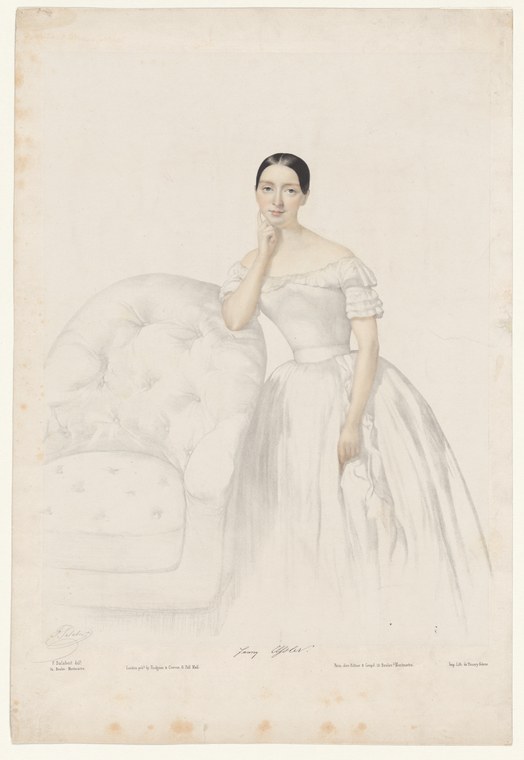
A young woman in an elegant white ball gown stands in a posed, contemplative attitude beside an upholstered chair or sofa. She wears a bare-shouldered dress with short puffed sleeves and a full skirt that extends to the floor, typical of early-to-mid 19th-century formal wear. Her dark hair is parted and smoothed close to her head. She rests her chin on her hand in a gesture of thoughtful repose, her body turned slightly toward the viewer. The composition is spare: the figure dominates a cream-colored ground with minimal setting detail. A facsimile signature reading "Fanny Elssler" appears below the image, and publication information is printed at the base. The work is executed in a delicate linear style with subtle tonal modeling, characteristic of lithographic or engraved portraiture of the period.
The dancing
The dancer stands at ease rather than in active motion, her weight distributed evenly on both feet. Her right arm is raised with the elbow bent, hand touching her cheek and chin in a pose of gentle contemplation. Her left arm hangs naturally at her side. The body is elongated and elegant, the posture upright but relaxed. There is no suggestion of a partnered dance or active movement; this is a portrait attitude rather than a captured moment of performance.
The dance depicted
This is a portrait of Fanny Elssler, the legendary Austrian-Italian prima ballerina of the Romantic era (1810–1884), one of the most celebrated dancers of the early 19th century. The image shows her in street dress or formal day wear rather than theatrical costume or pointe shoes, presenting her as a public figure and celebrity. Elssler was known for her technical brilliance in classical ballet and for her interpretations of character dances, particularly Spanish and Italian forms. The contemplative pose suggests an intimate, off-stage moment, inviting viewers to regard her as a person of sensibility and refinement rather than only as a performer.
How it was made
This is a print—most likely a lithograph or steel engraving, executed in black ink on cream-colored paper. The technique is tonal and linear, with fine parallel lines and delicate shading used to model the fabric, face, and form. The precision of the line work and the capacity to render subtle gradations of tone suggest either lithography or a finely executed engraving; the signature and publication line are printed as part of the composition. This mode of reproduction allowed wide circulation of celebrity likenesses; such prints were collected, framed, and exchanged, making Elssler's image available to a bourgeois audience far beyond theaters.
About this work
This is a formal portrait print of Fanny Elssler, the preeminent Romantic-era ballerina, presented in refined domestic dress and a moment of quiet reflection. It belongs to a vast corpus of 19th-century celebrity portraiture through which dance stars were commodified and disseminated as objects of public admiration. The work captures not the dancer in performance but the dancer as icon—a woman of beauty, sensibility, and public consequence whose image held market value independent of any particular role.
How to look at it
Observe the careful attention to the fabric and form of the gown—the lightweight drape of the skirt, the precision of the neckline, the careful modeling of the bare shoulder. Note the gesture of the hand to the face: a pose of reverie or introspection drawn from academic portraiture and sentiment art. This is not a dynamic image; the viewer is invited to regard the subject as a person of interior life, not only as a performer. The artist has chosen stillness and contemplation as the mode of representing one of the century's most celebrated dancers.
The artist
The artist is not recorded in the catalogue. The print is a commercial work produced for a wide market, and such celebrity portraits were often executed by prolific printmakers whose names did not appear on the sheet or were recorded only in publisher records. The style is consistent with mid-19th-century lithographic or engraved portraiture in Paris, London, or Vienna, the centers of Elssler's fame.
The period
Fanny Elssler danced at the height of the Romantic ballet movement (1830s–1850s), when the ethereal ballerina in white tulle became the dominant visual and artistic ideal. Yet this portrait shows her in day dress, not stage costume, reflecting a broader 19th-century phenomenon: the elevation of the dancer as a public personality whose private image was as marketable as her performance. The print medium and the contemplative pose align with contemporary aesthetics of refinement and feeling, positioning dance as an art of sensibility rather than mere spectacle.
Where it lives
Held in the New York Public Library's collection of prints depicting dance. This is a commercial reproductive print, one of many circulating likenesses of famous performers; no individual provenance is recorded.
Dance in this work
Questions about this work
Who was Fanny Elssler?
An Austrian-Italian prima ballerina (1810–1884) who was one of the most celebrated dancers of the Romantic era. She was known for her technical virtuosity in classical ballet and for her performances of Spanish and character dances. She performed across Europe and the Americas and was a major celebrity of the 1830s–1850s.
Why is she wearing a ball gown, not a ballet costume?
This is a portrait of Elssler as a public figure and celebrity, not a depiction of her in performance. Such prints presented famous dancers in refined dress for domestic consumption, inviting viewers to admire them as women of sensibility and social consequence, not only as stage performers.
What dance style did Elssler represent?
Elssler was a principal dancer of the Romantic ballet, which idealized the ethereal, otherworldly ballerina. She also became famous for her interpretations of character dances with national flavor, particularly Spanish dances, which she performed as both a classical ballerina and a character dancer.
How were such prints used in the 19th century?
Celebrity portraits like this were mass-produced and widely distributed. They were collected, framed, and displayed in homes; given as gifts; or kept in albums. They made the dancers' faces and figures available to a broad bourgeois audience and were part of a commercial economy of fame that predates photography.
More dance artwork





