49 works in this view — arrow keys or swipe to move between them.
Dance in Art
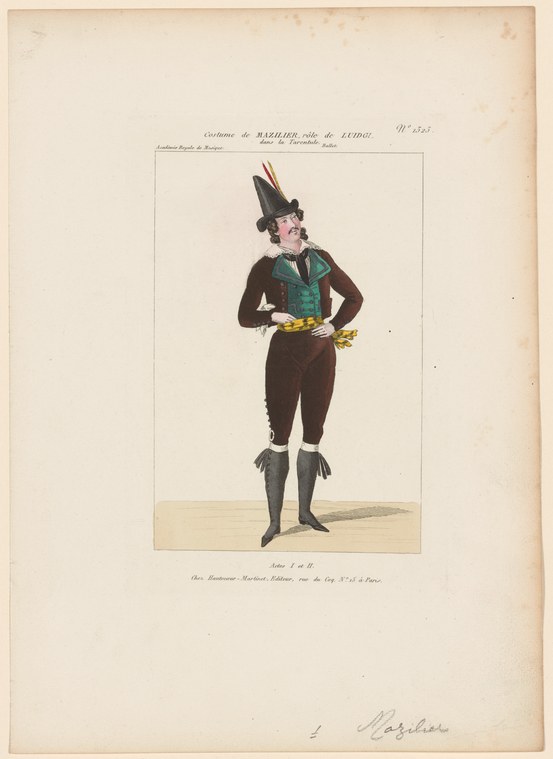
Costume de Mazilier, rôle de Luidgi, dans La tarentule, ballet, Académie royale de musique, actes I et II
Unknown artist
- Collection:
- Prints depicting dance
- Source:
- New York Public Library
- Rights:
- Public domain — free to use, share and adapt.
- Recorded as:
- Public Domain
Male dancers in Romantic ballet are often invisible in surviving imagery, which tends to focus on the ballerina in her tutu; this print is valuable evidence of how the male lead was costumed, presented, and valued as a spectacle. The work also documents Mazilier, who was as important a figure in early 19th-century French dance as any ballerina but is now comparatively forgotten. It reveals the visual vocabulary of nobility and refinement that Romantic ballet relied on to establish character and narrative.
What you are looking at
A single male figure stands alone against a plain background in a three-quarter frontal pose. He wears a tall black bicorne hat with a plume, suggesting military or aristocratic dress of the late 18th or early 19th century. His costume consists of a dark brown or maroon jacket with what appears to be a green or teal vest or waistcoat beneath, trimmed with gold braid or buttons at the center front. White gloves cover his hands, and his lower legs are clad in gray stockings that rise to mid-calf, ending in buckled shoes. His posture is upright and composed, with his weight shifted onto one leg in a stance that suggests controlled formality rather than active movement. The lighting is even and frontal, casting a soft shadow beneath the figure. The entire composition reads as a costume study or theatrical character portrait rather than a scene of choreography in progress.
The dancing
The dancer presents in profile-adjacent stance with his body elongated vertically. His arms hang naturally at his sides with hands positioned forward, fingers slightly extended in a refined, aristocratic manner. His weight rests primarily on the back leg, while the front leg is nearly straight, a posture typical of formal presentation stance rather than active dance vocabulary. The stillness of the figure—the absence of any flex in the knees, any torsion in the spine, or dynamic arm placement—suggests this is a moment of formal introduction or curtain call rather than an actual step or movement phrase.
The dance depicted
The image is identified in the catalogue as the costume of 'Mazilier, rôle de Luidgi' from the ballet *La tarentule* (The Tarantula), likely from a production at the Académie royale de musique in Paris. Mazilier was a celebrated dancer and choreographer of the Romantic era. The formal stance and aristocratic costume—the bicorne hat, military-style jacket, and formal stockings—suggest a nobleman's role rather than a character of lower station, consistent with the conventions of Romantic ballet where the male lead typically embodied courtly elegance. The pose is that of formal presentation: how a dancer would position himself before an audience or in a tableau rather than mid-choreography.
How it was made
This is a hand-colored engraving or aquatint, characteristic of early 19th-century theatrical costume documentation. The precision of the line work, the even application of color in distinct fields (brown coat, green vest, gray stockings), and the centered composition all indicate professional theatrical publication work. The technique allowed wide circulation of costume designs and star performer portraits; such prints were sold to theater-goers and collectors as souvenirs and references for costume makers. The hand-coloring gives it the specificity required for costume reproduction while the engraved line structure ensures clear legibility in reproduction.
About this work
This is a costume portrait of the dancer Mazilier in the role of Luidgi from the Romantic-era ballet *La tarentule*, preserved as a hand-colored engraving. It documents not a moment of dancing but the formal appearance—the 'character'—that an elite male dancer presented to the audience. The work belongs to a large tradition of theatrical costume prints that circulated in early 19th-century Paris, serving both as souvenirs for theater patrons and as records for costume departments. It tells us what the role looked like, what status and social position it signified through dress, and how a celebrated male dancer of the Romantic period was meant to be seen when not in active movement.
How to look at it
This is a costume study, not a movement study. The artist has frozen the figure in formal presentation stance—the way Mazilier would greet the audience or hold a tableau—rather than capturing the middle of a jump or turn. Notice the deliberate formality of the pose: the vertical line from the crown of the hat to the pointed toe, the refined hand position, the even weight distribution. The bicorne hat and military styling are the keys to understanding the role: this is a man of rank and authority, not a comic or supernatural character. This costume vocabulary—what the designer and dancer chose to wear to tell the audience who this character was—is the entire content of the image.
The artist
The artist is not recorded in the catalogue, which is typical for theatrical costume prints of this era. The work was likely produced by a professional printmaking workshop in Paris affiliated with the Académie royale de musique or a commercial theater publisher. Such prints were often unsigned or attributed generically; they were considered documentation of the performance rather than independent artworks, and the dancer or the role, not the artist, was the draw for purchasers.
The period
This work dates from the height of the Romantic ballet era in Paris, when the Académie royale de musique was the center of dance innovation in Europe. Male dancers during this period occupied a paradoxical position: celebrated as virtuosos and often as star attractions, yet increasingly subordinated compositionally and narratively to the ballerina. The formal, aristocratic costume seen here—the military jacket, the refined posture—reflects the Romantic male lead's role as protector, lover, or nobleman rather than the primary focus of the choreography. By the 1830s–1840s, when this print was likely made, the male dancer's visibility in ballet was already declining, making such costume documentation an important historical record.
Where it lives
The print is held in the New York Public Library's collection of prints depicting dance. It is part of the extensive archives of Romantic-era theatrical documentation, which the NYPL maintains as a resource for performance history. Such prints are classified as theatrical ephemera—commercial products made for circulation and sale—rather than fine art, and many examples survive because they were pasted into scrapbooks, bound into albums, or preserved in institutional collections.
Dance in this work
Questions about this work
Was Mazilier a famous dancer?
Yes. Joseph Mazilier (1797–1868) was one of the most celebrated male dancers of the Romantic era and later became an important choreographer. He was a principal dancer at the Paris Opera and created ballets that were performed across Europe. He is less well-known today than ballerinas like Maria Taglioni, but he was equally influential in establishing the aesthetic and narrative conventions of Romantic ballet.
What is 'La tarentule'?
La tarentule (The Tarantula) was a Romantic-era ballet based on the legend of a woman bitten by a tarantula spider who must dance herself to death. The ballet was produced at the Paris Opera and featured roles for both male and female dancers. Mazilier's role as 'Luidgi' (likely a variant of Luigi or Lorenzo) would have been a nobleman, probably the female lead's love interest or protector.
Why is he wearing a military-style jacket?
In Romantic ballet, costume directly communicated social status and character type to the audience. A military or aristocratic jacket signaled that this was a nobleman—a character of rank, authority, and refinement. This visual shorthand was essential in Romantic narrative ballets, which relied on the audience immediately understanding who characters were and their social relationships.
Is this a photograph or a drawing?
Neither. This is a hand-colored engraving, a printmaking technique that was the standard way to reproduce and circulate images in the early 19th century. The engraved lines were cut into a metal plate, then the print was hand-colored with watercolor or gouache. This technique allowed hundreds of copies to be made and sold to theater patrons.
More dance artwork





