32 works in this view — arrow keys or swipe to move between them.
Dance in Art · 2019
Polka
Unknown artist
- Medium:
- Lithograph
- Dance:
- Polka
- Era:
- Late 1800s (Victorian Ballroom)
- Source:
- New York Public Library
- Rights:
- Public domain — free to use, share and adapt.
- Recorded as:
- public_domain
The polka was the first truly modern couple dance, spreading globally with unprecedented speed in the 1840s and democratizing ballroom dancing across class lines; this image documents its aesthetic in the ballroom at its peak. For historians of dance and fashion, the print is a precise record of how the polka was danced—the posture, the hold, the moment of elevation—and of the dress codes that surrounded it. For anyone studying the social history of the 19th-century ballroom, the image offers tangible evidence of the intimacy and formality, the display and constraint, that characterized the dance in this era.
What you are looking at
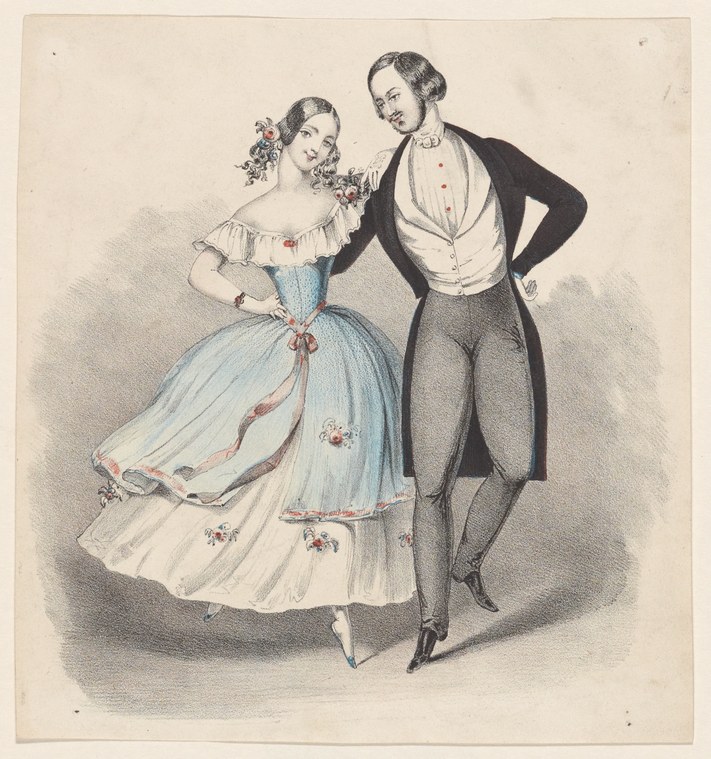
A young couple poses mid-dance against a neutral background, the woman in an off-the-shoulder white gauze gown with a blue corset, her skirt caught in mid-swirl showing the full extent of the voluminous fabric, while the man in formal black tailcoat and light waistcoat stands beside her in a proprietary stance, his hand at her back. Both wear flowers in their hair—she adorned with a flowing floral wreath, he with a simpler boutonnière. The woman's weight appears caught on her left leg, her body tilted toward her partner; the man stands upright and composed. The scene is rendered in lithograph with hand-coloring, the technique allowing soft modeling of light across the fabrics, particularly the translucent folds of the woman's skirt. There is no setting beyond the pale background, throwing all focus onto the dancers and the elegance of their dress.
The dancing
The couple maintains what appears to be a closed ballroom hold, though the moment chosen shows them separated enough to display the woman's dress fully. The man's posture is erect and formal, his right arm extended to support the woman's arm; her body inclines toward him with a graceful S-curve typical of the period. The woman's left foot appears pointed or lifted, suggesting a moment of elevation or turn. Both figures are posed rather than caught in action, a convention of dance portraiture of the era meant to showcase the elegance of the dancers and their clothing.
The dance depicted
This is a polka, as the record states, the most popular couple dance of the 1840s–1880s across Europe and North America. The polka was a democratic dance—performed at all social levels, from bourgeois ballrooms to working-class dance halls—and this image captures the formality of its ballroom iteration. The moment chosen shows the characteristic lightness and lift of the dance; the woman's apparent elevation and the swirl of her skirt suggest the hopping, bouncing quality that gave the polka its name and energy. The woman's elaborate dress, with its off-shoulder neckline and voluminous skirt, is typical of ballroom fashion of the 1860s–1870s, and her partner's formal coat and positioning reflect the gendered structure of the dance, in which the man led and the woman followed through rapid, turning figures.
How it was made
This is a hand-colored lithograph, a technique that allowed for mass production and wide circulation in the 19th century. Lithography was the dominant medium for popular dance imagery and fashion prints of the period, cheaper and faster than engraving but still capable of fine detail. The artist has used the medium to emphasize the play of light on the woman's gauze skirt and the shimmer of the silk and satin fabrics. The hand-coloring—the blue of the corset, the flesh tones, the subtle gray shading—suggests this was a commercial print, likely produced for a publisher rather than as a fine art original. Such prints were distributed widely and were often bound into albums or pasted into scrapbooks by middle-class collectors.
About this work
This is a polka, the defining couple dance of the mid-to-late 19th century, captured in a moment of ballroom elegance. The lithograph records not only the dance itself but the material culture of the ballroom—the fashionable dress, the formal propriety, the gendered dance relation in which the man led and the woman displayed herself through movement and costume. The polka was danced by hundreds of thousands of people across Europe and the Americas, and images like this one circulated as both fashion prints and dance instruction aids, making visible a form of social dancing that has largely disappeared. The work preserves a specific historical moment when the polka was at the height of its popularity and when the ballroom itself was a primary venue for the performance and display of respectability and courtship.
How to look at it
Look at the moment the artist has frozen: the woman's lifted weight and swirling skirt capture the hopping, turning quality that made the polka distinctive. Notice the formal distance the couple maintains even as they dance—they are not embraced but held at the proper arm's length prescribed by ballroom etiquette. The woman's expression is demure, her gaze averted; this was the ballroom ideal, a performance of modesty and compliance that contrasted with the physical activity of the dance itself. The elaborate off-shoulder dress and the flowers in both their hair are conventions of ballroom portraiture meant to signal elegance and occasion; the polka was always danced in formal dress, never in everyday clothes.
The period
The polka emerged in Bohemia in the late 1830s and exploded across Europe and North America in the 1840s, becoming the most fashionable dance of the mid-19th century. It arrived in Paris in 1840 and in London by 1844, and from there spread rapidly to the United States and across the European continent. The polka was faster and more energetic than the waltz, with a distinctive hopping rhythm that made it feel modern and even slightly transgressive to contemporaries; it was danced by all social classes and in all venues, from grand ballrooms to public dance halls. This print dates to the height of the polka's popularity, probably the 1860s or early 1870s, when polka-mania had settled into respectability and the dance had become a staple of ballroom propriety. The lithograph format and hand-coloring are typical of the popular prints and fashion plates of the period, which served as both records of fashion and instructional aids for the millions of people learning to dance.
Where it lives
The print is held in the New York Public Library collection. It is a mass-produced lithograph, one of thousands of similar dance prints and fashion plates that circulated in the 19th century, likely sold individually or in series by a commercial publisher.
Dance in this work
Questions about this work
What is a polka and why was it so popular?
The polka was a couple dance that emerged in Bohemia in the late 1830s and spread across the world with remarkable speed in the 1840s–1880s. It was faster and more energetic than the waltz, with a distinctive hopping rhythm, and it was danced by all social classes—from ballrooms to public dance halls. Its popularity lay in its relative simplicity, its energy, and the way it made ballroom dancing feel modern and exciting while remaining respectable.
Why was the man standing so upright and formal?
The upright, composed posture was the ballroom ideal for men of the period. The man's role was to lead the dance and support his partner with a firm, confident frame. Slouching or appearing at ease was considered unmannerly and would make leading difficult. The formal posture also signaled social rank and propriety—a gentleman held himself with control and dignity.
What do the flowers in their hair mean?
Flowers were a conventional decoration for ballroom dress, especially for women, and signaled occasion and festivity. They were typically worn on the hair or in a corsage pinned to the bodice. In this image, both dancers wear flowers, which suggests either a special ball or a formal evening; it was not typical to wear flowers for everyday dancing.
How is this different from a waltz?
The polka is faster, with a distinctive 2/4 hop-step rhythm, while the waltz is in 3/4 time with a smooth, gliding motion. The polka is also more energetic and playful, with turns and hops that make it feel livelier. Both are couple dances performed in ballrooms, but the polka was seen as more modern and fun, while the waltz was more formal and controlled.
More Polka artwork