49 works in this view — arrow keys or swipe to move between them.
Dance in Art
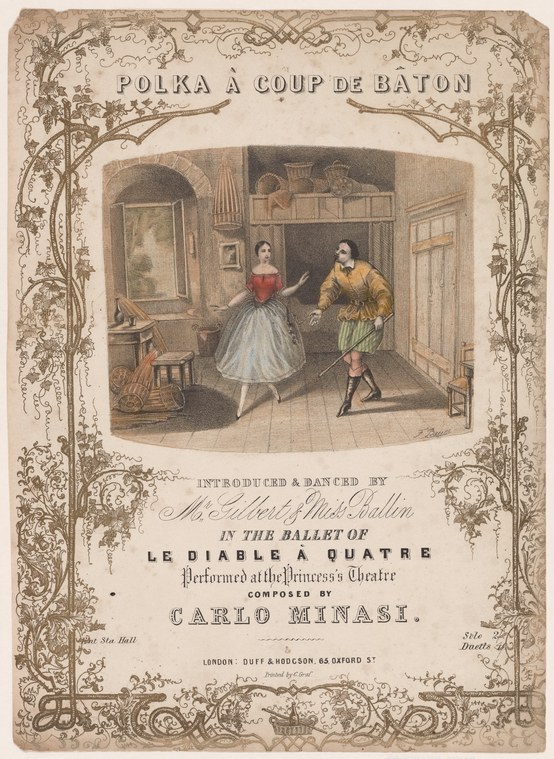
Polka à coup de baton introduced & danced by Mr. Gilbert & Miss Ballin in the ballet of Le diable à quatre.: Performed at the Princess's Theatre. Composed by Carlo Minasi
Unknown artist
- Collection:
- Prints depicting dance
- Source:
- New York Public Library
- Rights:
- Public domain — free to use, share and adapt.
- Recorded as:
- Public Domain
This engraving is evidence of the polka's rapid assimilation into theatrical dance and of how new social dances were instantly appropriated, elaborated, and dramatized for the stage. It also documents the work of specific performers—Mr. Gilbert and Miss Ballin—whose names would otherwise be lost, and shows how theatrical dance in this period combined narrative ballet technique with contemporary popular dance idioms. For historians of dance and print culture, it exemplifies the close relationship between live performance and mass-market visual documentation in the pre-photographic era.
What you are looking at
A hand-colored engraving depicts a moment from the ballet *Le diable à quatre* in an interior setting of the Princess's Theatre. The scene shows a woman in a mid-length white tulle skirt and fitted red bodice, her body caught in a dynamic leap or elevation, one leg extended. Opposite her stands a man in yellow breeches, dark jacket, and boots, his posture animated and confrontational. A third figure—likely an attendant or character—stands at left near a doorway. The setting is a domestic interior with period furnishings: a fireplace, a small table, a window with shutters, and ornamental architectural details. The composition is framed by an elaborate decorative border of acanthus scrollwork and floral motifs typical of mid-19th-century theatrical sheet music covers. The coloring is restrained and period-accurate: ochre walls, cool grays and browns in the background, with the woman's costume the brightest element. Light enters from the left, creating subtle shadows that give the figures dimensionality.
The dancing
The woman's body is elevated and energetic, with her torso upright and one leg extended in what appears to be a jumping step characteristic of stage technique. The man faces her in an open, aggressive stance with his body angled forward, his arms extended as if in pursuit or confrontation. Both dancers occupy the center of the space with an intensity that suggests a moment of narrative drama rather than purely decorative movement. The third figure stands apart, observing. The relationship between the two central figures—their relative heights, the woman's balletic elevation, the man's grounded pursuit—suggests a chase or a conflict, a narrative pivot rather than a social dance.
The dance depicted
The title identifies this as a *polka à coup de baton*—a polka performed with a stick or baton—introduced and danced by Mr. Gilbert and Miss Ballin. The polka was a newly fashionable social and theatrical dance in the 1840s–1850s, characterized by a hopping two-step pattern and playful energy. The *à coup de baton* variant appears to have incorporated a prop or a theatrical element of violence or comedy (the literal meaning is "polka with a blow of a stick"). This image captures a specific choreography created for the theatrical production *Le diable à quatre* (*The Mischievous Devil*, also known as *The Devil's Due*), which premiered in Paris in 1845 and became a popular touring vehicle for dancers across Europe. The composition suggests less the ballroom polka and more a theatrical interpretation—energetic, dramatic, with narrative content. The dancers' technique appears rooted in balletic training (the woman's elevation, the man's controlled dynamic), adapted to a popular dance idiom.
How it was made
This is a hand-colored engraving on paper, characteristic of theatrical publicity materials and sheet music covers of the 1840s–1850s. Engraving allowed for fine detail and sharp definition; the coloring was applied by hand after printing, which accounts for the slight variations and the restrained palette. The technique was ideal for mass circulation: these images were distributed as sheet music covers, playbills, and souvenir prints, making them affordable and widely available. The elaborate decorative border suggests this was either a cover for a published dance composition (the score by Carlo Minasi is named on the title page) or a promotional broadsheet. The image would have served both to document the actual staging and to market the performers and the work to a theater-going public.
About this work
This is a theatrical publicity engraving documenting a specific choreography from *Le diable à quatre*, a popular mid-19th-century ballet-pantomime. It captures the moment and energy of a new dance form—the polka—as interpreted and performed on a London stage by notable dancers of the era. The work combines precise documentation (the named performers, the composer, the venue) with artful composition and narrative drama, showing how dance and visual art collaborated to sell theatrical entertainment. The image is valuable for understanding both the technical and promotional culture of dance in the 1840s–1850s, the specific influence of the polka on stage choreography, and the role of women dancers in theatrical dance during the early Romantic period.
How to look at it
Look at the woman's body position: her elevation, the extension of her leg, and the balletic line of her arm and torso show formal training in classical dance technique, even as the polka rhythm and the man's pursuing stance signal a popular, energetic mode. The composition captures not a moment of balance but of dynamic transition—a jump, a chase—which gives the image its drama. The ornate border frames the scene as a spectacle, separating the theatrical world from the viewer's world. The careful rendering of the interior setting and the attendant figure suggest that this is not a generic dance image but a document of a specific scene with a narrative: the viewer is seeing what an audience member would see on stage.
The artist
The engraver is not recorded. Carlo Minasi, credited as composer, was an Italian conductor and composer active in London theaters during the 1840s–1850s, known for composing dance music and opera accompaniment for theatrical productions. The publication by Duff & Hudson of Oxford Street, London, places this within a significant London music publishing industry that specialized in theatrical scores and dance music for amateur and professional performance.
The period
The 1840s saw the polka at the height of its fashion in Europe and Britain, having arrived from Bohemia via Paris in the mid-1830s. It was embraced simultaneously in ballrooms and on stages, and by 1845 had become a central subject for composers and choreographers. *Le diable à quatre* itself was a vehicle for exploring the collision between diabolic and human worlds through light, comedic dance and pantomime—it belonged to the broader Romantic-era interest in the supernatural and the fantastic. The ballet was also a showcase for the technical abilities of female dancers during the early Romantic period, when women's elevation and leg extension were increasingly celebrated. The hand-colored engraving was the dominant form of theatrical publicity at this date, before photographic documentation became feasible.
Where it lives
The work is held in the New York Public Library's Prints collection, which documents visual culture and theatrical documentation from the 19th century onward. The collection specializes in prints related to performing arts, and works like this were often collected as both historical documents and souvenirs of theatrical productions.
Dance in this work
Questions about this work
What is a polka à coup de baton?
The title literally means "polka with a stick blow." The polka was a fashionable two-step dance of the 1840s–1850s with a hopping rhythm. The *à coup de baton* variant appears to have incorporated theatrical elements—possibly a prop, a mime of violence, or a comedic contact—that elevated it from a social dance to a theatrical spectacle. It was a way of adapting a contemporary popular dance to the narrative and technical demands of stage ballet.
Was the polka a ballroom or a stage dance?
Both. The polka originated as a social dance and spread rapidly through ballrooms across Europe in the 1830s–1840s. Almost immediately, it was adopted by theatrical choreographers and composers, who created elaborate staged versions, like this one, that combined the polka's distinctive rhythm and energy with balletic technique and dramatic narrative. This image shows how quickly the boundary between social and theatrical dance could blur.
Who were the dancers?
Mr. Gilbert and Miss Ballin are named as the introducers and performers of this choreography. They appear to have been notable dancers of the era active in London theaters, but detailed biographical information about them is not widely documented. Their names survive primarily through images and credits like this one.
What is Le diable à quatre?
The title translates as "The Mischievous Devil" or "The Devil's Due." It was a theatrical ballet-pantomime that premiered in Paris in 1845 and became a popular touring vehicle, reaching London stages shortly after. It belonged to a Romantic-era tradition of light supernatural comedies that used dance and mime to tell stories of magical intervention in human affairs.
More dance artwork





