49 works in this view — arrow keys or swipe to move between them.
Dance in Art
Flore et Zéphire
Unknown artist
- Collection:
- Prints depicting dance
- Source:
- New York Public Library
- Rights:
- Public domain — free to use, share and adapt.
- Recorded as:
- Public Domain
This work documents a turning point in ballet history—the moment when male-female partnership, aerial suspension, and mythological narrative became defining features of the form. For dancers and historians, it is evidence of how Romantic ballet technique was actually practiced and taught in the early 1800s, and it preserves the memory of one of the most influential ballets of its century at a moment before photography could record it.
What you are looking at
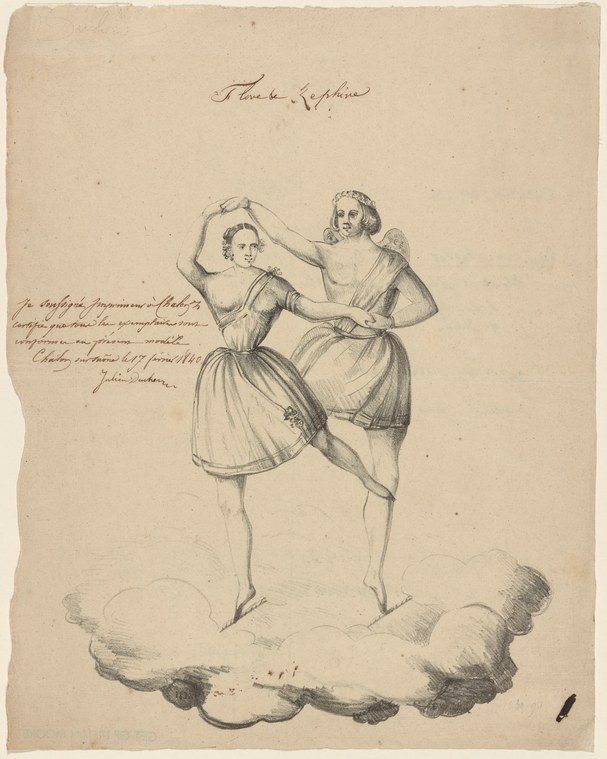
Two female figures dance together on a cloud in this neoclassical pen-and-ink drawing. The figure on the left, smaller and positioned lower, wears a short classical tunic and has her right arm raised overhead in an arched pose; the taller figure behind her, dressed in a longer draped garment, supports her with one arm while gesturing gracefully with the other. Both have their hair styled in the classical manner. The composition is set against a plain background, with the cloud rendered in soft shading beneath them providing the only sense of place. The drawing style is delicate and linear, with careful attention to the musculature and drapery of the figures. An inscription in cursive script appears at the top of the page—the title "Flore et Zéphire"—and additional handwritten notes in French run down the left margin, suggesting this is a study or design document rather than a finished exhibition work.
The dancing
Both dancers adopt high, lifted postures characteristic of early 19th-century ballet. The younger dancer on the left is en attitude derrière—her supporting leg straight and her free leg bent behind, with her torso arched backward and her raised arm creating an elongated line through her body. The taller figure, likely representing Zephyr (the West Wind), cradles and supports her with one arm around her waist or torso. The tallness differential, the support hold, and the asymmetry of the poses suggest a narrative of lift and flight—one dancer is quite literally being held aloft. Both figures have the turned-out legs and pointed feet expected of ballet technique, though the small scale and linear style make fine footwork difficult to read.
The dance depicted
This depicts a moment from *Flore et Zéphire*, a celebrated early Romantic ballet first choreographed by Jean-Louis Aumer in 1815 and danced by some of the era's greatest ballerinas, including Marie Taglioni. The narrative is mythological: Flora, goddess of flowers, is encountered and lifted into the air by Zephyr, the gentle west wind. The image captures the signature moment of the ballet—the elevation and weightlessness that became synonymous with Romantic ballet. The cloud setting, the mythological subject, the ethereal quality of the pose, and the emphasis on the female dancer's upward reach and suspension all align with Romantic ballet vocabulary of the 1810s–1830s, when supernatural encounters and aerial effects through male partner support became central to the form.
How it was made
This is a pen-and-ink drawing with wash or light shading, executed with confident line work and fine detail. The technique allows for precise anatomical study while maintaining the spontaneity of a working drawing or design sketch. The handwritten annotations in French suggest this may have been a choreographic study, costume design reference, or rehearsal note—one of the many ephemeral documents created to communicate a ballet to dancers and collaborators. The scale and presentation indicate it was likely not intended for public sale but rather served as a working document within the theater or studio.
About this work
This drawing records a pivotal moment from one of the most celebrated ballets of the Romantic era. *Flore et Zéphire* (1815) was a landmark work that showcased the technical and expressive possibilities of the newly refined ballet vocabulary—above all, the male dancer's ability to suspend and elevate the ballerina in ways that made her appear weightless and otherworldly. The artist has chosen to freeze the moment of their meeting and lift, capturing both the physical technique and the poetic conceit: the goddess of flowers suspended in the embrace of the wind itself. The drawing's neoclassical style, its careful attention to pose and drapery, and its documentary function place it among the working materials of 19th-century theatrical production—evidence of how choreography was studied, preserved, and transmitted before film and notation.
How to look at it
Look first at the moment of weightlessness the artist has chosen: the younger dancer is not standing or sitting, but suspended—her supporting leg is active but almost invisible, while her free leg and raised arm create an illusion of flight. The composition places her slightly lower and forward, so that Zephyr's taller frame and supporting gesture appear to lift her into the space above the cloud. Notice the difference in scale and dress: Flora is diminutive, delicate, and comparatively undressed, while Zephyr is larger, more draped, more substantial. This visual hierarchy—smallness and lightness for the female dancer, size and strength for the male—became a foundational aesthetic of Romantic ballet, quite different from the balanced symmetries of earlier court dance.
The period
The early 1800s saw ballet undergo rapid transformation in Paris, the dance capital of Europe. The Romantic movement brought renewed interest in mythology, the supernatural, and the representation of weightlessness and transcendence—themes perfectly suited to ballet's unique capacity for elevation and extension. Jean-Louis Aumer's *Flore et Zéphire* premiered in 1815 and became a vehicle for the greatest ballerinas of the Romantic era. The ballet's success rested partly on advances in pointe work and partnering technique, and partly on a shift in aesthetic values: the ballerina was now expected to embody otherworldly, ethereal qualities rather than virtuosity alone. Drawing and prints became important tools for preserving and circulating knowledge of new choreography across Europe, since ballet notation systems were still evolving and inconsistent.
Where it lives
Held by the New York Public Library as part of its Prints collection devoted to dance imagery. The work's preservation in a major research library suggests it was valued as a historical record of an important ballet rather than as autonomous fine art.
Dance in this work
Questions about this work
What is *Flore et Zéphire* and why is it famous?
*Flore et Zéphire* is a ballet choreographed by Jean-Louis Aumer in 1815, with music by Wenzel Galilei. It tells the story of Flora, goddess of flowers, who is met and lifted into the air by Zephyr, the west wind. It became one of the signature ballets of the early Romantic period and a vehicle for the greatest ballerinas of the era, including Marie Taglioni. The ballet's fame rests on its blend of mythological narrative, ethereal choreography, and groundbreaking partnering technique.
How do we know what early 19th-century ballet looked like if there were no films?
Dancers, choreographers, and theater professionals recorded ballets through multiple means: written notation (which varied widely), drawings and engravings like this one, descriptions in letters and reviews, and the living memory of dancers who learned choreography by watching and repeating. This drawing, with its precise attention to pose and its handwritten notes, is exactly the kind of working document that helped preserve and communicate choreography before film technology existed.
What is the technique shown in this image?
The younger dancer is posed en attitude derrière—a signature position of Romantic ballet in which the supporting leg is straight, the free leg bent and lifted behind, and the body arched. She is being held aloft by her partner, Zephyr, in what would be called a supported lift or promenade. This kind of male-female partnership, in which the man suspended the ballerina in the air, became central to Romantic ballet aesthetic and technique.
Who was the artist of this drawing?
The catalogue record does not attribute this work. The handwritten annotations in French and the documentary nature of the drawing suggest it may have been created by a choreographer, ballet master, or dancer associated with the production, but the artist's identity is currently unknown.
More dance artwork





