49 works in this view — arrow keys or swipe to move between them.
Dance in Art
The ball
Unknown artist
- Collection:
- Prints depicting dance
- Source:
- New York Public Library
- Rights:
- Public domain — free to use, share and adapt.
- Recorded as:
- Public Domain
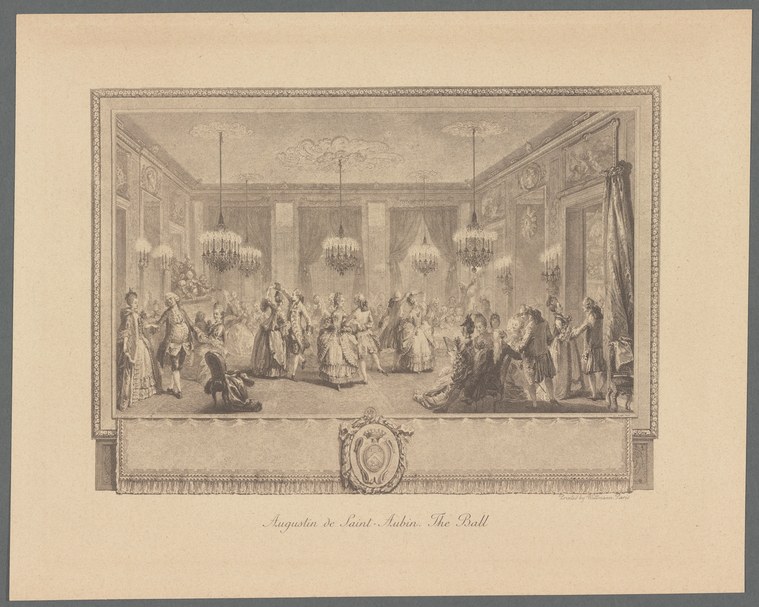
For dance historians, this engraving is primary evidence of how rococo ballroom dances were actually arranged and practiced—the number of couples, their spacing, the degree of interaction, the relationship between dance and architectural setting. The print also shows how dancing was represented and valued by printmakers and their audiences: formal, elegant, documentary, and intimate with social hierarchy.
What you are looking at
A formal ball set in an opulent eighteenth-century interior lit by multiple crystal chandeliers hanging from a coffered ceiling. The room has paneled walls with decorative overdoors and is crowded with dozens of elegantly dressed figures in rococo costume—women in full skirts, many holding fans, men in breeches and coats. The composition is theatrical and crowded but not chaotic: figures are distributed across the floor in conversational groups and dancing pairs, some turned toward each other in close proximity, others standing or promenading. The architectural frame of the image—with its decorative cartouche at the base—emphasizes this as a formal, documented record of court or aristocratic life. The print's hand-colored pale tones and the careful arrangement of light suggest a celebration or major social event, not a casual gathering.
The dancing
Most figures stand upright in the formal posture of rococo society. Several pairs visible in the middle distance appear to be in the closed holds characteristic of period dances, with partners facing each other at arm's length. The women's full skirts—some caught in profile showing volume and movement—suggest the swaying and turning motion of dances like the minuet or cotillion. Many figures hold fans, parasols, or wear decorative elements that would constrain movement to the refined, restrained gestures of courtly dance. No visible footwork detail, but the overall bearing and spacing are consistent with social dances requiring partnership and formal frame.
The dance depicted
This depicts a grand ball of the rococo period, most likely mid-eighteenth century, when the minuet, cotillion, and quadrille dominated aristocratic dancing. The assembly and the formality of dress and setting confirm this as a social dance event of the elite. The multiple pairs suggest group dances or sequences of individual pairings rather than a single dominant couple, consistent with cotillion or quadrille practice. The annotation 'Augustin de Saint Aubin: The Ball' (if accurate) would link this to a documented artist-observer of French court and salon life, though the print shows typical generalized rococo ballroom iconography rather than a specific historical event.
How it was made
This is an engraving or etching on laid paper, hand-colored in pale ochres and grays. The technique creates fine detail in the architectural setting and costume while maintaining an overall aerial perspective that shows the full room and crowd. The careful line work and the precision of the frame suggest a professional print made for circulation among educated audiences—likely a commercial publication or collection documenting manners and social life. Hand-coloring over the printed lines is evident in the soft, watercolor-like washes on fabric and the subtle gradation of the interior space.
About this work
This is a documentary engraving of an eighteenth-century aristocratic ball, recording both the architecture and the choreography of rococo social dancing. The print belongs to a substantial European tradition of depicting court and salon life, in which the ball itself—as spectacle, as evidence of civility, as social ritual—was a worthy subject for fine art reproduction. The work demonstrates how minuet, cotillion, and quadrille dancing were inseparable from interior decoration, fashion, and the performance of rank. It is both a record of a dance event and an artifact of how that event was understood and circulated through prints.
How to look at it
Notice how the engraver has frozen the ballroom at a moment of general activity rather than a climactic single turn—multiple things are happening at once. Observe the women's skirts: some are shown from the side, revealing the full dimension of the hoop or panniers, which tells you how much space the dancer's body required and how the silhouette itself was part of the dance's aesthetic. The standing groups and the paired dancers are roughly equal in number, suggesting the intermittent, social nature of the event—not everyone danced at once. Look at the architecture: the height, the light, the ornament—these were as much part of the experience as the movement itself.
The artist
If this is indeed from Augustin de Saint-Aubin (1736–1807), a prolific French engraver and draughtsman, the work reflects his specialty in depicting scenes of Paris aristocratic and bourgeois life—salons, promenades, concerts, and social gatherings. Saint-Aubin was known for precise, socially observant engravings that recorded fashion and manners with accuracy and wit. He often worked from his own drawings and was commissioned to document both specific events and generalized types of social scenes.
The period
The rococo period (c. 1730–1770) saw the minuet at its height as a formal social dance, performed and danced at balls, courts, and salons across Europe. The cotillion was rising in popularity as a more playful alternative. Engravings of ballroom scenes became fashionable commodities, consumed by people who attended such events and by those who aspired to know how refined society behaved. The eighteenth century was the great age of prescriptive dance manuals and of prints that codified social behavior through visual representation.
Where it lives
This engraving is held in the New York Public Library's collection of prints depicting dance, part of a broader archive of visual documents on social and theatrical dance. It is catalogued as a print object, likely published in the eighteenth century as a single sheet or as part of a series documenting aristocratic manners and entertainments.
Dance in this work
Questions about this work
What dances are being shown here?
The specific dances are not labeled, but the formal dress, the architecture, and the arrangement of couples are consistent with rococo ballroom dances of the mid-eighteenth century—most likely the minuet, cotillion, or quadrille. The print shows a generalized ballroom type rather than a specific choreography.
How do you know this is a real event and not a fantasy?
You don't, from the image alone. Rococo ballroom prints often depicted generalized scenes of aristocratic life rather than documented specific events. However, the architectural detail, the careful observation of costume and pose, and the printing convention all suggest the artist intended to represent actual practice rather than imagination.
Why is everyone standing so formally?
Rococo court and salon dancing was restrained and dignified by modern standards. Posture was part of the dance itself—the upright frame, the minimal arm movement, the small steps conveyed refinement and education. Standing and conversing between dances was also part of the social event, as much as dancing itself.
Who would have owned a print like this?
Educated, affluent people—those who attended balls themselves, or who studied manners, fashion, and social behavior. Prints like this were sold individually and in series, serving both as documentary records and as fashionable objects for collectors.
More dance artwork





