49 works in this view — arrow keys or swipe to move between them.
Dance in Art
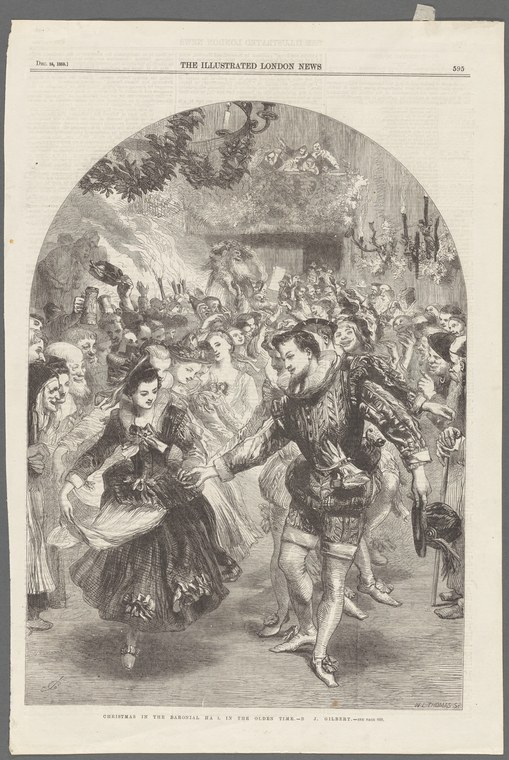
Christmas in the baronial hall in the olden time
Unknown artist
- Collection:
- Prints depicting dance
- Source:
- New York Public Library
- Rights:
- Public domain — free to use, share and adapt.
- Recorded as:
- Public Domain
For dancers and historians, this engraving is a primary source for how the waltz and country dances were actually performed and experienced in Victorian homes, not as formal technique but as social practice. The image preserves the spatial and social context of 19th-century ballroom dancing—the room, the clothing, the audience, the moment—in a way that written descriptions cannot. It also captures an important transitional moment: the waltz and its variations were still relatively new to British and American society in the mid-19th century, and this image shows it embedded in traditional domestic celebration.
What you are looking at
A crowded indoor celebration fills an arched hall lit by candlelight and a fireplace, with guests in Victorian-era dress clustered throughout the space. In the foreground, a young couple dominates the composition: a woman in a dark dress with white collar and cuffs dances with a man in ornate military or ceremonial costume with braided details and what appears to be a sword or decorative belt. Their bodies are close and actively engaged. Behind them, dozens of onlookers—men in dark coats, women in elaborate gowns and bonnets—press in to watch, some seated on benches along the walls, others standing. The scene captures a moment of high energy: the couple's movement is animated, the crowd's attention riveted. The setting is grand but convivial, with architectural detail visible in the vaulted ceiling and elaborate wall decorations suggesting a baronial manor house.
The dancing
The dancing couple are in close proximity, the woman's body angled toward her partner with her skirts in motion, suggesting a turning or traveling movement. The man leans slightly forward, one arm extended toward his partner in a guiding frame. Neither is in a rigid ballroom hold; their posture is more relaxed and intimate than formal, with weight appearing to flow through the torso rather than held stiffly upright. The surrounding figures—some seated, some standing—create a frame that channels attention to the couple but also records the social nature of the event: this is not a performance for an unseen audience, but a dance watched by friends and family in close quarters.
The dance depicted
This depicts a social dance of the 19th century, most likely a waltz or country dance at a Victorian house gathering, though the exact step cannot be determined from the image. The couple's proximity and the woman's raised skirts suggest a turning movement consistent with waltz technique, but the casual frame and the domestic setting indicate this is social dancing rather than theatrical performance. The composition emphasizes the participatory nature of such entertainments: dancing was a central activity at Victorian celebrations, and the engraving documents both the dancers and the audience's rapt engagement with them.
How it was made
This is a wood engraving, a technique identifiable from the fine cross-hatching, the precision of the line work, and the tonal range achieved through density of marks rather than wash or solid color. Wood engraving allowed for high-resolution detail and was the dominant method for reproducing illustrations in periodicals during the 19th century—this would have appeared in a newspaper or magazine, circulating to thousands of readers. The technique constrains the artist to work in line and tone alone, yet the engraver has achieved considerable atmospheric effect through the handling of light and shadow, particularly the candlelit quality of the scene.
About this work
This is a Victorian-era wood engraving depicting a Christmas celebration in a baronial hall, centered on a couple dancing while surrounded by onlookers. The work documents a social custom—the house dance or ball as a central winter entertainment—and captures the intimate, participatory nature of 19th-century ballroom culture. The engraving combines narrative detail (the crowd, the setting, the festive mood) with a precise, almost ethnographic recording of how people stood, moved, and interacted while dancing. It belongs in a gallery about dance as evidence of a specific historical moment in how people performed sociability: the Victorian waltz and country dance as part of the fabric of middle- and upper-class domestic life.
The work is valuable precisely because it is not a stylized or theatrical rendering. The artist has chosen to show dancing as it actually appeared in a drawing room—crowded, convivial, watched intently—rather than as an idealized spectacle. This grounds the image in historical fact while making visible the cultural meanings attached to dance: propriety, pleasure, courtship, family bonds, and the seasonal marking of time.
How to look at it
Notice how the engraver has handled light: the candlelight creates a warm glow and renders some figures in sharp detail while others fade into shadow, creating depth and atmosphere. The couple at the center are well-lit and clearly drawn, but they are not isolated; the viewer's eye travels outward to the crowd, which is rendered with less detail but considerable liveliness. Observe the variety of postures among the watchers—some lean forward intently, others stand back; some sit patiently on benches, others seem to be conversing. The architectural setting (the vaulted ceiling, the fireplace, the wall decorations) frames the action and reinforces the sense of an actual, inhabited space rather than a generic 'ballroom.' Pay attention to the woman's skirt: the engraver has shown it in motion, caught mid-turn, which conveys the dynamic quality of the dance without freezing it into a static pose.
The artist
The artist is not recorded. The work was published in The Illustrated London News, a major periodical founded in 1842 that pioneered the use of wood-engraved illustrations to report on current events, social life, and culture. The ILN employed staff artists and engravers and purchased illustrations from freelancers; the work would have been commissioned as a seasonal illustration—Christmas in a country house was a perennially popular subject for the periodical's middle- and upper-class readership.
The period
This engraving dates from the Victorian era (likely mid-to-late 19th century, given the costume and the style of the periodical). By this time, the waltz had been established in Britain and America for several decades, though it remained somewhat controversial; it was also the period when published dance instruction manuals proliferated and dancing masters taught the waltz in schools and studios. The painting reflects the peak of the house ball as a social institution for the gentry and professional classes. Christmas celebrations in country houses were a staple of Victorian leisure culture and a frequent subject for the periodical press, which catered to readers who enjoyed seeing depictions of 'olden time' customs and the life of the aristocracy and gentry.
Where it lives
This engraving is held in the New York Public Library's collection of prints depicting dance. It was published in The Illustrated London News, a weekly periodical that documented social, cultural, and current events for Victorian readers, and would have reached a wide middle- and upper-class audience in Britain and America.
Dance in this work
Questions about this work
What dance is being shown?
The couple appears to be dancing a waltz or a country dance—the exact step cannot be determined from the image alone. The close frame and the woman's raised skirts suggest a turning movement, consistent with waltz technique. However, the casual posture and domestic setting indicate this is social dancing rather than a formal waltz as taught by dancing masters.
When would a Christmas dance like this have happened?
House balls and dances were a standard feature of Victorian Christmas celebrations for the gentry and professional classes, typically held in the weeks surrounding Christmas. They were major social events, often lasting many hours and featuring multiple dances, refreshments, and often cards and other entertainments.
Why would the artist show the crowd as well as the dancers?
For The Illustrated London News, the interest lay in documenting a complete scene of Victorian social life. The crowd watching the dance is as much the subject as the dancers themselves; the image conveys how dancing fit into the social fabric of the time—as a participatory, communal entertainment rather than a performance by professionals for an audience.
How was this image made and distributed?
This is a wood engraving, a technique in which an image is carved into the end-grain of a block of wood and then inked and printed. This allowed for mass production: thousands of copies could be printed and distributed in copies of The Illustrated London News, making it accessible to a wide readership. The technique produces the fine lines and tonal variations visible in the image.
More dance artwork





