49 works in this view — arrow keys or swipe to move between them.
Dance in Art
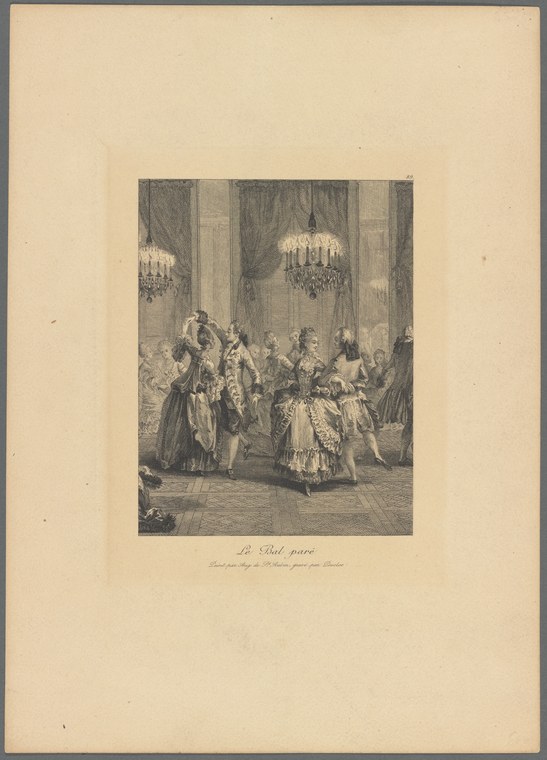
Le bal paré
Unknown artist
- Collection:
- Prints depicting dance
- Source:
- New York Public Library
- Rights:
- Public domain — free to use, share and adapt.
- Recorded as:
- Public Domain
Court dance prints like this one are among the few detailed visual records we have of how movement actually looked in formal baroque and rococo society. The image documents not just the costume but the posture, spacing, and social arrangement of a formal dance occasion—the very things dance historians cannot recover from written descriptions alone. It is evidence of a now-lost movement vocabulary in which restraint, formality, and the presentation of the body in expensive cloth were the primary aesthetic aims.
What you are looking at
A formal ball or court dance in an opulent interior, lit by two large crystal chandeliers hanging from a coffered ceiling. The space is columned and richly appointed, with draped fabrics visible in the background. In the foreground, a woman in an elaborate pale gown with full skirts dominates the composition, her posture upright and her body angled to the viewer's right. She is attended by several figures in formal dress—men in dark coats and breeches, women in long gowns—who surround her in a loose grouping. The woman's skirts are voluminous and appear to be in motion or arrested mid-movement. The atmosphere is one of courtly ceremony and social display rather than vigorous movement; the gathering suggests a formal procession or the opening moments of a court dance rather than an energetic reel or country dance.
The dancing
The central female figure stands with shoulders back and head held high, her posture formal and composed; her gown's broad skirts command the visual space. The surrounding figures are arranged loosely rather than in the tight partnered holds of later ballroom dance—there is no visible hand-hold between the woman and the men near her. The men stand upright in formal court dress. The overall bearing is processional and stately rather than partnered or interactive; the dancers appear to be executing a formal court ritual in which position and presentation matter more than physical contact or active footwork.
The dance depicted
This is a court or formal ball scene, almost certainly a historic-baroque court dance, most likely a minuet, pavane, or similar processional court form from the 17th or 18th century. The title *Le bal paré* (The Decorated Ball, or The Formal Ball) reinforces a reading of a state occasion rather than social dance. The absence of visible holds, the formal dress, the columned hall, and the ceremonial grouping all point to the French or European court dance tradition. The movement appears restrained and formal; if a minuet, the footwork would be small and precise, with the visual interest in the line of the body and the fall of the cloth rather than in vigorous stepping.
How it was made
This is a copper-plate engraving, identifiable from the fine parallel hatching, the tonal gradation achieved through line density, and the overall monochromatic treatment. The engraving technique allowed for wide circulation and reproduction; this image was likely issued as a single print or as part of a series documenting court life or dance manners. The precision of line-work made it the preferred medium for recording costume and social ritual, and the print's small scale and portable format suggest it was aimed at a broad educated audience rather than collectors of fine art alone.
About this work
This is a record of a formal court ball, frozen in the moment of procession or the opening of the dance. The engraving documents both the choreography and the costume of the occasion—the voluminous skirts, the formal stance, the columned ballroom, the social grouping. The work belongs to a long tradition of prints depicting court life and social display in the baroque and rococo periods; such images served simultaneously as documentation of fashion, as records of how people moved in formal dress, and as aspirational images of courtly behaviour for a wider public audience. The image captures the stillness and ceremony of a formal occasion rather than the exuberance of popular or vernacular dance.
How to look at it
Attend to the posture and spacing of the figures rather than looking for active movement. The artist has chosen a moment of processional stillness rather than vigorous stepping—the woman's skirts appear caught in the act of falling or turning, but the overall composition emphasizes vertical lines and formal arrangement over motion. Notice how the voluminous gown dominates the picture; in formal court dress of this era, the fabric itself was as much a part of the dance as the body moving within it. The columned hall and the two chandeliers frame the scene as a formal state occasion rather than an intimate social gathering, signalling to the viewer that this is a performance of rank and courtesy as much as a dance.
The period
This engraving dates stylistically and materially to the 18th century, a period of intense documentation of court manners and dance in prints aimed at the educated public. Court dances like the minuet were the dominant social form among the aristocracy and upper middle classes of France and England during this period, and they were frequently depicted in prints, often with titles identifying the specific occasion or type of ball. The rococo aesthetic visible in the composition—the light handling of the figures, the ornate setting, the emphasis on clothing and surface—is consistent with mid-18th-century French taste. The formality and ceremony of the scene reflects an era in which dance was as much about demonstrating social rank and refined behaviour as about physical pleasure or expression.
Where it lives
This engraving is housed in the New York Public Library's collection of prints depicting dance. It is a single-sheet copper-plate engraving, the standard medium for the dissemination of cultural images in the 18th century.
Dance in this work
Questions about this work
What dance is this?
Most likely a minuet, pavane, or other formal court dance of the baroque or early rococo period. The formal dress, the columned hall, the processional arrangement, and the restrained posture all point to a court ceremony rather than a country dance or popular form. The title *Le bal paré* suggests a state ball or formal occasion rather than a named choreography.
Why do the figures not seem to be moving?
They are likely captured in the processional or ceremonial moment of the dance rather than in active footwork. Court dances like the minuet involved small, precise steps and a great deal of stillness and formal stance. The visual interest was in the line of the body and the presentation of expensive costume, not in vigorous or showy movement.
Is this a record of an actual event?
Possibly. The title and the formal setting suggest it may document a specific royal or aristocratic ball, but it may equally be a generic representation of a formal court dance occasion. Many 18th-century dance prints were issued as types or ideals rather than records of particular events.
Who is the woman in the centre?
The catalogue record does not identify her, and the engraving itself bears no legend or coat of arms that would indicate her rank or identity. She may be an idealized figure representing the woman leading or featured in a formal ball rather than a portrait of a specific person.
More dance artwork





