49 works in this view — arrow keys or swipe to move between them.
Dance in Art
Foyer de la danse
Unknown artist
- Collection:
- Prints depicting dance
- Source:
- New York Public Library
- Rights:
- Public domain — free to use, share and adapt.
- Recorded as:
- Public Domain
For dance historians and practitioners, this print is crucial evidence of early Romantic-era ballet training methods, the role of the ballet master as a correcting authority, and the social rituals of the rehearsal studio. The image shows ballet not as spectacle but as labor and instruction—a necessary corrective to the myth of the performer. The foyer de la danse was also a space of class and gender anxiety in 19th-century Paris, and this print records that social dynamic with unusual candor.
What you are looking at
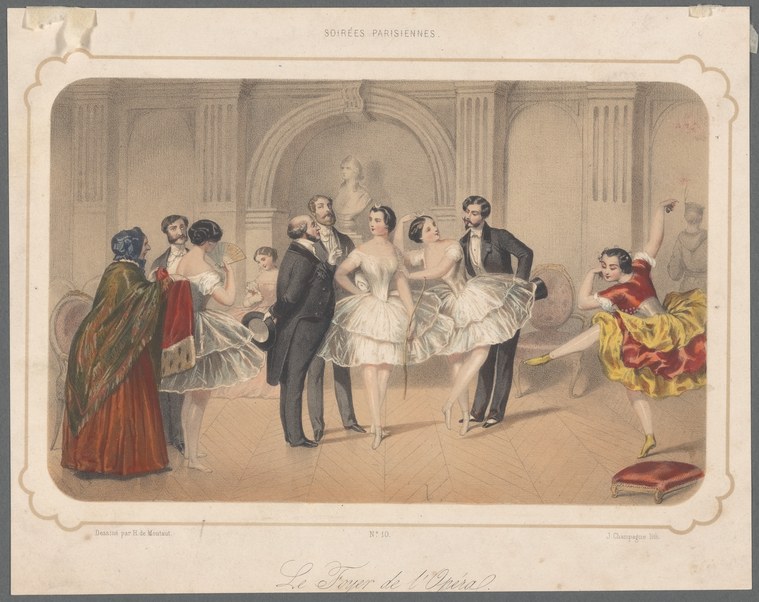
A rehearsal or informal gathering in an elegant neoclassical interior, likely a ballet studio or foyer. The space features fluted pilasters, a semicircular arch, and classical architectural detailing in soft sepia tones. A young female dancer in a white tulle skirt stands near the center, attended by a well-dressed man in dark formal wear who appears to be adjusting or admiring her costume or posture. Around them, several other figures—women in street dress with cloaks and bonnets, men in tailcoats—observe or converse. On the right side of the composition, a second female dancer in a pink-toned skirt is captured mid-movement, her body animated and her skirt swirling. A small child sits in the lower right corner. The lighting is diffuse and theatrical, emphasizing the delicate fabrics and the classical proportions of the space. The overall mood is one of casual professionalism—this is a working space where dancers prepare, adjust, and demonstrate.
The dancing
The central male figure holds an upright posture typical of a ballet master or instructor, with one hand raised toward or touching the shoulder of the standing dancer, suggesting correction or guidance. The dancer in white stands in an upright, composed position with arms held gracefully. The dancer on the right is captured in active movement, her torso inclined and her limbs extended in a balletic line, suggesting a phrase of dancing rather than a static pose. The other figures maintain the composed stance and dress of spectators or fellow company members. The two dancers are clearly the focal points, positioned to show contrasting moments—stillness and preparation versus active motion.
The dance depicted
This depicts ballet training or rehearsal, most likely in the Romantic era (1830s–1840s) based on the tutus, the classical setting, and the presence of a ballet master directing a student. The title 'Foyer de la danse' (Dance Foyer) refers to the rehearsal space behind the stage where dancers prepared, trained, and socialized—a space that became iconic in Parisian ballet culture. The image captures the pedagogical relationship central to ballet: the master observing and correcting the pupil's alignment and carriage. The active dancer on the right suggests the kind of petit allegro or adagio phrase that would have been central to training. This is ballet in its social and institutional context, not a performance, but rather a document of how dancers actually worked.
How it was made
This is a hand-colored lithograph or colored engraving, executed in the commercial print tradition of 19th-century Paris. The soft palette, the delicate line work defining the architecture and figures, and the applied color in discrete zones suggest either a colored lithographic print or an engraved plate hand-finished with watercolor or gouache. The technique allowed for rapid reproduction and wide circulation among the Parisian middle class, who were increasingly fascinated by ballet and theatrical life. The composition and style are consistent with the popular 'Soirées Parisiennes' (Parisian Evenings) or similar series of theatrical and social scenes produced for the art market in the 1830s–1840s.
About this work
This work belongs to a significant genre of 19th-century French prints documenting ballet culture and the ballet studio—a space that held both professional and romantic significance in Parisian society. The foyer de la danse was as famous for the social encounters that took place there as for the dancing itself; prints like this one offered viewers a glimpse behind the curtain at rehearsal, training, and the everyday life of dancers. The image sits at the intersection of theatrical documentation, social observation, and artistic practice, serving both as a record of ballet pedagogy and as a cultural artifact reflecting the era's fascination with the ballet world. The presence of the ballet master, the careful rendering of the dancers' bodies, and the architectural precision of the setting all mark this as a work made for an educated audience interested in the technical and social realities of ballet.
How to look at it
Observe the contrast between the two dancers: the upright, composed figure being corrected, and the animated dancer in motion on the right. This juxtaposition shows the dual nature of ballet training—the holding of position and the execution of movement. Notice also the ballet master's gesture, which is the true center of the composition: he is teaching, correcting, and controlling the dancer's body. The architectural setting is rendered with precision to establish authority and formality; the foyer is not a haphazard space but a rational, classical chamber devoted to the cultivation of the body. The spectators in their street dress emphasize that this is a behind-the-scenes moment, a transparency into a normally private professional world.
The artist
The work is credited as part of the 'Soirées Parisiennes' series (inscribed 'Soirées Parisiennes' at the top), a popular commercial series of hand-colored prints depicting Parisian theatrical and social life. The artist and exact engraver are not recorded in the present catalogue, but the style and execution are consistent with the shop production of major Parisian print houses such as Aubert or Martinet, who specialized in such theatrical scenes in the 1830s–1840s. These prints were mass-produced, hand-colored, and sold to a broad middle-class audience eager for glimpses of theatrical life.
The period
This print was made during the height of Romantic ballet in Paris, when works like La Sylphide (1832) and Giselle (1841) were reshaping the art form around ethereal, otherworldly female dancers. The ballet studio itself became a subject of intense cultural interest and artistic representation during this period. Contemporary French literature and visual art frequently depicted the foyer de la danse as a space of artistic discipline, social hierarchies, and romantic intrigue. The print captures this moment when ballet was transitioning from a court entertainment to an urban, commercial, middle-class spectacle, and when the dancer's body and labor were becoming subject to new forms of scrutiny and representation.
Where it lives
This work is held in the New York Public Library's collection of prints depicting dance (the 'Prints depicting dance' category in the library's holdings). It is one of hundreds of such theatrical prints from the 19th century that document the social and professional world of performance in Paris and Europe. The work is part of a commercial mass-produced series, not a unique art object, and should be understood within the context of print culture and popular theatrical imagery of the era.
Dance in this work
Questions about this work
What is the 'foyer de la danse'?
The foyer de la danse is the rehearsal and gathering space behind the stage at a ballet theater where dancers warmed up, trained, and socialized. In 19th-century Paris, it became legendary as a space of artistic discipline, social interaction, and romantic encounters. Many artists depicted it as a site where the public could imaginatively access the 'real' ballet world behind the curtain.
Who is the man in dark clothing?
He is most likely a ballet master or maître de ballet—a senior teacher and choreographer who directed company rehearsals and corrected dancers' technique. His gesture toward the dancer's shoulder is characteristic of the pedagogical relationship in ballet training, where the teacher uses physical demonstration and correction to shape the student's body.
What era of ballet does this show?
This print dates to the Romantic period of ballet, roughly the 1830s–1840s, as evidenced by the white ballet skirts (tutus), the classical architectural setting, and the overall style. This was the era of La Sylphide, Giselle, and the rise of the ethereal ballerina as the central figure in ballet.
Why are there so many onlookers in the foyer?
The foyer was a semi-public space where not only dancers and ballet masters gathered, but also patrons, admirers, family members, and people with professional connections to the theater. The presence of these spectators was part of the social ritual and prestige of the ballet world.
More dance artwork





