49 works in this view — arrow keys or swipe to move between them.
Dance in Art
Foyer de la danse
Unknown artist
- Collection:
- Prints depicting dance
- Source:
- New York Public Library
- Rights:
- Public domain — free to use, share and adapt.
- Recorded as:
- Public Domain
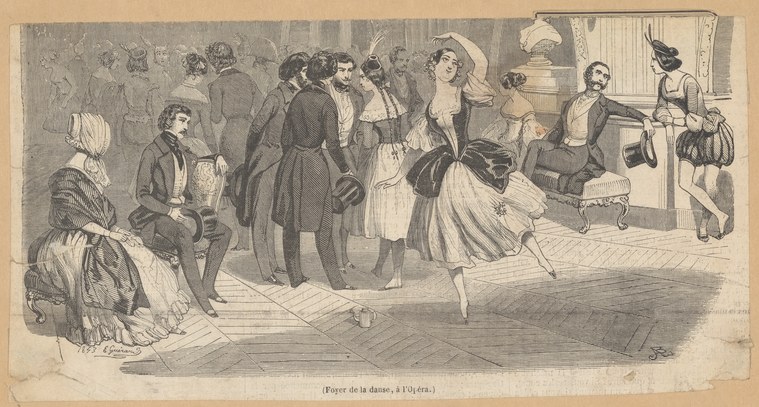
The foyer de danse was the institutional space where the economics and sexual politics of Romantic ballet were actually conducted; this engraving is documentary evidence of how dancers were displayed and made available to patrons. Understanding this space and its rituals is essential to any serious account of nineteenth-century ballet as a professional and social practice, not merely an art form.
What you are looking at
An engraving depicting the foyer of a dance academy or theater, crowded with fashionably dressed figures of the mid-nineteenth century. The scene is dense and animated: men in dark tailcoats and women in elaborate full-skirted dresses with bonnets and shawls move and converse throughout the space. In the foreground, a woman in a white ballet dress with a fitted bodice sits prominently, her posture graceful and her costume distinctly that of a professional dancer. Other women in street dress sit or stand nearby, some watching. In the background, more figures cluster in conversation; the architectural setting includes classical pilasters and a doorway, suggesting an elegant institutional interior. The composition captures a moment of social mixture—dancers, patrons, visitors, and staff—in the characteristic leisure and courtship rituals of the foyer de danse, where dancers and their admirers mingled between rehearsals and performances.
The dancing
The central seated dancer displays the upright carriage and pulled-up posture typical of ballet training, with her arms relaxed and her costume—a short white tulle skirt and fitted bodice—marking her professional status. The surrounding figures adopt the varied stances of social gathering: some seated in conversation, others standing and gesturing animatedly, their weight distributed in the casual postures of street dress and social leisure rather than dance technique. The mix of professional and civilian dress, and the spatial separation of the dancer from the conversing crowds, suggests the social hierarchy and boundary between performer and visitor that structured these spaces.
The dance depicted
This is a document of the social world of Romantic-era ballet, specifically the foyer de danse—the public rehearsal room or circulation space attached to major opera houses and academies where professional dancers were visible to patrons, students, and admirers. The single fully costumed dancer in ballet dress is the visual anchor of the composition; her presence among clothed figures makes clear the foyer's function as a place where the professional female dancer was on display and available for social and economic transaction. The engraving records the practice itself rather than the dancing, making it a social history work.
How it was made
This is a wood engraving or steel engraving, a technique allowing fine detail and wide circulation through repeated printing. The medium's capacity for tonal gradation through cross-hatching is used here to distinguish the pale tones of the dancers' dresses and bonnets from the darker tailcoats and interior shadows. The technique implies publication in a periodical or illustrated book aimed at an urban, educated audience interested in contemporary social customs and theatrical life. The style is consistent with French illustrated journalism of the 1840s–1860s.
About this work
This engraving documents the foyer de danse, one of the most socially significant spaces in nineteenth-century ballet culture. The foyer was the semi-public rehearsal room adjoining major European opera houses where professional female dancers practiced, socialized, and were available for viewing by male patrons, students, and society figures. The work captures not a performance moment but a social-economic reality: the visibility and accessibility of dancers as objects of both artistic and erotic interest. The central figure of the professional dancer in white, seated among fashionably dressed civilians, makes plain the work's subject—the intersection of professional dance, sexuality, and social hierarchy that defined Romantic ballet.
For dance historians, this image is crucial evidence of the material conditions of professional dancing in the Romantic period. The foyer de danse was a real architectural and institutional space where the economics of ballet—the system by which dancers were supported, promoted, and circulated—actually occurred. The engraving records a social practice, the visibility and courting of dancers, that shaped the profession for generations.
How to look at it
Look at the spatial hierarchy: the professional dancer in ballet dress is isolated, seated, and available to view, while the clothed civilians cluster and interact among themselves. The contrast between the refined white costume and the dark tailcoats and street dresses around her makes her the visual center despite her stillness. Notice also the variety of poses and gazes among the standing and seated figures—some look toward the dancer, others engage in their own conversation, making the foyer a place of competing social and economic attention. The artist has chosen a moment of pause rather than performance, emphasizing the social rather than the choreographic function of the space.
The period
The foyer de danse became a standard feature of European opera houses during the Romantic period (c. 1830–1870), institutionalizing the visibility of female dancers. In France, the Paris Opéra's foyer de danse was especially famous and frequently depicted in illustrated periodicals and memoirs. The mid-nineteenth century saw the consolidation of ballet as a profession dominated by women, who were economically and socially vulnerable and dependent on the patronage system. Contemporary writers—including Théophile Gautier and later social critics—documented the foyer as a space of courtship, transaction, and the commodification of women's bodies. This engraving is consistent with the documentary and satirical interest that French illustrated press took in theatrical and operatic life during this period.
Where it lives
This engraving is held in the New York Public Library's Prints collection, a resource for visual documentation of dance, theater, and social history. The work is part of a larger body of nineteenth-century illustrated material on theatrical life and institutions.
Dance in this work
Questions about this work
What was the foyer de danse and why was it important?
The foyer de danse was a semi-public rehearsal room or circulation space attached to major opera houses, especially the Paris Opéra. It was a place where professional ballet dancers could be seen, studied, and approached by patrons, students, and admirers. It was crucial to the economics of Romantic ballet: dancers depended on patronage for income and advancement, and the foyer made them visible and accessible. It was also a site of sexual and economic vulnerability for women dancers, who had limited other means of employment.
Who danced in the foyer de danse?
Professional female ballet dancers, especially those employed by the opera house. Male dancers also used the space, but the foyer's social and economic function centered on female dancers. Young dancers in training would also practice there. The foyer was not open to all; it was restricted to staff, students, and invited patrons and admirers.
Why is this image relevant to dance history?
It documents a real institutional space and social practice that shaped professional ballet for generations. The foyer de danse was where the actual economics of the profession—patronage, promotion, visibility—occurred. Without understanding this space and its rituals, it is impossible to understand how Romantic ballet actually functioned or how dancers survived economically. The image is evidence of both the professional practice of ballet and the sexual politics embedded in it.
Is this a depiction of actual dancing?
No. The work documents the social space where dancers gathered and were viewed, not a rehearsal or performance. The single professional dancer is seated and still, surrounded by conversing civilians. The artist has chosen to record a moment of pause and social transaction rather than choreographic movement, making this a document of the ballet profession's material and social conditions.
More dance artwork





