49 works in this view — arrow keys or swipe to move between them.
Dance in Art
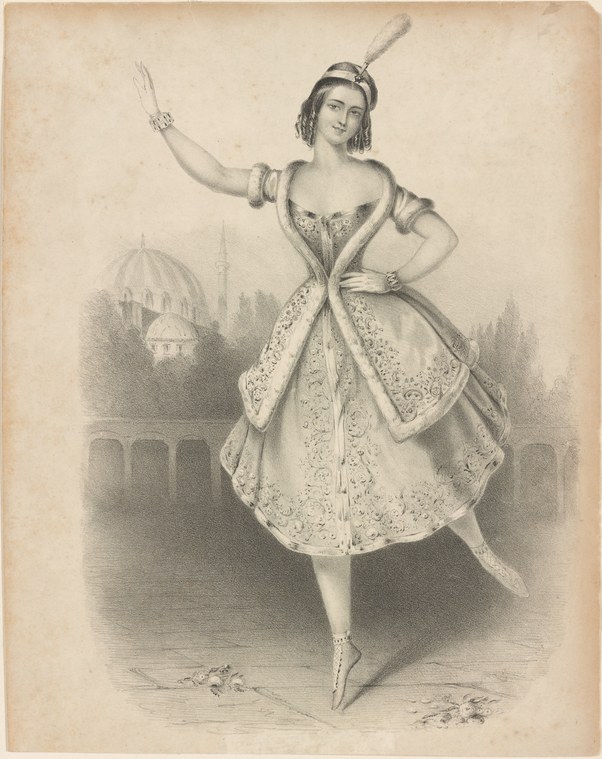
Madlle. Fanny Elssler
Unknown artist
- Collection:
- Prints depicting dance
- Source:
- New York Public Library
- Rights:
- Public domain — free to use, share and adapt.
- Recorded as:
- Public Domain
Fanny Elssler was one of the two defining figures of Romantic ballet, yet the only record most people have of her dancing is prints like this. Steel engravings were the mass media of nineteenth-century dance, and they shaped how audiences understood technique, costume, and the balletic body. This portrait is material evidence of how Romantic ballet was disseminated, celebrated, and remembered.
What you are looking at
A young woman in Romantic-era stage costume performs a dynamic pose against a backdrop of Orientalist architecture. She wears a white muslin dress with a fitted corseted bodice and full skirt decorated with ornamental embroidery, the skirt caught mid-swirl to reveal her legs and pointe shoes. A short draped overskirt or tunic in diaphanous fabric is pulled to one side. She wears a feathered or jeweled headpiece typical of Romantic ballet costume and holds one arm raised in an arabesque-like gesture while her body twists in profile. The background shows domed architecture with minarets, suggesting an exotic or Oriental setting common to Romantic-era spectacles. The lighting is soft and atmospheric, created through fine stippled shading that models the figure and creates depth behind her. The entire composition emphasizes the ballerina's elongated line, ethereal costume, and the theatrical fantasy of the period.
The dancing
A solitary female dancer photographed in three-quarter view, her weight shifted onto her back leg in what appears to be a preparation for or extension from an arabesque. Her raised arm extends upward and slightly forward in a classical épaulement, while her lower body is angled in profile—the back leg extended, the supporting leg straightened and en pointe. The pose captures a moment of balletic elegance and control, with the torso gracefully curved and the head held in the refined carriage expected of the Romantic ballet vocabulary. The visible pointe shoes and the geometry of the extended line confirm training in classical ballet technique.
The dance depicted
This is a portrait of the celebrated ballerina Fanny Elssler, one of the two pre-eminent dancers of the Romantic ballet era (the other being Marie Taglioni). The image depicts her in costume for a theatrical performance, likely a Romantic ballet such as *La Sylphide*, *Giselle*, or *Cachucha*—dances that dominated the 1830s–1840s stage. The exotic architectural setting behind her suggests either an Oriental-themed work or a fantastical scenario typical of the genre. Elssler was famous for her technical virtuosity, dramatic presence, and earthy sensuality, qualities that set her apart from the ethereal, weightless ideal associated with Taglioni. The pointe work, the classical port de bras, and the theatrical costume here document the balletic vocabulary of the early-to-mid nineteenth century at its height.
How it was made
This is a steel engraving or fine-line engraving, created from a carefully worked plate using the burin to produce fine parallel lines (hatching and stippling) that create tone and shadow. The technique allows for fine detail in the costume and features, and the print would have been hand-coloured after printing, likely with watercolour or gouache, as evidenced by the soft washes of tone in the background and the delicate shading on the fabric. Steel engraving permitted multiple impressions and affordable reproduction, making such prints a principal form of mass circulation for celebrity imagery in the nineteenth century. This print was likely distributed as a souvenir, a form of fan merchandise, or in periodicals devoted to theatrical news and celebrity.
About this work
This engraving documents Fanny Elssler, one of the two greatest ballerinas of the Romantic era, captured mid-performance in classical arabesque pose. The image preserves not only the star's likeness but the visual vocabulary of early-nineteenth-century ballet: the pointe shoe technique, the ethereal muslin costume, the precise port de bras, and the theatrical exoticism of Romantic fantasy. Elssler's career (she retired in 1851) spanned the defining decades of the Romantic ballet movement, and prints such as this one were the primary means by which dance was circulated beyond the theatre itself—a visual record of steps and bodies that live performance alone could not document.
The print belongs to a genre of theatrical celebrity portraiture that flourished in the age of Romantic ballet. Unlike photographs (which would not capture dance in motion reliably until much later), engravings allowed for idealisation and dramatic staging. This image shows not a candid moment but a composed, classical pose—a carefully chosen instant that conveys both the dancer's technique and her role as a figure of fantasy and desire. For historians of dance, costume, and popular culture, such prints are invaluable evidence of how Romantic ballet was imagined and celebrated by its audience.
How to look at it
Pay attention to the precise geometry of the pose: the dancer's weight is clearly supported on the back leg, the front leg extended and turned out, the foot pointed. This is the arabesque, one of the foundational positions of classical ballet. Notice how the artist has used the background architecture to frame and isolate the figure—the vertical lines of the building echo the dancer's elongated silhouette. The soft, atmospheric shading creates the illusion of stage lighting, lifting the figure forward. The detail of the pointe shoes is crucial: these were a relatively new technology in the 1830s, and their presence signals the technical modernity of Romantic ballet. Finally, observe the costume itself—the high-waisted Empire silhouette, the delicate muslin, the exotic headpiece—these elements stage the dancer as a figure from fantasy or the Orient, central to the Romantic ballet aesthetic.
The artist
The artist is not recorded in the catalogue. The print is a professional theatrical reproduction, likely created by a commercial engraving workshop in London or Paris—the two cities where Elssler performed to great acclaim. Such prints were typically executed by skilled technicians working from a drawing or painting, often after a theatrical scene painting or a sketch made from life. The quality of the line work and the precise rendering of the costume suggest a practised hand familiar with both classical anatomy and theatrical convention.
The period
This print dates to the height of the Romantic ballet era (c. 1830–1850), when ballet shifted dramatically from the formal neoclassical vocabulary of the late eighteenth century toward a new aesthetic of fantasy, emotion, and the supernatural. The Romantic ballet celebrated the female dancer as ethereal and otherworldly, yet also demanded extraordinary technical control—pointe work, rapid footwork, and dramatic presence. Fanny Elssler, unlike her great rival Marie Taglioni, embodied a more earthy, passionate, and technically dazzling style of dancing; she was celebrated for her ability to convey dramatic character and for her mastery of folk idioms such as the Spanish cachucha. The 1830s and 1840s saw the rise of dance prints as a commercial form—images of celebrated dancers were sold as prints, incorporated into periodicals, and collected by theatre-goers. The invention of steel-plate engraving allowed for longer print runs and cheaper reproduction than copper-plate methods, democratising access to images of the stars.
Where it lives
This engraving is held in the New York Public Library's collection of prints depicting dance, part of its broader theatrical and performing arts holdings. It is a commercial print, likely published in the 1830s or 1840s during or shortly after Elssler's active career.
Dance in this work
Questions about this work
Who was Fanny Elssler?
Fanny Elssler (1810–1884) was an Austrian ballerina and one of the two greatest stars of the Romantic ballet era, alongside Marie Taglioni. She was celebrated for her technical virtuosity, dramatic intensity, and earthy sensuality, in contrast to Taglioni's ethereal style. She performed across Europe and the Americas and retired from the stage in 1851. Prints such as this were among the only visual records of her dancing.
What is she wearing, and why?
She wears the standard costume of Romantic ballet: a white muslin dress with a fitted bodice, full skirt, and exotic headpiece. The soft, flowing muslin and pale colour created the illusion of weightlessness and otherworldliness central to the Romantic aesthetic. The Oriental architectural setting suggests the costume is for a work with an exotic theme, common in Romantic ballets that drew on travel literature and fantasy.
Why was she on her toes?
Pointe work—dancing on the tips of the toes, supported by reinforced satin shoes—was a relatively new and highly fashionable technique in the 1830s and 1840s. It allowed dancers to create an illusion of weightlessness and ethereality, and it required extraordinary strength and control. Elssler was renowned for her pointe technique and for her ability to move rapidly across the stage en pointe while maintaining dramatic expression.
Why is this an engraving, not a photograph?
Photographs could not reliably capture movement in the nineteenth century; exposure times were too long. Engravings and lithographs were the primary visual media for documenting and circulating images of dance. They allowed for idealisation, dramatic staging, and the frozen moment—and they could be produced in multiples and distributed cheaply as prints and periodical illustrations.
More dance artwork





