49 works in this view — arrow keys or swipe to move between them.
Dance in Art
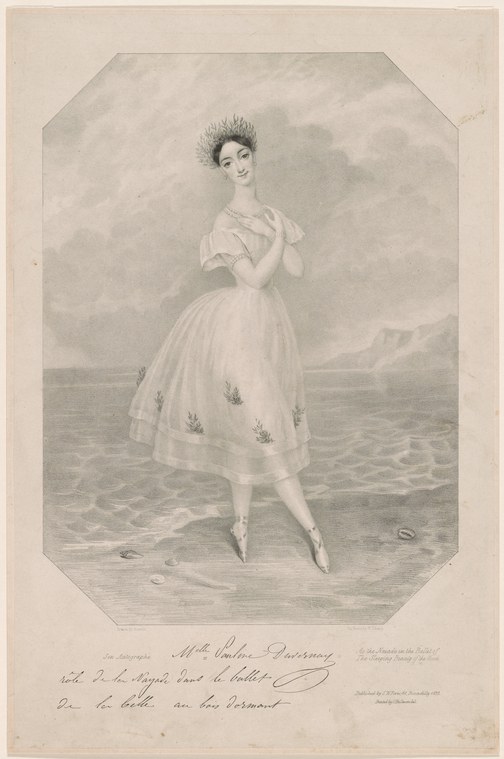
Melle. Pauline Duvernay, rôle de la nayade dans le ballet de La belle au bois dormant [in facsimile of Duvernay's handwriting]
Unknown artist
- Collection:
- Prints depicting dance
- Source:
- New York Public Library
- Rights:
- Public domain — free to use, share and adapt.
- Recorded as:
- Public Domain
Duvernay was a major figure in Romantic ballet, and this image preserves her interpretation of a signature role in one of the era's most important ballets. The work shows how nineteenth-century ballet was distributed and marketed through print culture, and how dancers themselves curated and authenticated their own images.
What you are looking at
A young woman stands alone on a beach, her body caught in a moment of poised stillness against a soft, clouded sky. She wears a pale muslin dress with a fitted bodice and short puffed sleeves, the skirt reaching to mid-calf and decorated with small embroidered sprigs. Her dark hair is crowned with a simple circlet or tiara. Her arms are raised and extended in a graceful, open gesture—the left arm lifted higher, the right bent across her body—and her weight rests on the ball of one foot while the other leg extends behind her, suggesting either a preparation for movement or the apex of a leap. The beach setting is rendered with minimal detail: a few pebbles at her feet, the waterline visible behind her, and empty sky above. The overall composition is intimate and dreamlike, presenting the solitary figure as if suspended between earth and air.
The dancing
A single dancer is depicted in a pose of remarkable lightness and extension. Her arms frame her body in an open, uplifted alignment—a classical port de bras that suggests trained movement. Her raised knee and the extension of her supporting leg create a line of ascending movement. Her posture shows an elongated spine and lifted sternum characteristic of theatrical training. The extended foot appears to be on its point or demi-pointe, though the image does not show pointe shoes explicitly; her feet appear bare or in soft slippers.
The dance depicted
This is a Romantic-era ballet image, most likely depicting a water nymph or naiad role—the inscription references 'La Nayade dans le ballet de La belle au bois dormant' (The Naiad in the ballet Sleeping Beauty). The pose captures the aesthetic ideals of early nineteenth-century ballet: weightlessness, ethereal extension, and a sense of supernatural or elemental grace. The beach setting and the naiad subject matter situate this within the Romantic ballet tradition's preoccupation with otherworldly female figures. Pauline Duvernay was a celebrated French dancer of the 1830s–1840s, known for roles in Romantic ballets.
How it was made
This is an engraving or lithograph—likely a lithograph based on the soft tonal gradations in the sky and the delicate line work. The technique allows for wide distribution as a print, making this a form of theatrical publicity or souvenir. The inscription in what appears to be Duvernay's own handwriting adds a documentary quality: it is both an artwork and a signed memento, suggesting this was made from a live performance or a preparatory study and subsequently autographed by the dancer. The soft medium suits the ethereal subject matter.
About this work
This is a record of Pauline Duvernay performing as a naiad in an early nineteenth-century production of Sleeping Beauty. It captures the Romantic ballet aesthetic at its height: a solitary, weightless female figure in an idealized landscape, her body articulated in the vocabulary of classical dance. The work exists at the intersection of theatrical documentation and fine art—a promotional image that is also a serious artistic print. The handwritten inscription by Duvernay herself transforms it from a generic theatrical engraving into a signed artifact of performance history.
How to look at it
Attend to the pose itself: the artist has chosen a moment of suspension—not in mid-leap, but at the apex of the movement, where the body appears weightless and the next motion is held in potential. The raised arms and extended leg create a triangular composition that emphasizes verticality and lift. Notice how the beach setting, though minimal, frames the figure as isolated and ethereal rather than grounded—the classical ballet ideal of transcending the body's weight. The soft handling of the sky and the precise drawing of the figure's silhouette are characteristic of lithography and heighten the sense of the dancer as a luminous, almost supernatural presence.
The period
This lithograph dates to the 1830s–1840s, the height of the Romantic ballet era. During this period, elaborate theatrical productions of fairy-tale ballets became a dominant form of entertainment in European theaters. The Sleeping Beauty was one of several story ballets (alongside La Sylphide, Giselle, and others) that established the template for full-length ballet narrative. Pauline Duvernay was celebrated for her technical brilliance and her ability to embody the ethereal, supernatural heroines these ballets demanded. Lithographed prints of famous dancers in their signature roles became a form of celebrity merchandise, circulated among enthusiasts and collectors. The inscription in the dancer's own hand reflects a practice of authentication and personalization that made such prints valuable souvenirs.
Where it lives
This work comes from the New York Public Library's collection of prints depicting dance. It is a lithograph, likely a theatrical souvenir or publicity image, authenticated by Duvernay's autographed inscription in French.
Dance in this work
Questions about this work
Who was Pauline Duvernay?
Pauline Duvernay (1813–1894) was a French ballet dancer celebrated for her technical prowess and her interpretations of Romantic ballet heroines. She performed at the Opéra in Paris and the King's Theatre in London, and was known for roles in La Sylphide and other major ballets of the 1830s–1840s. Her autographed prints, like this one, were sought-after souvenirs among theater patrons.
What is a naiad in ballet?
In Romantic ballet, a naiad is a water nymph—a supernatural or elemental spirit. Such roles allowed choreographers and dancers to explore the ethereal, otherworldly movement vocabulary that became central to the genre. The naiad character typically embodies lightness, fluidity, and an otherworldly grace.
Is this the original 1890 Sleeping Beauty?
No. This print documents an earlier Sleeping Beauty production from the 1830s–1840s, likely a French version. The famous Petipa–Tchaikovsky Sleeping Beauty premiered in Russia in 1890. This image predates that work by several decades and represents a different theatrical and choreographic tradition.
Was this printed from a drawing by a famous artist?
The catalogue record does not identify the lithographer or the artist who created the original design. The work is known through Duvernay's inscription rather than through the printmaker's signature. It may have been created specifically as a theatrical souvenir.
More dance artwork





