49 works in this view — arrow keys or swipe to move between them.
Dance in Art
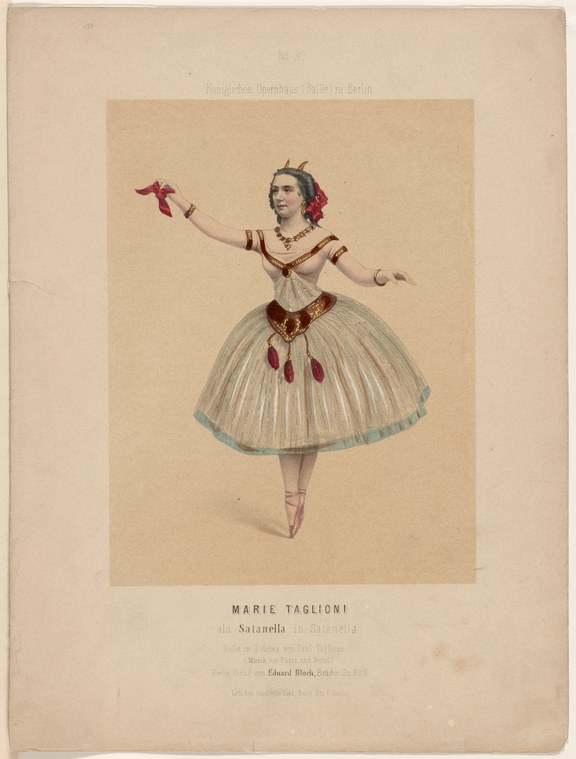
Marie Taglioni als Satanella in Satanella. Ballet in 3 Acten von Paul Taglioni (Musik von Pugni and Hertel)
Unknown artist
- Collection:
- Prints depicting dance
- Source:
- New York Public Library
- Rights:
- Public domain — free to use, share and adapt.
- Recorded as:
- Public Domain
Prints like this are among the most direct visual evidence we have of how famous Romantic ballets were actually performed, danced, and dressed. They document not only the dancer but the choreography, music, and theatrical context of now-lost performances, making them invaluable to historians seeking to reconstruct nineteenth-century dance practice.
What you are looking at
A single female dancer is shown mid-performance against a pale background, captured in a moment of ethereal suspension. She stands on the ball of one foot in a pose suggesting upward lift, her body angled in a classical alignment. Her costume is a romantic-era tutu in pale silk or tulle with a blue-grey trim at the hem, worn over pink tights and pointe shoes. The tutu falls to mid-calf in a bell shape, characteristic of mid-nineteenth-century ballet. She wears a short-sleeved bodice with a deep burgundy or maroon corsage front, accented with gold or metallic banding on the sleeves. Her dark hair is crowned with red flowers or feathers, and she holds a red ribbon or scarf aloft in one extended arm, creating a sense of movement and flourish. The pose and costume place her as a principal dancer performing a solo variation, likely from a mid-century European ballet.
The dancing
The dancer's weight is lifted onto the ball of one foot, creating an impression of elevation and ethereal lightness typical of Romantic ballet. Her supporting leg is extended and turned, and her free leg appears bent or crossed, though the exact position is softened by the artist's rendering. Both arms are active—one raised and extending the ribbon prop, the other positioned in a natural, open frame. Her torso is upright and composed, with the head slightly tilted, conveying grace and control. This is the isolated figure of a soloist, not a corps line.
The dance depicted
This is a depiction of Romantic ballet, almost certainly a souvenir or advertisement for a specific principal dancer and role. The catalogue identifies the subject as Marie Taglioni performing in *Satanella*, a three-act ballet choreographed by Paul Taglioni (the dancer's brother) to music by Cesare Pugni and Eduard Hertel. The print documents a real nineteenth-century theatrical work and preserves a record of how a celebrated role was performed and presented. Taglioni was the pre-eminent ballerina of the Romantic era, and such prints were distributed to audiences and collectors as mementos of her performances.
How it was made
This is a hand-coloured lithograph or engraving, evident from the delicate line work defining the figure and the selective use of colour in the costume and accessories. The technique allowed for mass production and affordability, making these prints accessible to theatregoers and ballet enthusiasts. The pale background and fine detail suggest a high-quality print intended for framing and display in domestic or theatrical spaces. The hand-colouring adds a precious quality to the image, distinguishing finer copies from cheaper editions.
About this work
This is a theatrical souvenir documenting Marie Taglioni's performance as Satanella in the ballet of that name, likely produced in the 1850s during or shortly after the work's performance in Berlin or another European capital. It preserves both a record of the dancer's iconic status and visual evidence of mid-nineteenth-century Romantic ballet costume and aesthetics. The print belongs to a large category of nineteenth-century dance ephemera—images designed to commemorate performances and celebrate celebrated dancers, circulated through theatres and among collectors.
How to look at it
Observe the precision of the pose: the dancer is caught not in a moment of transition but in a held position of maximum grace and composure. This is a 'presentation' pose rather than an action, chosen to display the dancer's line, the costume's architecture, and her command of classical form. Notice how the extended ribbon and the angled body create a sense of effortless buoyancy. The pose exemplifies the Romantic ideal of the ballerina as otherworldly and spiritually elevated, not merely athletic.
The artist
The print is credited only to the title and subject; the lithographer or colourist is not recorded. Such theatrical prints were often produced anonymously or by commercial printing houses in major European cities, particularly Berlin, Paris, and Vienna, where they were sold near theatres and through circulating libraries.
The period
This print dates to the height of the Romantic ballet era (1830s–1860s), when the ballerina became the focal point of theatrical spectacle and virtuosity. Marie Taglioni was the defining figure of this period; her performances of *La Sylphide* (1832) established the aesthetic of weightlessness and spirituality that shaped Romantic ballet. By the time of *Satanella*, Taglioni was in her mid-fifties and still performing principal roles; the ballet was a vehicle for her technique and celebrity. Lithographic prints of dancers were a major form of theatrical promotion and souvenir, paralleling the later development of photograph-based postcards.
Where it lives
This print is held in the New York Public Library's collection of prints depicting dance. It is catalogued as a theatrical print and appears to be a contemporary or near-contemporary souvenir of the ballet's performance.
Dance in this work
Questions about this work
Who was Marie Taglioni?
Marie Taglioni (1804–1884) was a Swedish-born Italian ballerina and the most celebrated dancer of the Romantic era. She originated the role of the Sylphide in *La Sylphide* (1832) and performed across Europe for five decades. She was known for her ethereal technique, turnout, and ability to convey emotion through movement, and she set the aesthetic standard for Romantic ballet.
What is *Satanella*?
*Satanella, or la reine des gnomes* is a three-act ballet choreographed by Paul Taglioni, Marie Taglioni's brother, with music by Cesare Pugni and Eduard Hertel. It was first performed in Berlin in 1852. The title role was a vehicle for principal ballerinas and was performed for decades, including by Marie Taglioni herself.
Why are there so many prints of ballet dancers from this period?
Theatrical prints were the primary form of theatrical memorabilia and promotion in the nineteenth century, serving purposes now filled by photographs, posters, and social media. They were sold in theatres, displayed in homes, and collected by ballet enthusiasts. They also functioned as advertisements for upcoming performances and celebrations of famous dancers.
What do the red flowers in her hair mean?
The flowers (or feathers) are a costume element, part of the dancer's headpiece or headdress. They add visual interest and height to the silhouette and were typical embellishments of Romantic-era ballet costumes. The specific colour and style may also have carried narrative meaning within the ballet.
More dance artwork





