49 works in this view — arrow keys or swipe to move between them.
Dance in Art
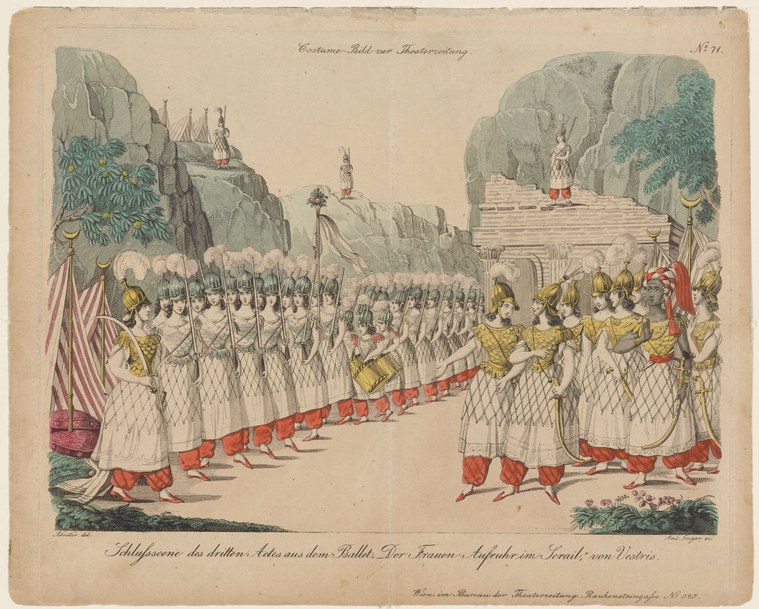
Schlussscene des dritten Actes aus dem Ballet 'Der Frauen-Aufruhr im Serail,' von Vestris
Unknown artist
- Collection:
- Prints depicting dance
- Source:
- New York Public Library
- Rights:
- Public domain — free to use, share and adapt.
- Recorded as:
- Public Domain
This print preserves evidence of a now-forgotten ballet production and its visual and choreographic conventions during a pivotal moment in ballet history—when ensemble spectacle, exotic narrative, and formal beauty were becoming central to the art form. For historians of dance, it shows how the corps de ballet was conceptualized and deployed as a spatial and visual tool, as well as the costume and staging conventions of the period. For anyone studying orientalism in European theater, it reveals how women's bodies, rebellion, and exotic spaces were simultaneously centralized and controlled through geometric arrangement and formal costume.
What you are looking at
A large ensemble of female dancers in classical dress is arranged in two groups facing each other across a mountainous ravine, with a palatial structure perched on the right cliff. The dancers wear white muslin skirts with gold jackets and red trim at the hem, their hair arranged in period style. A long red ribbon or fabric extends from the left group toward the right, creating a visual thread connecting the two formations. The setting is fantastical—soaring rocky peaks frame the scene, with greenery clinging to the cliffs and a statue visible on a platform above the right group. The composition suggests a formal processional or ceremonial gathering, with the dancers arranged in rigid, orderly lines rather than in active movement. The hand-coloring of the print is delicate, with muted greens and ochres in the landscape contrasting with the bright gold and white of the costumes.
The dancing
The dancers stand in upright, formal postures with arms held at their sides or extended outward in controlled gestures. They are arranged in parallel lines, creating a geometric, symmetrical composition that emphasizes formation and spatial design rather than dynamic choreography. The frontality of the figures and their uniform dress and positioning suggest a corps de ballet or ensemble arrayed for a formal scene. There is no sense of active partnering or momentum; the bodies are still and presentational, as if frozen in a tableau or between moments of action.
The dance depicted
This depicts the final scene of the third act of the ballet 'Der Frauen-Aufruhr im Serail' (The Women's Uprising in the Seraglio), a theatrical work that likely emerged from the European tradition of exotic or orientalist ballet in the late 18th or early 19th century. The subject—women in revolt within a seraglio—suggests a dramatic narrative ballet with comedic or satirical elements. The formal ensemble arrangement and the architectural fantasy indicate a grand spectacular finale typical of Romantic-era ballet, where elaborate stagecraft and corps de ballet formations were central to the theatrical effect. The specific choreography cannot be determined from this image, but the uniformity and precision of the ensemble speaks to the classical ballet vocabulary of the period.
How it was made
This is a hand-colored engraving or aquatint, a reproductive print technique that allowed wide circulation of theatrical imagery. The composition and technique—fine linear detail combined with delicate watercolor tinting—is consistent with late 18th-century German or Austrian theatrical documentation, where such prints served as souvenirs and publicity for stage productions. The precision of the engraving allows legibility of costume and formation even in a complex multi-figure scene, while the hand-coloring adds immediacy and theatrical presence. This method of reproduction was essential for spreading knowledge of celebrated productions across Europe before photography.
About this work
This print documents a moment from a theatrical ballet centered on a fantastical orientalist premise—a women's rebellion in a seraglio. The image combines the neoclassical taste for exotic settings with the Romantic ballet tradition of elaborate ensemble spectacles. The final scene presented here uses architectural fantasy and geometric formation to create a sense of culmination and formal resolution. As a hand-colored engraving, it is both a theatrical souvenir and a document of how European audiences imagined non-European settings and female agency within exotic narratives. The work sits at the intersection of Enlightenment orientalism, late 18th-century theatrical spectacle, and the emerging conventions of ballet as a narrative art form.
How to look at it
The viewer should attend to the geometric precision of the ensemble arrangement—note how the dancers are distributed in parallel lines, creating symmetry and balance rather than narrative action. Observe the moment chosen: this is not a moment of active rebellion or dramatic conflict, but a formal resolution or presentation, possibly a wedding, reconciliation, or ceremonial conclusion. The ribbon or fabric extending across the ravine is a key element—it may represent a symbolic connection or may be a stage property integral to the narrative. Finally, notice how the costumes and setting work together: the classical dress and orientalist architecture create a hybrid visual world that is neither authentically Eastern nor fully European, reflecting the theatrical and imaginative nature of the production.
The period
This work dates to the late 18th or early 19th century, when European ballet was undergoing rapid transformation. The Romantic era was beginning to assert itself, with growing interest in storytelling, emotion, and the supernatural alongside the technical vocabulary inherited from the French court ballet tradition. Orientalism was a dominant aesthetic and commercial force in European theater and visual culture, providing exotic backdrops for comedies, ballets, and pantomimes that often satirized European society through imagined Eastern settings. The fashion for spectacular ensemble scenes and elaborate stagecraft—visible here in the rocky gorge and palatial architecture—reflects both the growing technical sophistication of European theaters and the taste for visual excess that characterized late 18th-century theatrical production. The title itself suggests a comic or satirical treatment of female agency within an orientalist frame.
Where it lives
This print is held in the New York Public Library's collection of prints depicting dance, as part of their broader holdings of theatrical and performance imagery. As a hand-colored engraving, it likely served as a commercial souvenir or publicity material for the ballet production, circulated among audiences and collectors interested in theater history.
Dance in this work
Questions about this work
Was this a real ballet, or a fictional one?
The ballet titled 'Der Frauen-Aufruhr im Serail' appears to have been a real production, likely staged in a German or Austrian theater in the late 18th or early 19th century. However, no comprehensive records of this work survive in major dance archives, making it now largely lost except for this image and possibly a few other prints. Such prints were often the only documentation of ballets of this period.
What does 'Serail' mean, and why would women 'rebel' in one?
A serail (or seraglio) is the palace of an Ottoman ruler, and in European theater of this era it became a stock setting for exotic comedies and ballets. The premise of women rebelling or uprising in a serail was a way for European audiences to enjoy narratives of female agency and resistance while safely exoticizing and satirizing non-European settings. These works often had comic or satirical intent, mocking both Eastern customs (as European audiences imagined them) and European society itself.
What can we learn about how this ballet was actually danced?
From this single image, we can observe that the ensemble was arranged in formal, orderly lines and that costume was uniform and refined. The stillness and symmetry suggest that the 'choreography' of this final scene emphasized formation and spatial design over individual technical display or rapid movement. However, we cannot determine footwork, petit or grand allegro, or the specific movement vocabulary from a static image alone. This is why prints like this must be read alongside written descriptions, music, and other documentation to reconstruct historical dance.
More dance artwork





