49 works in this view — arrow keys or swipe to move between them.
Dance in Art
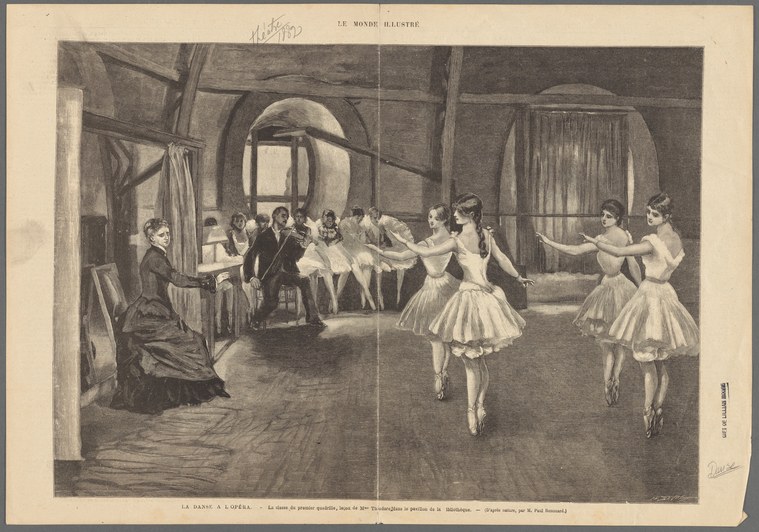
La danse a l'Opéra: la classe du premier quadrille, leçon de Mme Théodore dans le pavillon de la bibliothèque
Unknown artist
- Collection:
- Prints depicting dance
- Source:
- New York Public Library
- Rights:
- Public domain — free to use, share and adapt.
- Recorded as:
- Public Domain
The image provides direct visual evidence of ballet studio practice and instruction at a named, verifiable institution, with a named teacher—a rare specificity in 19th-century dance documentation. It shows the quadrille not as a finished stage picture, but as an exercise and teaching tool, reframing how we understand this form's place in ballet pedagogy.
What you are looking at
A ballet class in progress at the Paris Opéra, depicted in this engraving as a formal pedagogical moment. The studio is a tall, vaulted space with classical architectural detail—a large arched window admits light, and the walls are lined with the permanent fixtures of a dance hall. At left, an older woman in dark street dress sits at a small table or desk, evidently the instructor Mme Théodore, observing and supervising. The main floor is occupied by a group of young female dancers in short white tutus, arranged in a loose formation. Several are en relevé or in active movement; the nearest figures are caught mid-gesture or transition, with arms extended and bodies in the upright, controlled posture of classical ballet. A musician or accompanist is visible in the middle distance. The engraving's tonal range and hatching create a sense of the studio's cool, shadowed atmosphere, with the dancers' white costumes catching the strongest light.
The dancing
The dancers display the hallmarks of classical ballet training: elongated necks, pulled-up spines, and arms held in rounded positions. Several appear to be in the process of a combination or exercise—one figure is distinctly en relevé with arms raised, another appears to be turning or traveling across the floor. The group is not in a formal line (as in a rigid demonstration) but rather in the looser arrangement of an actual working class, with dancers at different depths in the space and at varying moments in the same movement phrase. The instructor's seated position and watchful gaze establish this as a teaching moment rather than a performance.
The dance depicted
This is a ballet class, specifically documented as instruction in the quadrille by Mme Théodore at the Opéra. The quadrille was a central component of 19th-century ballet training—a four-dancer formation executing synchronized steps and patterns. What the image shows is not the formal, geometric quadrille of a performance, but the working environment in which it was taught: a studio session with multiple students, some waiting, others actively executing. The presence of white tutus, the arched feet, and the upright carriage confirm this as classical ballet training of the romantic era or its immediate successor.
How it was made
This is an engraving, identifiable by the linear hatching, fine parallel lines, and tonal control characteristic of the medium. The technique allowed for detailed documentation of interior space and human anatomy with strong legibility—important for a work intended to illustrate the methods and conditions of training at a prestigious institution. The formal precision of line and the careful rendering of architectural detail suggest this was a commissioned or editorial work, likely published to document Parisian cultural life. The print quality and composition suggest it was intended for a periodical or illustrated book, given access to institutional subjects.
About this work
This engraving documents a ballet training session at the Paris Opéra during the 19th century, capturing the pedagogical work of Mme Théodore and her quadrille class. It is a rare visual record of the interior teaching space and the methods by which classical ballet was transmitted to the next generation of professional dancers. The work sits at the intersection of dance history, art history, and institutional documentation—it shows not performance ballet, but the labor and discipline of daily training. For historians of ballet technique and pedagogy, it is valuable evidence of how dancers were actually trained and positioned in this period.
How to look at it
The artist chose to capture the working moment rather than a moment of culmination or display—dancers are in mid-exercise, not posed in a final attitude. Notice the variety of body positions and levels, which records the actual flow of a class rather than a static group portrait. The seating of the instructor and her posture of observation emphasize that this is a teaching space, not a stage. Pay attention to how the engraver used line weight and shadow to define individual bodies within the group, and how the architecture frames and contains the action—the arched window and the vertical proportions of the space emphasize the formal, institutional context.
The period
This work dates from the era of Romantic ballet (approximately 1830s–1870s), a period when ballet was becoming increasingly professionalized and institutionalized in France. The Opéra was the apex of ballet training and employment in Paris. The engraving format and its circulation suggest this was part of the mid-to-late 19th-century illustrated press tradition, when periodicals like L'Illustration (founded 1843) published detailed engravings of Parisian cultural institutions and notable practices. The quadrille was a standard pedagogical tool in classical ballet training, particularly useful for teaching coordination and formation dancing; its appearance here reflects its status as foundational to ballet education. The focus on Mme Théodore as a named instructor indicates that individual teachers had recognizable reputations and were subjects of public interest.
Where it lives
This print is held in the New York Public Library's collection of prints depicting dance. It is catalogued as sourced from the NYPL collection. The specific publication context or original periodical is not recorded in the current catalogue entry.
Dance in this work
Questions about this work
Who was Mme Théodore?
The engraving identifies her as an instructor of the quadrille at the Paris Opéra, teaching the 'premier quadrille' (first quadrille), which was the most advanced section. Beyond this image, little may be recorded about her, but her presence and naming suggest she was a recognized pedagogical authority at the institution. She may be a figure documented elsewhere in 19th-century Parisian dance records.
What is a quadrille in ballet?
A quadrille is a formation of four dancers executing coordinated steps and patterns, typically in two pairs. It was both a ballroom social dance and a standard component of ballet training and performance. In ballet pedagogy, it was used to teach coordination, spacing, and formation work—skills essential to the corps de ballet.
How is this different from a stage performance?
This is a rehearsal or class session, not a performance. The dancers are in practice clothes (tutus), the space is a functional studio, and the instructor is actively supervising. Stage performances of quadrilles were more formal and stylized, often with elaborate costumes and scenery. This image records the unglamorous, disciplinary work behind performance.
What does the architecture tell us?
The vaulted ceiling, arched window, and classical proportions indicate this is a purpose-built or carefully adapted studio within an institutional building—the Opéra pavilion specifically. This level of architectural investment reflects the status and resources of the institution and underscores that ballet training at the highest level was a formally structured, well-resourced enterprise.
More dance artwork





