49 works in this view — arrow keys or swipe to move between them.
Dance in Art
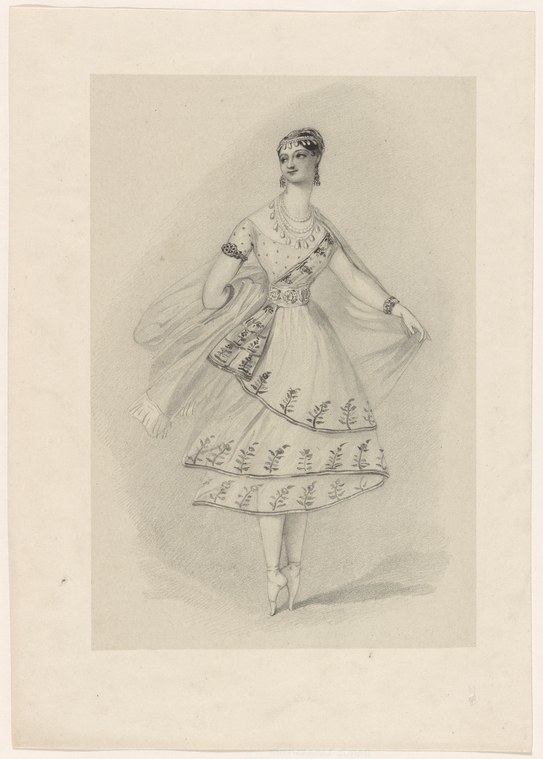
Marie Taglioni in Le dieu et la bayadère
Unknown artist
- Collection:
- Prints depicting dance
- Source:
- New York Public Library
- Rights:
- Public domain — free to use, share and adapt.
- Recorded as:
- Public Domain
This image is primary evidence for how Romantic ballet looked, was documented, and was consumed by its public. It shows the Romantic ballet dancer not in the midst of virtuosic display but in a moment of poetic stillness, which is crucial to understanding the era's aesthetic values. Taglioni was not merely a dancer but a cultural icon whose image circulated widely; this drawing is part of that circulation and evidence of the nineteenth-century celebrity system around dance.
What you are looking at
A young woman in Romantic-era ballet costume stands alone against a plain background, posed in a languid contrapposto that suggests a moment of reverie or dramatic pause. She wears a white muslin dress with a low neckline and short puffed sleeves, the skirt falling in two tiers decorated with small embroidered or printed floral motifs. Over her shoulders drapes a gossamer scarf or shawl. A circlet or headpiece sits in her dark hair, which is gathered up in the style of the 1830s–1840s. Her feet are placed in ballet positions, and her gaze is directed upward and to the side, as if she is observing something or someone beyond the frame. The entire composition is rendered in fine pencil on paper, with careful attention to the fall and transparency of the fabrics and the delicate proportions of the figure.
The dancing
A single female dancer in a posed standing position with weight placed lightly, suggesting the balletic carriage of the classical ballet tradition. Her arms are positioned with one hand near her waist and the other extended gracefully; the stance shows the turnout and elongation of line fundamental to ballet vocabulary. The posture conveys a moment of stillness or pause rather than dynamic motion—a characteristic suspension of the Romantic aesthetic. Her head is tilted back in an attitude of yearning or introspection, a gesture deeply coded in Romantic ballet iconography.
The dance depicted
This depicts a scene from *Le Dieu et la Bayadère* (*The God and the Bayadère*), a major Romantic ballet of the 1830s. The work, choreographed by Jean-Augustin Lartigue with music by Adolphe Adam, was a signature vehicle for the Paris Opéra's leading ballerinas. The image is identified by the title as portraying Marie Taglioni, the Swedish-Italian dancer who was the supreme ballerina of the Romantic era and the creator of this and many other defining roles. The bayadère (a temple dancer from the Indian tradition, mediated through European orientalist fantasy) was a stock character of Romantic ballet, and Taglioni's interpretation set the standard for the role. The pose and costume shown here capture the apotheosis of Romantic ballet style: the ethereal quality, the emphasis on verticality and weightlessness, and the emotional register of spiritual longing or transcendence.
How it was made
This is a pencil drawing on paper, rendered with fine hatching and tonal modulation to suggest the drape and shimmer of silk and muslin. The technique is that of a theatrical sketch or costume study, likely made for the purposes of documenting the ballet for circulation among artists, connoisseurs, and the paying public. Such prints and drawings were common in the 1830s–1840s, serving as souvenirs and publicity for celebrated performances. The delicate precision of the rendering—particularly the careful attention to the transparency and movement of the fabrics—suggests this may have been engraved or lithographed for wider distribution, though the record does not confirm this. The drawing technique allows the artist to capture the immaterial, ephemeral quality that audiences experienced watching Taglioni dance.
About this work
This is a study of Marie Taglioni as the bayadère in *Le Dieu et la Bayadère*, one of the canonical images of the Romantic ballet. The drawing documents not just a costume but an entire aesthetic moment: the marriage of technical ballet vocabulary with a repertoire of emotional and spiritual expression that defined the 1830s. Taglioni was the dominant dancer of her era, and her roles and performances were widely circulated through prints, drawings, and lithographs aimed at the growing middle-class audience for ballet. This image belongs to a large corpus of theatrical documentation that shaped how audiences understood the dance and how the dance was remembered after the performances themselves had vanished.
How to look at it
Look at the moment the artist chose: not a leap or a turn, but a pause, an attitude of longing. This is characteristic of Romantic ballet, which valued the sustained, weightless, spiritually charged moment as much as the pyrotechnic. Notice how the artist has rendered the fabrics—the scarf is almost invisible, the muslin nearly transparent—to convey the immateriality that audiences marveled at. The tilt of the head and the upward gaze are not accident but language: they are the visual vocabulary through which Romantic ballet communicated emotion and transcendence. The bare simplicity of the setting (plain background, no scenery) is also typical of such studies, meant to focus attention entirely on the figure and her costume.
The artist
The artist is not recorded. However, the drawing's style and technique are consistent with the work of the theatrical lithographers and sketch artists who worked for the Paris Opéra and its associated print publishers in the 1830s–1840s. Artists such as Eugène Lami, Émile Mongenet, and the lithographic firms of Chabot and others produced vast numbers of such studies, often in rapid succession around premieres and successful runs. The anonymity of the draftsperson is typical of the period; theatrical documentation was often a collaborative and commercial enterprise rather than the work of individually credited fine artists.
The period
*Le Dieu et la Bayadère* premiered at the Paris Opéra in 1830 and was revived repeatedly throughout the 1830s and 1840s, becoming one of the defining ballets of the Romantic era. The Romantic ballet was characterized by a fascination with exoticism, spirituality, sylphs, and other-worldly female figures—a fascination that extended to the orientalist fantasy of the bayadère. The 1830s were the apogee of Marie Taglioni's career; she had recently perfected the pointe work and the ethereal aesthetic that would define the era. Simultaneously, the lithographic reproduction of theatrical scenes was booming as a commercial enterprise, making ballet images available to a much wider audience than could attend performances. This drawing sits at the intersection of live performance, technological innovation in printmaking, and the emergence of dance as a subject of fine and commercial art.
Where it lives
The drawing is held by the New York Public Library in its collection of prints depicting dance. It is catalogued as a historical document of theatrical production and performance. The NYPL collection includes thousands of images documenting ballet, opera, and theatrical dance from the eighteenth century to the modern era.
Dance in this work
Questions about this work
What is a bayadère and why was it important in Romantic ballet?
A bayadère is a Hindu temple dancer, a figure from South Asian dance traditions mediated through European orientalist fantasy. The role became iconic in Romantic ballet as a symbol of exotic spirituality, sensuality, and otherness. Taglioni's *Bayadère* was one of the most celebrated interpretations of the character, setting a standard that influenced how the role was danced for decades. The bayadère allowed choreographers and dancers to explore themes of love, duty, spirituality, and transcendence within an orientalist framework.
Why is Marie Taglioni so important?
Taglioni was the dominant ballerina of the Romantic era and the supreme interpreter of the spiritual, ethereal ballet aesthetic. She was among the first to perfect the pointe technique that would become standard in classical ballet, and she did so in a way that made it look weightless and effortless. Her performances and roles (including the Sylph and the Bayadère) defined what Romantic ballet meant, and her fame spread rapidly through prints, drawings, and written accounts. She was also a celebrity in the modern sense—widely recognized, discussed, and imitated.
How do we know this drawing is of Taglioni?
The catalogue record identifies it as depicting Marie Taglioni in this role. The drawing itself bears no visible signature or inscription that we can make out in the image, so attribution depends on the provenance and the library's research. Given the iconicity of the role and Taglioni's prominence, theatrical prints of the Bayadère from this era were almost always made to capitalize on her fame.
What does the costume tell us about the ballet?
The muslin dress with its light, flowing skirts and the gossamer shawl are the hallmarks of the Romantic ballet aesthetic—an emphasis on immateriality, transparency, and ethereal beauty. The low neckline and short sleeves, the embroidered floral motifs, and the delicate circlet all suggest exoticism and fantasy while remaining within the bounds of what the Paris Opéra's middle-class audiences found acceptable. The costume is designed to make the body appear weightless and the dancer appear to inhabit a realm beyond the everyday.
More dance artwork





