49 works in this view — arrow keys or swipe to move between them.
Dance in Art
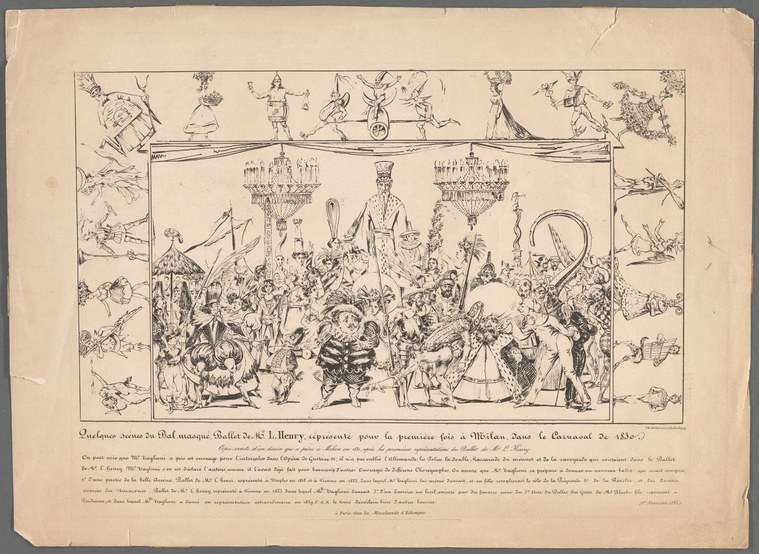
Quelques scènes du Bal masqué, ballet de Mr. L. Henry, représenté pour la première fois à Milan, dans le Carnaval de 1830
Unknown artist
- Collection:
- Prints depicting dance
- Source:
- New York Public Library
- Rights:
- Public domain — free to use, share and adapt.
- Recorded as:
- Public Domain
This print is one of the few surviving visual records of a significant ballet from the 1830 Milan Carnival season, a moment when Italian theatres were competing with Paris and Vienna for prestige in the new Romantic ballet repertory. It shows how ballet was marketed and documented—through large, expensive, finely engraved prints that circulated among artists, impresarios, and theatre-goers across Europe. For dance historians, it provides evidence of the choreographic structure of a now-lost work and of the visual language and aesthetic priorities of early Romantic ballet.
What you are looking at
A densely populated masquerade ball unfolds in a grand interior, the composition divided into a central theatrical scene flanked by a border of smaller vignettes showing revelers in various states of carnival revelry. The central panel depicts a crowded ballroom where dozens of figures in elaborate costumes and masks mingle beneath hanging chandeliers and decorative swags. The space is architecturally grand, with classical elements visible in the background. To the left and right of this main scene, and along the top and bottom margins, are numerous smaller scenes—some showing acrobatic performers, musicians, couples in intimate poses, and masked figures in comic or grotesque attitudes. The drawing style is precise and linear, rendered in black ink on cream paper, with dense cross-hatching creating depth and shadow. The overall effect is one of chaotic festivity: the eye cannot rest, there is always another figure, another pose, another moment of theatre to discover.
The dancing
The bodies in the central ballroom are upright and formally posed, with many standing in conversational clusters or in the classical ballroom stance—men and women facing each other at arm's length, suggesting the structured courtship rituals of ballroom dance. Some figures show the characteristic arm positions of early 19th-century social dance: extended, controlled, with weight held upright. In the marginal vignettes, the bodies shift dramatically—acrobats are inverted, contorted, or in active flight; musicians lean into their instruments; some figures slouch or contort in caricature. The density of figures and the overlapping of forms create a sense of movement and crowding, though individual dancers are not shown in mid-step motion; instead, the artist has caught them in the pause or the stance.
The dance depicted
This is a theatrical print documenting a specific ballet: the 'Bal masqué' choreographed by L. Henry (also known as Louis Henry), first performed at La Scala in Milan during Carnival 1830. The central scene shows the grand ball that forms the dramatic and social centrepiece of the ballet. The marginal vignettes document the divertissements and comic interludes typical of Romantic-era ballet, where acrobatic feats, pantomime, and character dances interrupt the main narrative. The print is not recording an actual ballroom but rather a theatrical representation of one—a ballet about masquerade and carnival. The formal ballroom poses and the emphasis on spectacle and variety are entirely consistent with ballet d'action of the 1820s–30s, where elaborate scenarios and visual excess were paramount.
How it was made
This is a line engraving or etching, rendered with remarkable precision and detail. The technique allows for the density of fine parallel lines that create tonal variation and shadow without solid fills; this was the standard reproductive method for theatrical prints of this period and enabled wide circulation across Europe. The composition—a grand central image surrounded by a decorative border of smaller scenes—follows the established format for ballet documentation prints, which served both as souvenirs for audiences and as records for other theatre companies wishing to restage or adapt the work. The precision of the line work and the scale of the composition suggest this was a significant and expensive publication, marking the ballet as notable enough to warrant formal documentation.
About this work
This is a print documenting *Bal masqué*, a ballet choreographed by Louis Henry and premiered at La Scala, Milan, in the 1830 Carnival season. The work belongs to the tradition of the ballet d'action—a narrative ballet in which character, plot, and spectacle are woven together through a sequence of dances and pantomime. The print is a theatrical record: it shows not an actual ballroom but a staged representation of one, complete with the elaborate décor, costumes, and compositional density that defined Romantic ballet. The marginal scenes record the variety acts and divertissements that surrounded the main narrative—acrobatics, comic turns, character dances—which were essential to the appeal of such productions.
For a modern viewer, the print is valuable as evidence of how early 19th-century ballet audiences experienced spectacle: as overwhelming, crowded, various, and populated with bodies in constant motion or gesture. The formality of the central ballroom contrasts with the chaos and acrobatic excess of the margins, suggesting the tension between refined social ritual and theatrical excess that animated Romantic taste.
How to look at it
Attend first to the central ballroom scene: the formal positions of the dancers, the classical architecture, the overhead perspective that allows you to see the entire space. Then trace the eye outward to the margins: the acrobats, the musicians, the comic figures. Notice how the print uses the border to frame and contextualize the main action—these are not scenes happening simultaneously but rather the range of entertainments available in a single evening at a grand theatre. The engraver has chosen to show the ballroom at a moment of social and theatrical stasis—not mid-dance but in the pause or conversation that frames the dance. This was a deliberate choice: it allowed maximum visibility of costume, décor, and the composition of the space itself.
The artist
The artist is not recorded in the catalogue, but the precision and scale of the engraving suggest it was the work of a professional printmaker working in Milan or northern Italy in the early 1830s, likely commissioned by the theatre or a publisher to capitalize on the success of Henry's ballet. Louis Henry was an important choreographer of the period, known for creating ballets for Italian theatres; his work bridges the late neoclassical and early Romantic periods.
The period
The early 1830s saw a rapid evolution in ballet aesthetics. The classical vocabulary and narratives of the late 18th century were being displaced by Romantic ballet—works that emphasized the supernatural, the exotic, and the emotional, and that placed new technical demands on dancers. The masquerade ball was a favoured scenario in Romantic opera and ballet: it allowed for elaborate spectacle, social comedy, masked identity-play, and the collision of the refined and the grotesque. Milan's La Scala was one of the premier European opera houses and a major venue for new ballets; the Carnival season was the most prestigious and well-funded performance season of the year. This print testifies to the investment in spectacle and the importance of visual documentation in the theatrical economy of the time.
Where it lives
The print is held in the New York Public Library's collection of prints depicting dance. It is catalogued as a historical record of theatrical production, part of the NYPL's broader documentation of 19th-century performance.
Dance in this work
Questions about this work
Who was Louis Henry and what made this ballet significant?
Louis Henry was an important choreographer active primarily in Italy in the early 19th century. He created ballets for major Italian theatres, including La Scala in Milan. *Bal masqué* was premiered during the prestigious Carnival season of 1830, a moment of intense competition between European theatres for dominance in the new Romantic ballet repertory. Henry's work exemplifies the transition from classical to Romantic ballet aesthetics.
What do the marginal scenes show?
The scenes around the border document the divertissements and variety acts that surrounded the main narrative of the ballet. These included acrobatic feats, comic pantomime, character dances, and musical performances. In early 19th-century ballet, these interruptions were not considered breaks in the action but essential parts of the theatrical experience, showcasing different virtuosities and keeping audiences entertained.
How were ballets documented and circulated in this period?
Ballets were documented through expensive, finely engraved prints commissioned by theatres or publishers after successful premieres. These prints served multiple purposes: as souvenirs for audiences, as records for other theatres wishing to stage or adapt the work, and as advertisements for the theatre's prestige and artistic reach. They required significant investment and were produced only for notable works.
What does the formal ballroom dance vocabulary suggest about the actual choreography?
The upright, controlled postures and the classical arm positions visible in the central ballroom scene suggest that the ballet used the vocabulary of social ballroom dance—waltzes, quadrilles, and other partner dances of the period—but elevated and theatricalized. The density of the composition suggests a ensemble or corps work, with coordinated movement creating visual patterns rather than individual virtuosity.
More dance artwork





