49 works in this view — arrow keys or swipe to move between them.
Dance in Art
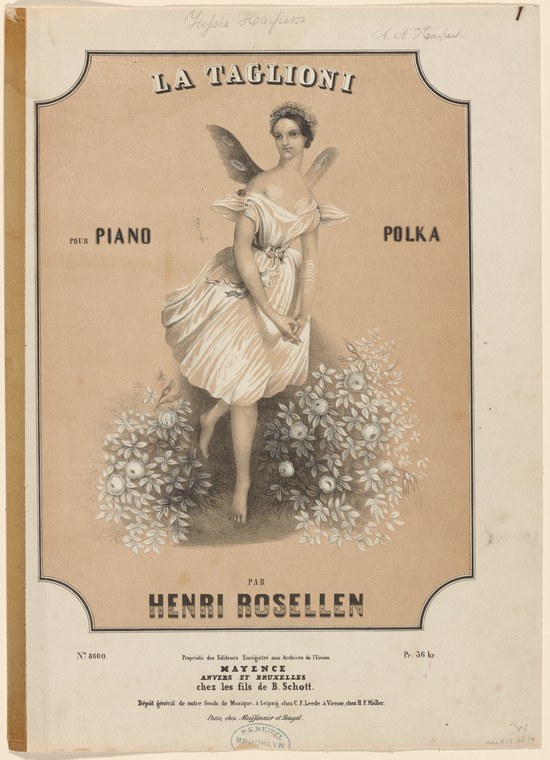
La Taglioni polka pour piano par Henri Rosellen
Unknown artist
- Collection:
- Prints depicting dance
- Source:
- New York Public Library
- Rights:
- Public domain — free to use, share and adapt.
- Recorded as:
- Public Domain
This cover shows how thoroughly Romantic ballet had saturated European commercial culture by mid-century, and how a single dancer—Taglioni—had become synonymous with the image of ethereal, effortless feminine grace. It documents the symbiosis between theatrical dance and social dance: the polka was a real ballroom craze, yet its commercial packaging borrowed the aesthetic and iconography of elite ballet. For researchers of dance as cultural commodity, this is essential evidence.
What you are looking at
A classical female figure in a flowing white chemise stands barefoot amid blooming flowers, her body turned in contrapposto with wings emerging from her shoulders. The composition is a cover design for a polka—a dance work for piano—dedicated to or named after the famous Romantic-era ballerina Marie Taglioni. The figure occupies the centre of a decorative cartouche, surrounded by delicate floral detail at her feet. The print is hand-coloured, with sepia tones dominating the background and careful shading defining the drapery and musculature of the dancer's form. The overall effect is one of ethereal grace: the winged figure suggests both classical mythology and the supernatural registers of Romantic ballet.
The dancing
The dancer stands in a relaxed, upright posture with her weight centred, one leg straight and the other subtly bent. Her arms hang loosely at her sides, with the left arm extended slightly forward and the right curving back—a pose of repose rather than active movement. The wings, rendered in soft grey-brown wash, extend from her shoulders at an angle that suggests lightness and flight rather than anatomical precision. Her torso is nude above the waist; the lower body is wrapped in diaphanous drapery that falls to the ankle, suggesting a neoclassical or Romantic theatrical costume. The pose conveys stillness and contemplation rather than the virtuosic display of the polka as a social dance.
The dance depicted
This is a cover design for *La Taglioni polka*, a piano piece by the composer Henri Rosellen, almost certainly named in honour of the legendary Romantic ballerina Marie Taglioni (1804–84), who created the role of Sylphide in 1832. The winged figure is an unmistakable reference to the sylph—the ethereal supernatural being who became the defining character type of Romantic ballet. The polka itself, a lively couples' dance of Central European origin, became fashionable in European ballrooms from the 1840s onward. This cover conflates two registers: the sylphic ethereality of classical ballet and the social-dance craze of the day, suggesting that the piano piece was intended for performance in ballroom or salon contexts. The figure's nudity and mythological wings situate it in a tradition of allegorical female representation common to dance and music covers of the mid-19th century.
How it was made
This is a hand-coloured lithographic print, a technique that allowed rapid, economical production of sheet-music covers and promotional imagery for the growing commercial music market of the 1840s–50s. The image shows the characteristic look of lithography: soft, fluid tonal transitions in the drapery and wings, achieved through crayon on stone; the bold framing cartouche typical of the period; and the precision of the printed text. The edition information at the base—*Dépôt de l'Éditeur. Enregistré aux Archives de l'Union*—and the publisher's address (Matgenée / Antwerp & Brussels / chez les fils de B. Schott) identify this as a commercial publication, likely circulated across continental Europe. Hand-colouring, a labour-intensive addition to the lithographed base, indicates that this was a relatively high-value item, aimed at affluent music consumers.
About this work
This is a promotional cover design for a piano polka named after Marie Taglioni, the most celebrated ballerina of the Romantic era. The image uses the winged sylph—Taglioni's most famous role—to invoke the otherworldly grace and elevation associated with her name, even though the work itself is a ballroom dance, not a ballet. It is a vivid document of mid-19th-century commercial culture: the moment when Romantic ballet's artistic prestige and imagery began to saturate mass-market music and fashion. The work sits at the intersection of theatrical and social dance, linking the cultish admiration for Taglioni among elite audiences to the popular pleasures of the expanding ballroom. For historians of dance, fashion, and visual culture, it reveals how a real dancer's body and achievement could be abstracted into an allegorical image that sold commercial products across Europe.
How to look at it
Attend to the pose: despite the wings, this is not a figure in mid-leap or mid-arabesque, but one at rest, standing quietly. The artist has chosen to invoke the sylph not through action but through attribute—the wings—and through the refinement of the pose and drapery. Notice how the drapery adheres to neoclassical convention: transparent, revealing the body beneath, and falling in graceful folds. The contrast between the ethereal upper body (nude, winged) and the clothed lower half reflects Romantic costume conventions. The flowers at her feet are not merely decorative: they recall the pastoral and magical settings of sylph ballets. The overall composition—a still, poised, almost contemplative figure—was designed to be readable at a glance by people flipping through a music merchant's catalogue or window display.
The artist
The artist is not recorded. The composer Henri Rosellen (1811–76) was a prolific French pianist and composer of salon and dance music, known for polkas, galops, and variations on operatic themes. The publisher Schott, with offices in Antwerp and Brussels, was a major music publisher serving the Continental European market. The cover design follows the conventions of mid-19th-century sheet-music illustration: allegorical female figures, neoclassical or Romantic iconography, hand-coloured lithography.
The period
The 1840s–50s were the height of Romantic ballet in Europe, with Marie Taglioni at its centre. The polka, originating in Bohemia in the 1830s, became a ballroom sensation across Europe from the 1840s onward, eventually spreading to the Americas. This period saw the rapid commercialization of dance culture: famous ballet roles were adapted into social dances, and dancers' names became brand markers for music, prints, and fashion goods. At the same time, the ballroom was itself becoming a subject of intense artistic and commercial interest, as middle-class leisure and consumption expanded. The lithographic printing revolution made illustrated sheet music affordable and collectible, allowing dance imagery to circulate far beyond the theatre.
Where it lives
This is a sheet-music cover from the New York Public Library's Prints collection depicting dance. It is a commercial lithograph, one of thousands produced for the music trade in the mid-19th century, and its survival suggests it was valued and preserved as part of a collection of music ephemera or dance-related imagery.
Dance in this work
Questions about this work
Who was Marie Taglioni and why was she so famous?
Marie Taglioni (1804–84) was a Swedish-Italian ballerina who became the most celebrated dancer of the Romantic era. She created the title role in *La Sylphide* (1832), a ballet that defined the Romantic aesthetic: ethereal, weightless, supernatural. She danced en pointe, wore the flowing white muslin dresses and ethereal wings visible in this image, and became a cultural icon—so much so that her image and name were used to sell everything from sheet music to fans and jewellery.
What is a polka, and what does it have to do with ballet?
The polka is a lively couples' dance in 2/4 time, originating in Bohemia and becoming a ballroom craze across Europe from the 1840s onward. It has nothing to do with ballet in form or technique. However, this cover conflates them: the music is a polka for piano (a ballroom dance), but the cover image invokes the sylph—the most famous character in Romantic ballet. This was a common strategy in 19th-century music marketing: use the prestige and aesthetics of high art to sell commercial popular music.
Why are there wings on the figure?
The wings mark this figure as a sylph—a supernatural, ethereal being from Romantic ballet, most famously the character Taglioni made famous in *La Sylphide*. In Romantic ballet, sylphs were portrayed as weightless, otherworldly creatures, often depicted with gossamer wings. The wings here are an iconographic shorthand: they tell the viewer instantly that this cover is trading on Taglioni's fame and the glamour of Romantic ballet, even though the music itself is a secular social dance.
Is this a painting or a print?
This is a hand-coloured lithograph—a print made from a design drawn on a lithographic stone, then printed and coloured by hand. Lithography was the dominant technology for producing illustrated music covers in the 19th century because it was fast, relatively cheap, and allowed for subtle tonal effects. Hand-colouring added value and aesthetic refinement, making this a mid-range luxury product aimed at affluent music consumers.
More dance artwork





