49 works in this view — arrow keys or swipe to move between them.
Dance in Art
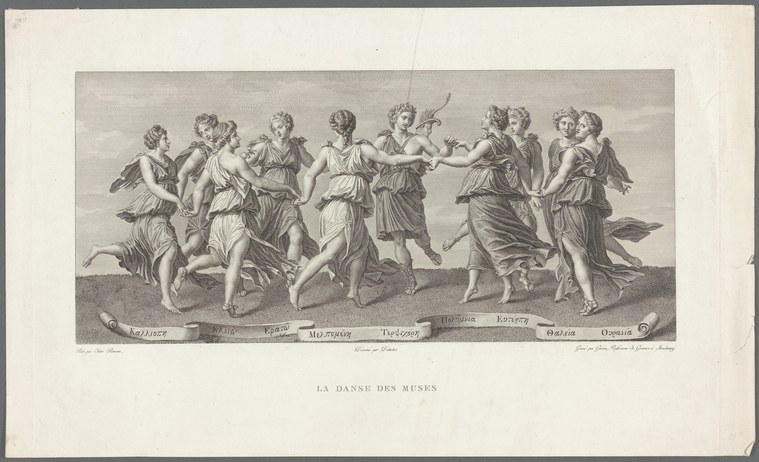
La danse des Muses
Unknown artist
- Collection:
- Prints depicting dance
- Source:
- New York Public Library
- Rights:
- Public domain — free to use, share and adapt.
- Recorded as:
- Public Domain
For dance historians, this image shows how the visual grammar of ballet and theatrical dance—the extended line, the sense of effortless flow, the composition of multiple bodies in space—was abstracted and deployed in fine art to represent concepts beyond literal movement. For art historians, it demonstrates the deeply embedded aesthetic exchange between dance and the sister arts during the 18th century, when the ideal body in motion became a primary vehicle for expressing neoclassical values. The work also preserves an idea of what trained, graceful movement looked like to educated viewers of the period, even though no actual dance is being documented.
What you are looking at
This engraving depicts nine female figures in classical dress arranged in a dynamic, spiraling composition across a shallow stage-like space. The women wear flowing Greco-Roman drapery and are barefoot or in soft shoes, their bodies caught in continuous movement. Each figure occupies a distinct position in a choreographed pattern: some lean backward with arms extended, others reach toward companions, and the group creates a visual rhythm of interlocking diagonal lines and curves. The setting is minimal—a ground line and subtle landscape backdrop suggest an idealized space rather than a specific location. The light is even and descriptive, clarifying every fold of fabric and the musculature beneath; there is no dramatic shadow. The title inscribed below identifies the nine figures as the Muses of classical antiquity, each labeled with her name (Calliope, Thalia, Melpomene, Terpsichore, Erato, Euterpe, Polymnia, Urania, Clio), and the composition reads as an allegorical representation of artistic inspiration through bodily grace.
The dancing
The nine women are spaced to create a sense of processional movement and mutual engagement. Their bodies demonstrate classical contrapposto and extended limbs; several have one leg forward with the torso twisted, creating S-curves through the spine. Arms are rarely contained—they reach, gesture, and interact across the group. The nearest figures lean toward one another as if in conversation or greeting; those farther back extend into space, suggesting forward motion or the act of leading. The poses show no weight-bearing strain; instead, the figures appear to float or glide, with a lightness that suggests trained grace rather than effort. There is no closed-hold partnering; instead, the women relate through spatial proximity and mirrored or answering gestures.
The dance depicted
This is not a specific named historical dance but rather an allegorical representation of the nine Muses, depicted in a style consistent with 18th-century neoclassical aesthetics and the aesthetic tradition of court dances translated into higher art. The movement vocabulary—extended lines, flowing transitions between positions, the emphasis on grace and lightness—suggests familiarity with ballet and with the idealized body of the period. The women are not performing a social or recreational dance but enacting a poetic concept: the divine inspiration and artistic harmony embodied by the Muses. This is a theatrical or allegorical image rather than documentation of an actual dance performed on stage, though it draws on the visual language of theatrical dance and the classical aesthetic that governed both ballet and history painting of the era.
How it was made
This is an engraving, identifiable from the fine parallel lines (hatching and cross-hatching) that create tone and volume, and the precise, linear quality of the contours. The technique allows for crisp definition of form and detail—every drapery fold and anatomical feature is legible—and the print medium ensured wide circulation among educated audiences. The even, descriptive light and the careful modeling of form suggest this was made to educate and elevate the viewer's understanding through visual clarity rather than to capture a moment of spontaneous action. The engraving technique was labor-intensive and expensive, placing this work among fine-art prints intended for collection by persons of taste rather than mass distribution.
About this work
This engraving represents the nine Muses in a choreographed arrangement that conflates classical allegorical tradition with the visual language of 18th-century theatrical dance. The work belongs to the tradition of history painting and allegorical art that drew on dance vocabulary to express abstract ideas—in this case, the nine domains of artistic inspiration. The image does not document a specific dance performed on stage, but rather uses the graceful, extended bodies and spatial relationships of trained dancers to give form to a poetic concept. It is an example of how dance aesthetics infiltrated fine art, and how the body in motion was understood as a vehicle for expressing ideals of harmony, grace, and intellectual aspiration during the neoclassical period.
How to look at it
Notice the careful distribution of weight and the way each figure's position answers or echoes another's, creating a visual rhythm across the composition. The artist has chosen a moment of flowing, continuous movement rather than a static tableau—the bodies spiral and interlock, suggesting that the dance is happening now, not frozen in the past. Attend to the near-nudity beneath the drapery and the emphasis on the trained, extended limbs: this is a body that has been disciplined and refined through instruction. The labeling of each figure with her classical name reminds the viewer that this is not merely graceful movement but meaningful movement, each Muse embodying a specific domain of art and knowledge.
The period
The 18th century saw an extraordinary flowering of written dance notation and theory, and the emergence of ballet as a serious theatrical art form under figures like Jean-Georges Noverre, whose Lettres sur la danse (1760) argued that dance was equal to poetry and painting. At the same time, neoclassical aesthetics dominated European visual culture, prizing clarity, balance, ideal form, and references to classical antiquity. The combination produced images like this one, in which classical subject matter (the Muses) is rendered through the vocabulary of trained movement, creating a kind of poetic visual argument: that artistic inspiration is embodied, graceful, harmonious, and rooted in antiquity. The allegorical use of dancing figures was commonplace in history painting and engraving of the period, and this work sits squarely within that tradition.
Where it lives
This print is held in the New York Public Library's collection of prints depicting dance. It is a historical engraving of the type that circulated among educated collectors during the 18th century.
Dance in this work
Questions about this work
Who were the Muses and why would they be depicted dancing?
In classical mythology, the nine Muses were goddesses who inspired different arts and domains of knowledge—from epic poetry (Calliope) to dance itself (Terpsichore). Depicting them in motion was a way of representing artistic inspiration as something living, flowing, and embodied. The image argues that grace and movement are divine gifts, and that the trained body is the proper vehicle for expressing the highest human aspirations.
Is this an actual dance that was performed?
This is not documentation of a specific, named dance performed on stage. Rather, it is an allegorical composition that uses the visual language of trained dance—extended lines, flowing transitions, spatial harmony—to express a poetic concept. However, the artist clearly understood how trained bodies move, suggesting familiarity with ballet and courtly dance of the period.
Why does this engraving matter to dance history?
It shows how thoroughly dance vocabulary had infiltrated the visual arts by the 18th century, and how the ideal moving body had become a primary way of expressing beauty, grace, and intellectual aspiration. For dance historians, it is evidence of how ballet aesthetics were understood and valued by the educated public of the period, even when the image was not meant to document an actual performance.
More dance artwork