49 works in this view — arrow keys or swipe to move between them.
Dance in Art
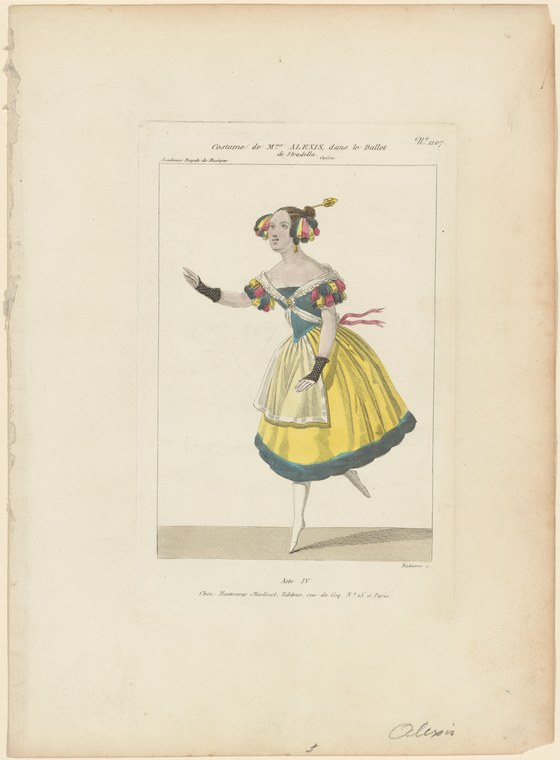
Costume de Mme. Alexis dans le ballet de Stradella, Opéra, Acte IV
Unknown artist
- Collection:
- Prints depicting dance
- Source:
- New York Public Library
- Rights:
- Public domain — free to use, share and adapt.
- Recorded as:
- Public Domain
For a dance historian or performer, this image is a rare direct record of how a Romantic-era ballet costume was actually constructed and worn, captured at the moment of performance or rehearsal. It documents not just the visual design but the bodily carriage and stance expected of a professional classical dancer in the 1830s–1840s, a period of fundamental importance to ballet's development. The print is evidence of how dance was disseminated to the public in the pre-photographic era, and how the female ballet body was presented and circulated as a cultural commodity.
What you are looking at
A single female dancer stands center stage in an elegant three-quarter pose against a neutral background. She wears a Romantic-era costume consisting of a fitted bodice with short, off-shoulder sleeves trimmed in colorful ribbon or braid, and a full skirt in pale yellow with a darker (likely black) hem band. Her head is adorned with what appears to be a decorative headdress or bonnet with colored embellishments on either side. Her right arm is raised and extended outward in a graceful gesture, while her left arm hangs naturally at her side; her posture is upright and poised. She stands en relevé or nearly so, on the balls of her feet, suggesting the lightness and elevation characteristic of ballet of the period. The composition isolates the figure against pale paper, typical of costume design or performance documentation, with careful attention to the rendering of fabric texture and the interplay of light and shadow.
The dancing
A single dancer occupies the composition in a three-quarter stance, weight forward and lifted through the torso. Her right arm is raised to approximately shoulder height with the elbow slightly bent, creating an open, inviting gesture; her left arm is relaxed. The pose suggests a moment between steps—neither a full lift nor a grounded position, but a sustained, ethereal quality. Her carriage is upright and elongated, with the head held high. The artist has captured the dancer in a moment of stillness that suggests movement about to occur or just concluded, a characteristic of Romantic ballet representation.
The dance depicted
This is a costume design or performance record for a female dancer in *Le Stradella*, identified by the inscription as Mme. Alexis in Act IV. The work is almost certainly Romantic ballet, given the costume style, the solo female focus, the ethereal pose, and the period of the image. *Stradella* was choreographed and first performed in the 1830s–1840s, and the costume—with its fitted bodice, full skirt, and decorative headdress—is consistent with Romantic ballet aesthetics of that era. The pose and bearing suggest classical ballet training and the vocabulary of the period, though the image does not show rapid footwork or complex choreographic sequence, instead presenting the dancer as a figure to be admired in costume.
How it was made
This is a hand-colored engraving or print, recognizable by the fine linear work defining drapery and form, the precise delineation of the figure, and the application of watercolor or gouache for the yellow skirt and colored ribbon trim. The technique allowed for reproducibility and wide circulation—costume prints of this kind were sold to audiences, dancers, and the theater-going public as both documentation and souvenir. The hand-coloring indicates it was produced for a market audience rather than mass mechanical reproduction, suggesting a mid-19th-century French theater-focused print house. The elegant refinement of the line work and the careful attention to costume detail are consistent with professional ballet documentation of the period.
About this work
This hand-colored engraving documents the costume and bearing of Mme. Alexis, a dancer in the Romantic ballet *Stradella*, in Act IV of the work. The image is both a record of performance and a costume design document—a common form of dance documentation in the 19th century, before photography made such records routine. The print preserves not only the visual appearance of a specific dancer in a specific role, but also the aesthetic and bodily ideal of Romantic ballet: the ethereal, weightless, upright female figure, isolated against an empty ground, presented as an object of beauty and admiration. The work belongs to a large corpus of printed costume documentation from European ballet houses, particularly French ones, which circulated widely among performers, audiences, and collectors.
How to look at it
The viewer should observe the precise moment the artist chose to freeze: the dancer is not in motion but in a pose of sustained elegance, neither fully weighted nor fully elevated, suggesting the Romantic ballet ideal of weightlessness and grace. Notice the careful rendering of the costume—the graduated color of the skirt, the precisely drawn ribbon trim, the delicate headdress—which indicates this is a professional document meant to guide construction and performance. The isolation of the figure against the blank ground is itself a convention of the period, presenting the dancer as a timeless aesthetic object rather than a human being in a theatrical context. This mode of presentation is distinctly different from later performance photography, which would situate the dancer within a set and narrative.
The period
This print was made during the height of the Romantic ballet period in Europe, roughly 1830–1850. In the 1830s, the ballet gained new prominence through works like *La Sylphide* (1832) and *Giselle* (1841), which established the ethereal, supernatural female dancer as the genre's central figure and ideal. *Stradella*, a ballet based on the life of the composer Alessandro Stradella, premiered in Paris in 1837 and was revived and toured throughout the 1840s. Costume prints of the kind shown here were a standard form of ballet publicity and documentation, created by print houses attached to or associated with major opera houses and theaters. They served multiple audiences: dancers used them as reference; wealthy patrons collected them; and the general public purchased them as souvenirs and evidence of the spectacles they had witnessed or desired to see.
Where it lives
The print is held in the New York Public Library's collection of prints depicting dance. The inscription at the top identifies it as a costume design for Mme. Alexis in *Stradella*, and the work appears to be a mid-19th-century French hand-colored engraving of the type produced for circulation to performers and the theater-going public.
Dance in this work
Questions about this work
What is Stradella?
*Stradella* is a Romantic-era ballet first choreographed and staged in Paris in 1837, based on the life of the 17th-century composer Alessandro Stradella. It was one of several ballets of the period to draw on historical or legendary subjects. The work was performed throughout Europe in the 1830s and 1840s and was revived multiple times. Like other Romantic ballets, it featured a prominent female role supported by corps de ballet.
Who was Mme. Alexis?
Mme. Alexis is identified in the inscription as the performer of a role in Act IV of *Stradella*. Beyond this attribution, little is documented in readily available sources. She was a professional ballet dancer active in mid-19th-century European theaters, likely based in Paris. The print records her costume and carriage in this specific role.
How were costume prints made and used?
Costume prints were created by engravers, often based on sketches by theater designers or from live observation of performers. The image was engraved on a copper plate, printed, and then hand-colored with watercolor or gouache. These prints served multiple purposes: they documented costumes for future productions, were sold to audiences as souvenirs, and circulated among dancers and choreographers as reference materials. They were a primary form of dance documentation before photography became practical in the 1860s.
Why is the dancer posed this way?
The pose combines classical ballet positions with a graceful, lifted quality that was the aesthetic ideal of Romantic ballet. The raised arm, upright carriage, and lightness suggest both the technical training required of professional dancers and the ethereal, otherworldly quality that characterized Romantic ballets of the period. The pose is not a snapshot of motion but a moment of poised stillness designed to convey elegance and refinement.
More dance artwork





