49 works in this view — arrow keys or swipe to move between them.
Dance in Art
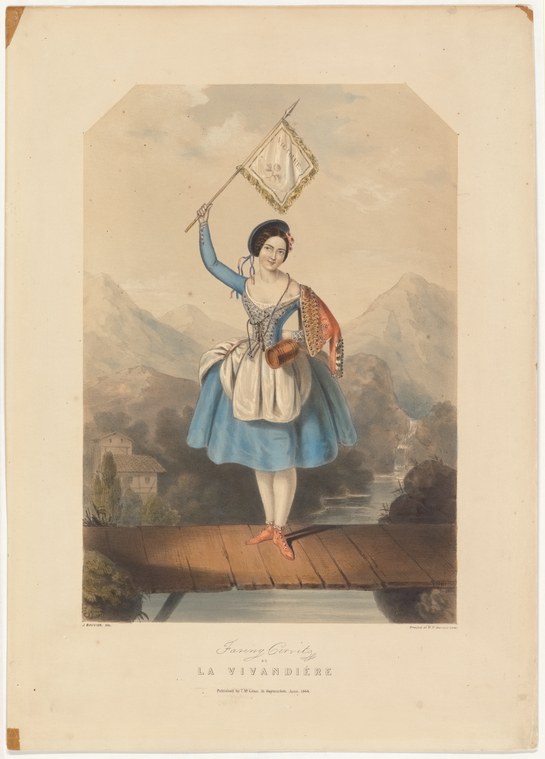
Fanny Cerrito [facsimile signature] as La vivandière
Unknown artist
- Collection:
- Prints depicting dance
- Source:
- New York Public Library
- Rights:
- Public domain — free to use, share and adapt.
- Recorded as:
- Public Domain
Cerrito was one of the few 19th-century female dancers whose artistry and celebrity were widely documented in visual form; this print is evidence of her fame and the commercial machinery that amplified it. The image also captures a rare moment of theatrical dance in action rather than in formal studio pose, showing how a character's personality and physical power were central to Romantic ballet performance.
What you are looking at
A young woman in mid-19th-century dress stands on a wooden bridge or platform over water, her body turned in a dynamic pose as she raises a diamond-shaped kite or flag toward the sky. She wears a blue dress with white apron and a rust-red shawl or jacket draped across her shoulders; her dark hair is styled in the period fashion. The landscape behind her is rendered in soft, atmospheric tones—distant mountains and trees suggest a rural or pastoral setting. The composition captures a moment of physical exertion and joy: her weight shifts through one leg, her raised arm extends fully, and her face shows concentration or delight. The print's soft coloring and romantic treatment of light suggest this is a hand-colored engraving or lithograph, a popular format for theatrical portraiture in the 1830s–1850s.
The dancing
The dancer's body is captured mid-movement in a pose that requires balance and extension. Her weight appears grounded in her lower body while her upper body and arm reach upward in a sweeping arc—a gesture that requires control and flexibility. The pose is frontal but animated, with a clear sense of spiraling energy through the torso. Her extended arm position and the tilt of her head suggest she is performing a spectacular moment rather than executing a technical step, the kind of tableau vivant or pantomimic gesture that was central to Romantic ballet and dance theatre of the period.
The dance depicted
This is almost certainly a portrait of the Irish-Italian dancer Fanny Cerrito (1817–1909), one of the great stars of the Romantic ballet era. The title identifies her as La vivandière—a reference to the 1844 ballet *La vivandière* (or *The Vivandière*), in which Cerrito danced the lead role of Kathy, a laundress and vivandière (sutler's daughter) who follows an army. The pose captures a moment from the dramatic or divertissement portions of the ballet, likely when the character is in her element—active, flirtatious, and physically unfettered. The kite or flag-like object she holds may be a theatrical property (a banner or sash) characteristic of the character's costume, or it may reference a pantomimic gesture from the ballet's choreography. Cerrito was celebrated for her elevation, speed, and dramatic presence; this image conveys those qualities through the sense of upward momentum and the confident, outward-facing stance.
How it was made
This is a hand-colored engraving or lithograph of the kind mass-produced in Europe during the 1840s–1850s for theatrical promotion and public consumption. The soft palette, the treatment of light and atmosphere, and the careful detail work suggest a skilled colorist working from a printed foundation. Such prints were inexpensive and widely distributed, allowing theatregoers to own a souvenir of a star performer or a celebrated role. The medium implies this was intended for a broad audience of theatre enthusiasts and dance admirers—not a rare or specialist work, but a democratic artifact of theatrical celebrity.
About this work
This is a mid-19th-century portrait print of Fanny Cerrito, one of Europe's greatest Romantic-era dancers, shown in the role of a vivandière—a character from the 1844 ballet of that name. The image captures not a formal portrait but a theatrical moment: Cerrito is shown in a dynamic, physical pose, her body extended and energized, holding aloft what appears to be a theatrical banner or property. The setting—a rural bridge, pastoral landscape, water below—evokes both the character's narrative and the Romantic taste for picturesque, emotionally suggestive backgrounds. The print is a record of what audiences saw on stage and how that performance was remembered and sold to the public.
How to look at it
Attend to the dancer's relationship to her own body and to space: she is not posed statically but is caught in a moment of effort and momentum. Notice the extension of her raised arm and the way her weight and torso suggest an upward surge. The kite or banner she holds is not incidental—it is part of her gesture and of the narrative of her character. The landscape behind her, rendered in soft atmospheric perspective, creates a romantic frame that elevates the figure without overwhelming it. This compositional strategy—a single, energized figure set against a picturesque but secondary landscape—was standard for theatrical portraiture of the period and served to emphasize the dancer's individual power.
The artist
The artist is not recorded in the catalogue. However, the style and execution are consistent with the commercial theatrical print workshops of Paris and London in the 1840s–1850s, where skilled engravers and colorists produced portrait prints for distribution to theatres, print sellers, and the public. Such prints were often unsigned or credited only to the printmaker or publisher rather than the designer; multiple hands would typically be involved in their creation.
The period
This print dates to the height of the Romantic ballet era (c. 1830–1860), when female dancers were celebrated as ethereal, transcendent figures and when ballet itself was understood as an art form capable of pathos, drama, and psychological depth. *La vivandière* was choreographed by Jean-Auguste-Aimé Saint-Léon and premiered in 1844; it was popular across Europe and was danced by many of the era's leading ballerinas. Fanny Cerrito, who was renowned for her technical brilliance and dramatic presence, brought her own interpretation to the role. The print's romantic landscape setting and the emphasis on the dancer's individual charisma reflect the star system that had made ballet a form of theatrical celebrity and commerce.
Where it lives
This print is held in the New York Public Library's collection of prints depicting dance, a resource built to document the visual culture of dance across media and periods. It is a commercial theatrical print from the mid-19th century, the kind of object that was made and sold in quantities and thus survives in libraries and collections across Europe and North America.
Dance in this work
Questions about this work
Who was Fanny Cerrito?
Fanny Cerrito (1817–1909) was an Italian-born ballerina who became one of the most celebrated dancers of the Romantic era. She was known for her extraordinary technical ability—including remarkable elevation and speed—as well as her dramatic presence and acting skill. She danced across Europe and had particularly strong associations with London and Paris. She was also a choreographer and created several ballets for herself.
What is a vivandière?
A vivandière is a woman, historically, who followed an army to sell provisions and do laundry for the soldiers. The term became a stock character type in 19th-century ballet and theatre—often portrayed as spirited, flirtatious, and physically free in a way that contrasted with the ethereal, restrained heroines of other ballets. *La vivandière* used this character to showcase a dancer's technical skill and comedic presence.
How do we know this is Fanny Cerrito?
The title of the print explicitly names her: 'Fanny Cerrito as La vivandière.' Such theatrical prints were standard merchandise, usually signed or captioned with the performer's name and the role to make them valuable as souvenirs and promotion.
What is she holding?
The object appears to be a diamond-shaped banner or flag, likely a theatrical property associated with the vivandière character or a specific moment in the ballet's choreography. It may also reference the camp or military setting of the narrative.
More dance artwork





