49 works in this view — arrow keys or swipe to move between them.
Dance in Art
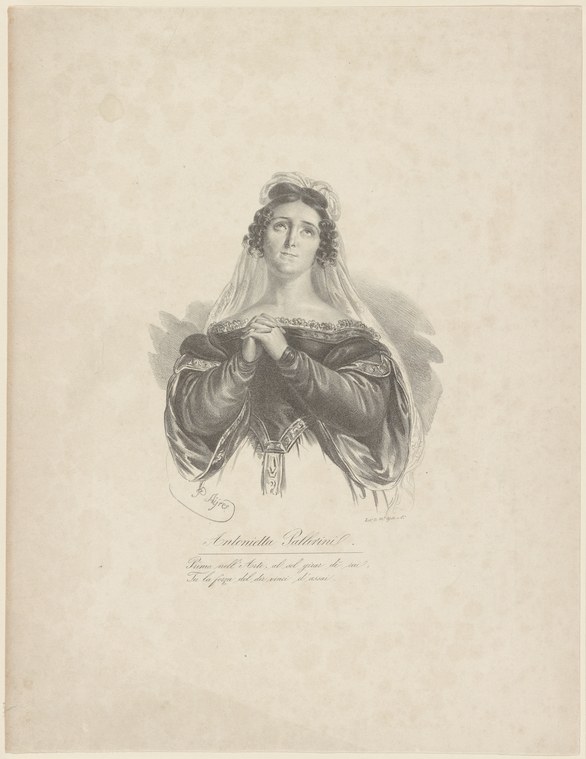
Antonietta Pallerini, prima nell'arte, al sol girar de'rai, tu la forza del dir vinci d'assai
Unknown artist
- Collection:
- Prints depicting dance
- Source:
- New York Public Library
- Rights:
- Public domain — free to use, share and adapt.
- Recorded as:
- Public Domain
This work is an invaluable document of Romantic ballet aesthetics and the cult of the prima ballerina in the early 19th century. It demonstrates how commercial portraiture preserved and commemorated celebrated dancers, shaping their public identity and legacy. For dancers and historians, it offers concrete visual evidence of costume, posture, and the emotional register associated with the period's most celebrated performance style.
What you are looking at
A half-length portrait of a young woman wearing an elaborate off-shoulder dress with draped sleeves of dark, lustrous fabric, likely silk. She wears a delicate veil or headdress secured with a decorative comb or pin at the crown, and her gaze is directed upward and to the side, suggesting a theatrical or narrative moment. The dress is richly ornamented at the neckline and upper bodice with embroidered or jeweled trim. The background is plain and neutral, rendered with soft shading that sets off the figure. The overall presentation is formal and elegant, typical of early 19th-century theatrical portraiture. The inscription below identifies the subject and includes a brief poetic quotation in Italian.
The dancing
The figure is shown from approximately the waist up, her body turned slightly toward the viewer while her head tilts upward with a contemplative or yearning expression. The arms are positioned with the hands drawn inward, one hand gathering or adjusting the heavy draped fabric of the off-shoulder sleeves—a gesture suggesting either preparation for movement or a moment of emotional intensity. The posture is upright and dignified, with no visible footwork or lower-body position. This is a portrait in repose rather than an active dance pose, though the theatrical costume and raised gaze suggest a performer in character.
The dance depicted
The inscription identifies this as Antonietta Pallerini, a prima ballerina of the early 19th century, known for her roles in Romantic-era ballet. The poetic quotation ("Forma and fate...al sol girar de'rai, tu la forza del dir vinci d'assai") suggests this is a character portrait, likely from a specific dramatic ballet rather than a generic image of the dancer. The elaborate off-shoulder costume and upward gaze are consistent with the aesthetics of Romantic ballet, in which female principals often wore soft, diaphanous skirts and adopted an ethereal, emotionally expressive demeanor. However, this portrait captures the dancer in a moment of dramatic pause or character embodiment rather than in the act of dancing.
How it was made
This is a finely executed engraving or lithograph, rendered in black ink on a cream or off-white paper. The delicate line work and careful modeling of light and shadow—particularly in the rendering of the face, the texture of the fabric, and the subtle gradations of tone in the background—are consistent with early 19th-century portrait engraving techniques. The precision and refinement of the execution suggest a work intended for circulation among the educated classes and the theater-going public. The formal, reverential treatment of the subject and the inclusion of an inscription indicate this was likely a commercial print produced to memorialize a celebrated performer.
About this work
This is a formal theatrical portrait of Antonietta Pallerini, a prima ballerina of the Romantic era, created as a commemorative print. The work documents both the visual culture of early 19th-century ballet and the social status of celebrated female dancers, who were often the subjects of such elegant engravings. The image shows the dancer not in motion but in character—wearing an elaborate costume and adopting a contemplative pose that reflects the emotional expressivity and narrative depth valued in Romantic ballet. As a print, it represents the mechanism by which theatrical performance was circulated and preserved in visual form, allowing audiences who had not seen Pallerini perform to encounter her image and understand her as a figure of cultural significance.
How to look at it
Attend to the relationship between the dancer's gaze and her hands: her eyes are raised in contemplation or yearning, while her hands—though still—are actively engaged with the fabric, suggesting an arrested moment within a dramatic arc. The artist has chosen to present Pallerini not in the virtuosic display of a leap or turn, but in a quieter moment of emotional presence, which speaks to the Romantic era's privileging of expressivity and interiority over technical display. The elaborate costume—with its off-shoulder cut, jeweled trim, and rich draping—was typical of the period and signals both the expense of theatrical production and the visual spectacle that audiences craved.
The artist
The artist is not recorded in the catalogue, but the refined execution and formal composition are consistent with the professional theatrical print workshops active in major European cities—particularly London, Paris, and Milan—during the 1820s and 1830s. Such portraits were typically commissioned by theaters or produced by publishers as commercial enterprises, capitalizing on public fascination with celebrated performers.
The period
Antonietta Pallerini was active during the height of the Romantic ballet era, a period (roughly 1830–1850) when female dancers achieved unprecedented social prominence and artistic authority. This was the age of Marie Taglioni, Fanny Cerrito, and other celebrated ballerinas who commanded high fees, international tours, and intense public devotion. The theatrical portrait print was a key medium for circulating images of these performers; such engravings were sold as souvenirs, collected by enthusiasts, and displayed in public spaces. Pallerini's upturned gaze and ethereal costume reflect the Romantic aesthetic that privileged emotional intensity, ethereal beauty, and an almost supernatural lightness—qualities achieved through the use of the pointe shoe, which became standard practice during this period.
Where it lives
This work is held in the New York Public Library's collection of prints depicting dance. It is one of many such theatrical portraits produced and circulated during the 19th century as commercial prints for public audiences.
Dance in this work
Questions about this work
Who was Antonietta Pallerini?
Antonietta Pallerini was an Italian prima ballerina active during the Romantic ballet era of the early 19th century. She performed in major European opera houses and was celebrated for her technical skill and dramatic presence. Like other celebrated ballerinas of the period, she was the subject of numerous theatrical portraits and prints, which helped cement her fame among the theater-going public.
What is the Italian inscription?
The inscription names the subject (Antonietta Pallerini, prima nell'arte—'first in art') and includes a poetic quotation in Italian that likely refers to a specific character or dramatic moment from a ballet she performed. The exact ballet is not identified here, but the quotation suggests this is a portrait of her in a specific theatrical role.
Is this an engraving or lithograph?
Based on the fine line work, precise modeling of tone, and delicate rendering of texture, this appears to be an engraving, though without examination of the physical object, a definitive classification cannot be made. Both techniques were used for theatrical portraiture during this period.
What do the off-shoulder dress and veil tell us about Romantic ballet?
The off-shoulder cut and delicate drapery were hallmarks of Romantic-era female ballet costume, designed to emphasize ethereality, beauty, and emotional expressivity. The veil or headdress often indicated a character role—such as a sylph, naiad, or other supernatural or exotic figure. These costumes, combined with the pointe shoe technique, created the visual impression of weightlessness and otherworldliness that audiences of the period adored.
More dance artwork





