49 works in this view — arrow keys or swipe to move between them.
Dance in Art
Taglioni and Camargo
Unknown artist
- Collection:
- Prints depicting dance
- Source:
- New York Public Library
- Rights:
- Public domain — free to use, share and adapt.
- Recorded as:
- Public Domain
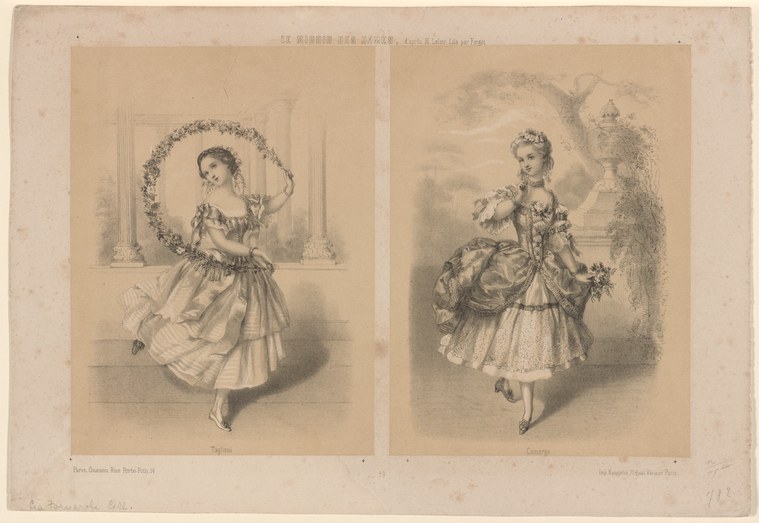
This print captures the visual grammar of Romantic ballet at its height and preserves the iconic imagery through which two of the era's most celebrated dancers were known to their public. For dancers and historians, it shows how Romantic ballet was constructed and consumed as a visual spectacle, and it documents the shift from 18th-century court dance (Camargo) to the ethereal, otherworldly aesthetic of the 19th-century stage (Taglioni).
What you are looking at
Two female dancers occupy separate vignettes in this engraved print. On the left, a figure in a voluminous white gown with a fitted bodice stands beneath an ornamental wreath suspended from a classical arch; she gazes downward, holding her skirt aloft with one hand in a demure gesture. The right panel shows a second dancer in similar dress but more elaborate styling, with ribboned hair ornaments and a fuller skirt caught mid-movement, her arm raised expressively as she stands before a draped curtain. Both figures wear the high-waisted empire silhouette, ballet pointe shoes, and the idealized pale complexion characteristic of 19th-century Romantic ballet imagery. The compositions are formal and symmetrical, with careful attention to the fall and volume of silk and gauze drapery.
The dancing
Both dancers stand in classical ballet positions with upright posture and turned-out legs, feet en pointe. The left figure holds a more passive, introspective pose with arms softly framing her body; the right dancer adopts a more dynamic attitude with one arm raised and the other gesturing toward her skirt, suggesting mid-rotation or a specific pantomimic moment. Neither dancer engages with a partner; each is isolated in her own framed space, emphasizing the individual performer. The weight appears to be held high and centered, with elongated lines from hip to foot.
The dance depicted
These are depictions of celebrated Romantic ballet dancers, identified in the title as Taglioni and Camargo. Both were legendary figures of 19th-century European ballet, though they lived in different eras—Camargo in the 18th century and Taglioni in the early-to-mid 19th. The print conflates or commemorates two epochal dancers across different periods of ballet history. The compositions suggest moments from their most famous roles: the ethereal, weightless quality and the emphasis on the vertical line of the body reflect the ideals of Romantic ballet technique and aesthetic. The precise gestures and stillness suggest this may document specific choreography or signature poses rather than capturing a moment of vigorous movement.
How it was made
This is an engraving or lithograph printed on cream paper, identifiable by the refined linear work, subtle tonal gradations, and the uniform pale ground. The technique allowed for fine detail in the rendering of drapery and facial features while maintaining the clarity necessary for mass production and circulation. The delicate half-tones and careful cross-hatching in the background and shadows are consistent with 19th-century reproductive engraving. Such prints were distributed widely to the theatre-going public, serving as souvenirs of celebrated performances and dancers.
About this work
This is a paired engraved portrait of two Romantic-era ballet dancers, Taglioni and Camargo, presented as isolated figures rather than as a scene or narrative. The print documents the visual ideals of 19th-century theatrical ballet: the ethereal silhouette, the pointe-work position, the pale silk drapery, and the introspective or graceful bearing that defined the era's most famous performers. The work belongs in a dance history collection as both a document of celebrity performance culture and a visual record of how Romantic ballet dancers were imagined and marketed to audiences. It demonstrates the centrality of the individual female dancer to 19th-century theatrical dance.
How to look at it
Notice how both figures are presented in stillness rather than caught mid-leap: the artist chose poses of poised elegance rather than dynamic action. Observe the careful rendering of the fabrics—the way light falls on the silk skirts and how the gauze catches shadow—which conveys the material luxury and visual drama of these costumes on stage. The formal framing of each dancer within her own architectural or draped space emphasizes the solitude and idealization of the Romantic ballet aesthetic: the dancer is presented as a vision rather than a working performer.
The period
This print dates to the Romantic era of European ballet, when the female dancer became the central figure on stage and when techniques of pointe work, the use of gauze and silk, and an aesthetic of weightlessness and otherworldliness dominated choreography and performance. The naming of Camargo and Taglioni together is historically interesting: Marie-Anne de Cupis de Camargo (1710–1770) was a celebrated dancer of the early 18th century known for technical brilliance and bravura; Marie Taglioni (1804–1884) became the prototype of Romantic ballet in the 1830s–40s. The print's conflation of these two figures across epochs suggests a retrospective or commemorative purpose, creating a pantheon of balletic greatness.
Where it lives
The print is held in the New York Public Library's collection of prints depicting dance. It is a reproductive engraving or lithograph of the type circulated to ballet audiences as commemorative prints during the 19th century.
Dance in this work
Questions about this work
Who were Taglioni and Camargo?
Marie-Anne de Cupis de Camargo (1710–1770) was a celebrated 18th-century dancer known for technical prowess and for reducing the weight of the dancer's costume to enable faster, sharper movements. Marie Taglioni (1804–1884) became the definitive Romantic ballerina of the 1830s–40s, famous for ethereal roles and is often credited as the first to dance en pointe. They lived in different centuries but were both revered as foundational figures in ballet history.
Why are these two dancers shown together?
The print appears to be a retrospective or commemorative work that pairs two historical legends of ballet, perhaps for a theatre souvenir or historical publication. It creates a visual genealogy of the art form by juxtaposing dancers from different eras and styles.
What does 'en pointe' tell us about this work?
Both figures are shown standing on the points of their toes, a technique that defines classical ballet and was particularly central to Romantic ballet aesthetics. The emphasis on pointe work signals that this is not 18th-century court dance but theatrical ballet of the 19th century, when pointe technique became a defining feature of the female dancer's body.
How were such prints used?
Engraved and lithographed prints of celebrated dancers were sold as souvenirs after performances, much like playbills or modern concert merchandise. They served both as commemorative objects for fans and as promotional material for theatres and dancers, circulating the image and fame of performers beyond the theatre itself.
More dance artwork





