49 works in this view — arrow keys or swipe to move between them.
Dance in Art
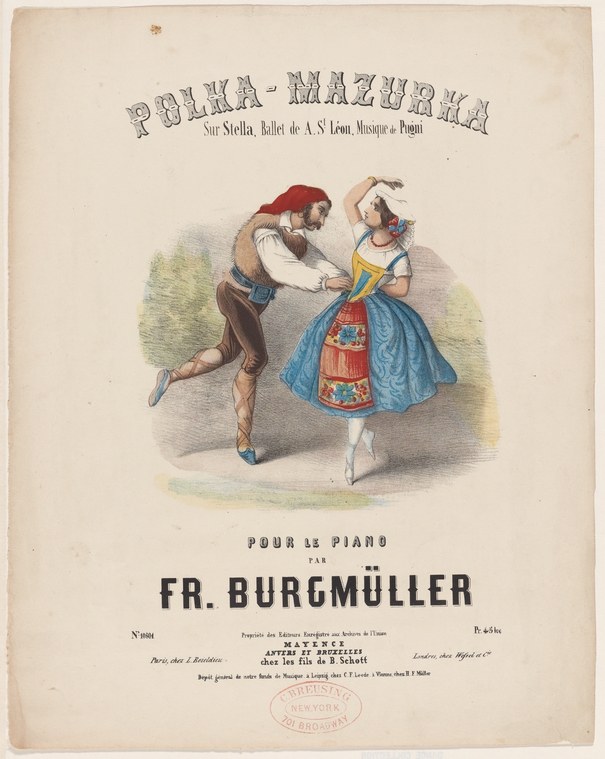
Polka-mazurka sur Stella, ballet de S. St. Léon, musique de Pugni. Pour le piano par Fr. Burgmüller
Unknown artist
- Collection:
- Prints depicting dance
- Source:
- New York Public Library
- Rights:
- Public domain — free to use, share and adapt.
- Recorded as:
- Public Domain
Saint-Léon was a pivotal figure in transitioning ballet from pure classical vocabulary to a hybrid language that incorporated character dance, national forms, and mime—a shift that shaped ballet's development into the twentieth century. This image shows that vocabulary at work: the polka-mazurka as a theatrical form, danced by trained ballet dancers but in a mode closer to social dancing than to academic technique. For historians of ballet technique and pedagogy, it is evidence of how social dances were absorbed into theatrical vocabulary and how male and female roles were gendered through movement and positioning.
What you are looking at
This is a lithographic cover for a piano arrangement of a polka-mazurka from the 1860s ballet *Stella*. A male dancer in red cap, tan breeches, and boots lunges forward with right leg extended and left arm raised overhead in a heroic attitude. He reaches toward a female dancer in a white muslin dress with blue overlay, red ornamental panels at the waist, and a headdress with feathering. She stands en relevé with her right arm raised to her head, her body turned away from him in a pose suggesting flirtation or resistance. The background is a soft wash of green and gray, suggesting an outdoor or studio setting with no specific architectural framing. The composition captures a moment of dramatic pursuit—the spatial relationship and gesture reads as courtship or seduction, a common theme in mid-nineteenth-century ballet pantomime.
The dancing
The male dancer's extended leg and reaching upper body show a lunging motion common to character or demi-caractère ballet vocabulary rather than classical technique. His weight is forward, his posture emphatic and theatrical. The female dancer, by contrast, is drawn up and away, standing nearly en relevé with an inward turn and a raised arm that mirrors his gesture yet refuses his advance. Neither dancer displays the turned-out classical line of academic ballet; instead, both occupy a more naturalistic, if still posed, physical vocabulary. The artist has captured a narrative moment—desire and evasion—through body angle and spatial tension rather than through classical alignment.
The dance depicted
The title identifies this as music for a polka-mazurka from Saint-Léon's 1860 ballet *Stella*, with music by Cesare Pugni. Saint-Léon was a major choreographer of the Second Empire whose ballets often combined classical technique with character dances and social forms—the polka and mazurka both appear as divertissement and narrative material in his works. The image illustrates the hybrid nature of this dance: the lunge and arm port evoke the folk vitality of character dance, while the female dancer's raised arm and épaulement suggest ballet training. The polka-mazurka was a Romantic-era social dance adapted for the stage; this scene shows its use in ballet narrative, likely a flirtation or courtship scene between a male character and a sylph or peasant heroine.
How it was made
This is a hand-colored lithograph, printed in France. The style is typical of mid-nineteenth-century theatrical sheet music covers—a cheap, reproducible medium designed for domestic circulation. The figures are rendered with soft outlines and applied color washes rather than the precision of engraving; this technique was ideal for capturing movement and costume without excessive detail. The publisher information at foot (Richault, Paris; Brandus, Brussels) indicates commercial distribution across Europe. Such covers served as advertisement, souvenir, and instruction—a pianist or piano student purchasing this arrangement would have been exposed to an idealized image of the ballet performance, likely having seen or hoped to see the work in a theater.
About this work
This lithographic cover documents a moment from *Stella*, a ballet that occupied a significant place in Saint-Léon's prolific career and in the repertoire of European theaters in the 1860s. It captures the visual grammar of mid-nineteenth-century theatrical dance: a moment of dramatic interaction between male and female dancers, expressed through gesture, costume, and spatial relationship rather than through pure classical line. The work is at once a record of choreography (or a choreographer's conception of narrative), a commercial artifact (sheet music sold to domestic consumers), and a window into how ballet was imagined and marketed to the dancing public.
How to look at it
Note the body angles: the male dancer leans forward with his center of gravity displaced, the female dancer pulls back and turns away. This is not a symmetrical, partner-based ballet hold but a moment of dramatic tension—approach and evasion. Look at the feet: both dancers are en relevé or rising, but the male dancer's weight is forward, active; the female dancer is more static, defensive. The lithographer has chosen not to show their feet clearly, but the calf and ankle positions suggest that this is a stylized social-dance movement, not a classical vocabulary. The raised arms—his reaching, hers deflecting—tell the narrative; in Romantic ballet and its descendants, the upper body and face communicate intention while the lower body and line communicate the technical accomplishment of the dancer.
The artist
The artist is not credited on this cover. The lithograph was produced commercially by the Paris music publishers Richault and Brandus. Such covers were typically designed by house artists or theatrical illustrators whose names were seldom recorded; they were understood as commercial ephemera rather than fine art. The style is consistent with French theatrical lithography of the 1860s, competent and clear in capturing costume and pose for the benefit of the consumer, not expressive or innovative.
The period
The 1860s were the height of the Second Empire in France and the apex of the Romantic ballet's evolution into a new mode. Classical ballet (Petipa and others) was rising in Russia; European theaters were experimenting with character dances, national forms, and dramatic narrative. Saint-Léon's ballets—*La Vivandière* (1848), *Le Corsaire* (1856), *Stella* (1860)—sit squarely in this tradition: they feature classical corps de ballet, soloists in classical technique, and substantial character or demi-caractère roles often danced by the same performers. The polka and mazurka were fashionable social dances, and their appearance on the ballet stage made sense both as spectacle (audiences recognized them) and as a way to draw on contemporary social life. Piano arrangements of ballet music were standard domestic entertainment; owning a copy of a ballet's polka-mazurka allowed amateurs to engage with works they might see only occasionally in theaters.
Where it lives
This work is held in the New York Public Library's Prints collection, part of a broader set of nineteenth-century theatrical and dance-related lithographs and engravings. It is catalogued as a sheet music cover, reflecting its original function as a commercial object distributed by European music publishers.
Dance in this work
Questions about this work
Who was Saint-Léon and why does he matter?
Michel Saint-Léon (1821–1887) was a major choreographer of the mid-nineteenth century who created ballets for Paris, London, and Russia. He was instrumental in developing a new vocabulary that blended classical ballet technique with character dance and contemporary social forms. His ballets were enormously popular and widely circulated through sheet music, lithographs, and touring productions; they shaped how European audiences understood ballet's role in theatrical life.
What is a polka-mazurka?
The polka-mazurka is a hybrid social dance that combines elements of the polka (a fast, hopping Central European dance) and the mazurka (a Polish national dance with a distinctive rhythmic structure). In the nineteenth century, such hybrid forms were popular in ballrooms and were quickly adapted for theatrical use. In ballet, they often appeared as divertissements—entertainment numbers that broke the narrative flow—or as character dances.
How was ballet music distributed to the public?
Ballet music was a major commercial product in the nineteenth century. Publishers issued vocal scores, piano reductions, and arrangements of individual dances and variations. A ballroom polka-mazurka from a popular ballet could be purchased separately, allowing amateur pianists to play and dancers to practice at home. The covers of these publications, like this one, featured theatrical imagery that served as advertisement and souvenir.
What does this image tell us about how men and women danced together?
The pose shows a conventional Romantic-era narrative: the male dancer as active pursuer, the female as object of attention who deflects or evasively turns away. This gendered positioning was central to Romantic ballet and remained influential for decades. Even in a lively social dance like the polka-mazurka, the male role emphasizes forward momentum and reaching gesture, while the female role emphasizes verticality, turning away, and a more contained or defensive carriage.
More dance artwork





