49 works in this view — arrow keys or swipe to move between them.
Dance in Art
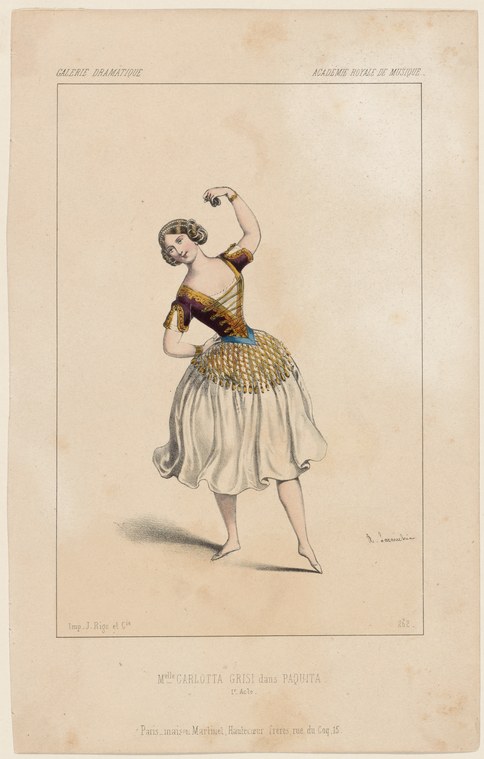
Académie Royale de Musique. Melle Carlotta Grisi dans Paquita. 1r acte
Unknown artist
- Collection:
- Prints depicting dance
- Source:
- New York Public Library
- Rights:
- Public domain — free to use, share and adapt.
- Recorded as:
- Public Domain
Carlotta Grisi was one of the greatest technicians and artists of the Romantic ballet, and this print is an official record of her in one of her signature roles. For historians and dancers, the image documents the appearance, costume, and physical ideal of Romantic ballet at the moment of its fullest development, allowing us to see how bodies were trained, dressed, and presented to the public in the 1840s. The print also demonstrates the role of theatrical portraiture in creating and sustaining the public presence of performers—an ancestor of the celebrity culture we know today.
What you are looking at
A single female dancer is shown in a moment of theatrical repose, her body gently curved in a pose of contemplation or transition. She wears a fitted bodice of gold or bronze silk with elaborate beading or embroidery across the torso, paired with a voluminous white skirt that falls to mid-calf in soft folds. Her dark hair is styled in the fashion of the 1840s, gathered up with ringlets framing her face. She stands nearly en profil, one arm raised gracefully toward her head in a gesture suggesting either adjustment of her coiffure or a moment of reverie. The other arm hangs naturally. Her legs are bare below the knee, and she wears flat ballet slippers. The background is plain cream or off-white, with only a subtle shadow beneath her feet to anchor her in space. The composition is intimate and posed—this is a portraiture of a dancer rather than a snapshot of performance, a convention of theatrical prints of this period.
The dancing
The dancer's weight appears evenly distributed, or slightly favoring one leg, suggesting a moment of stillness rather than active movement. Her body forms a gentle S-curve, with the raised arm creating lift through the torso. The pose suggests flexibility and ease in the upper body, with shoulders relaxed and open. There is a quality of elongation in her neck and carriage typical of the ballet vocabulary of the era. Her feet, though not in an extreme turnout position, suggest training in the ballet manner. The overall impression is of a dancer captured between moments—neither in full extension nor in sharp contraction, but in a state of theatrical presence.
The dance depicted
This is a portrait of Carlotta Grisi in the role of Paquita, Act I. Grisi was one of the most celebrated ballerinas of the Romantic era, and Paquita, choreographed by Joseph Mazilier to a libretto by Théophile Gautier, premiered at the Académie Royale de Musique (the Paris Opéra) in 1846. The pose shown here—graceful, introspective, with the characteristic Romantic-era costume of fitted bodice and full skirt—is consistent with the aesthetic and movement vocabulary of mid-19th-century ballet. The costume and pose do not suggest the Spanish character dance elements that appear elsewhere in Paquita; instead, this seems to represent a moment of the ballet's narrative. The image documents both the dancer's physical presence and the theatrical conventions through which ballet was marketed and consumed.
How it was made
This is a hand-colored engraving or lithograph, a print type that dominated theatrical portraiture in the 1840s. The base image shows fine linear work typical of engraving, with controlled hatching for shadow and form. The color—the gold bodice, the delicate tones of the face and arms, the white of the skirt—has been applied by hand or in a limited hand-colored edition, a process that made each print slightly unique and costly enough to appeal to dedicated followers of the opera and ballet. The technique allowed for rapid multiplication and distribution of images of celebrated performers, creating a market in dancer portraiture that fed public appetite for theatrical celebrity. The hand-coloring also created an almost lifelike quality that photographs of the period could not yet achieve, making these prints valuable documents of how bodies and costumes actually appeared on stage.
About this work
This is a hand-colored engraving depicting the celebrated Romantic-era ballerina Carlotta Grisi in her role as the heroine of Paquita, one of the definitive ballets of 1846. The print captures not the spectacle of performance but the quieter moment of a dancer in character, posed in a way that emphasizes her grace, training, and theatrical presence. Grisi was one of the few ballerinas of the Romantic era whose technique and artistry were considered exceptional even by contemporary standards, and this image—published by the Académie Royale de Musique, the Paris Opéra itself—is part of the official documentation of her fame. The work represents a crucial moment in dance history: the emergence of ballet as a form serious enough to deserve portraiture in the manner of dramatic actors, and the commodification of the ballerina as a figure of artistic and cultural authority.
How to look at it
Observe the pose carefully: the dancer is neither in motion nor in a classical position, but in a moment of theatrical presence. The raised arm and the gentle curve of the body suggest a quality of ease and flexibility that was central to the Romantic ideal of femininity. Notice how the bodice, though ornate and heavily decorated, is fitted tightly to show the line of the body and the dancer's controlled posture. The full skirt, by contrast, is allowed to fall in soft folds, creating the silhouette that was iconic of the era. The artist has chosen to show the dancer in a state of relative calm, allowing the viewer to appreciate her training and beauty rather than the spectacle of a leap or turn. This was a deliberate choice—it presents the dancer as a figure of artistic authority and grace rather than as an acrobat or entertainer.
The artist
The artist is not recorded in the catalogue, which is not unusual for theatrical prints of this period. Many were produced by workshops or publishing houses (in this case, the Paris Opéra) that credited the institution rather than individual printmakers. The signature visible on the print (if legible in the original) may identify an engraver or colorist, but the image was created as a commercial product of the opera house's publicity apparatus rather than as an independent work of art.
The period
Carlotta Grisi's Paquita appeared at the height of the Romantic ballet era, a period in which the ballerina became the central figure of operatic entertainment. The 1840s saw the apotheosis of dancers like Grisi, Marie Taglioni, and Fanny Cerito, whose technical innovations in pointe work and dramatic expression transformed ballet from a court entertainment into a public art form. The costume shown here—the fitted bodice and voluminous skirt—became the standard silhouette of Romantic ballet, designed to emphasize the dancer's upper body flexibility and the visual drama of the skirt in motion. Theatrical prints like this one were mass-produced and widely collected by theater-goers, making the ballerina one of the first forms of theatrical celebrity in the modern sense. This image belongs to the culture of Romantic ballet at its moment of greatest influence and prestige.
Where it lives
This print is held by the New York Public Library in its collection of dance-related prints and iconography. It was likely published by the Académie Royale de Musique (Paris Opéra) as part of the official documentation and promotion of Grisi's performances, making it both a theatrical portrait and an artifact of 19th-century celebrity marketing.
Dance in this work
Questions about this work
Who was Carlotta Grisi?
Carlotta Grisi (1819–1899) was an Italian ballerina who became one of the greatest artists of the Romantic era. She created leading roles in several major ballets, including Giselle (1841) and Paquita (1846), and was celebrated for her technical brilliance, dramatic interpretation, and physical beauty. She was known for her ability to move seamlessly between virtuosic display and intimate, emotionally nuanced performance.
What is Paquita?
Paquita is a three-act ballet choreographed by Joseph Mazilier with a score by Édouard Deldevez, which premiered at the Paris Opéra in 1846. The story concerns a Spanish gypsy (Paquita) who falls in love with a French nobleman. The ballet was created as a vehicle for Carlotta Grisi and showcased both her dramatic abilities and her technical prowess, including several showstopping variations. It remains in the repertory today, though most modern productions perform only a heavily revised version of the third act.
Why are Romantic-era ballet costumes designed this way?
The fitted bodice and full skirt were designed to show the dancer's technique and control while creating a flattering, ethereal silhouette. The bodice emphasizes the turn-out and control of the upper body, while the lightweight skirt (often made of tulle or silk gauze) moves fluidly with jumps and turns, creating a sense of weightlessness and otherworldliness that was central to Romantic ballet's aesthetic. The costume also allowed the dancer's legs and feet—the primary instruments of ballet technique—to be fully visible.
What makes this print valuable as a historical document?
Hand-colored theatrical prints like this one are among the most direct visual records we have of how 19th-century dancers actually looked on stage. The print shows the costuming, the dancer's physical presence and training, and the conventions of Romantic ballet at the moment of its greatest influence. It also documents the role of theater in creating celebrity culture and public taste in the 19th century, making it valuable to historians of both dance and cultural history.
More dance artwork





