49 works in this view — arrow keys or swipe to move between them.
Dance in Art
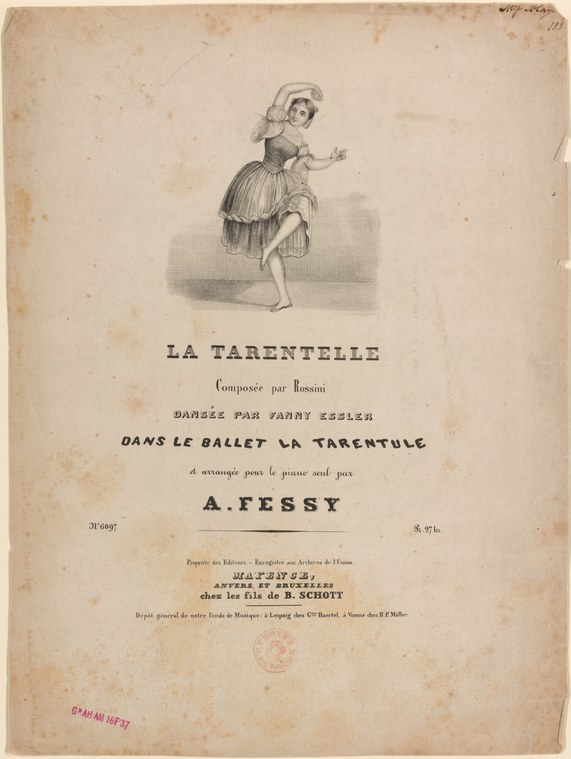
La tarentelle composée par Rossini, dansée par Fanny Essler [sic] dans le ballet La tarentule,: et arrangée pour le piano seul par A. Fessy
Unknown artist
- Collection:
- Prints depicting dance
- Source:
- New York Public Library
- Rights:
- Public domain — free to use, share and adapt.
- Recorded as:
- Public Domain
Fanny Essler was one of the greatest performers of her era, and the tarantelle was one of her signature roles—a piece that showcased her technical prowess and her flair for character and comedy. This image provides a rare visual record of her in action, frozen in a pose that conveys the unbridled energy and playfulness the role demanded, quite unlike the ethereal, melancholic tone of romantic ballet. For historians of dance, it documents how theatrical spectacle was marketed, remembered, and disseminated to a domestic audience through print, and how a single dance moment could be captured and commodified as both music and image.
What you are looking at
This is a printed score cover or frontispiece for a piano arrangement of a theatrical dance piece. A single female dancer is depicted in three-quarter view against a plain background, caught mid-movement in what appears to be a moment of lively, playful action. She wears a short, tiered skirt of gauzy material that rises above the knee, a fitted bodice, and a small bonnet or cap perched on her head—costume elements typical of mid-19th-century theatrical dress. Her body is angled forward with one leg extended or about to leave the ground, her arms raised and gesturing expressively. The pose suggests buoyancy and vivacity. The figure is rendered in a fine engraving or lithographic style with careful attention to the play of light and shadow across the fabric of her skirt and bodice. The composition is elegant and spare: the dancer occupies most of the frame against an empty background, with the printed text arranged below in a hierarchical typography announcing the work's title, composer, performer, and arranger.
The dancing
A single dancer is shown in a dynamic, ascending pose. Her weight appears to be shifting forward and upward, with one leg actively extended or lifting. Both arms are raised away from her body in an expressive, open gesture—the left arm higher and more extended than the right—creating a sense of spontaneous movement rather than a formal or constrained posture. Her upper body twists slightly, following the line of her lifted leg. The pose conveys lightness and momentum rather than the controlled verticality of classical ballet; her center of gravity has moved forward of her supporting foot.
The dance depicted
This is a printed arrangement of 'La Tarentelle' (or 'La Tarantule,' as the cover names it), composed by Rossini and danced by the famous ballerina Fanny Essler in the theatrical ballet 'La Tarantule.' The tarantelle is a rapid, whirling Italian folk dance traditionally associated with tarantism—a condition said to be cured by frenzied dancing. In theatrical ballet of the 1830s–50s, the tarantelle was a popular character dance, often performed as a solo or divertissement, prized for its speed, energy, and vivid storytelling potential. The pose in this image captures the spirit of the dance: weightless, agitated, and uninhibited—quite different from the ethereal restraint of romantic ballet. Essler, known for her technical brilliance and her gift for character roles, was particularly celebrated for her performances of such dances.
How it was made
This is a printed score cover, likely a lithograph or fine engraving, from the mid-19th century. The technique allows for precise rendering of fine detail—the texture of the skirt, the modeling of the face and limbs—while also permitting relatively easy and inexpensive mass production and distribution. The cover was designed to advertise and market the published piano score to domestic and concert musicians. Such covers served dual purposes: they promoted the music and the dancer's fame while providing a visual record of celebrated stage performances for the reading and piano-playing public at home. The presence of the publisher's mark and the careful typographic hierarchy suggest a commercial music publication from a European house, likely Parisian given the French text and Essler's prominence in Paris.
About this work
This is a cover for a mid-19th-century piano score based on Rossini's 'La Tarentelle,' as performed by the renowned ballerina Fanny Essler in the ballet 'La Tarantule.' The image captures a moment of kinetic energy: a single dancer in a state of upward, forward motion, her limbs released and expressive, her costume and pose evocative of the Italian folk dance tradition that inspired the piece. The engraving or lithograph documents not only a celebrated performance but also the machinery by which theatrical dance reached a broader public—through printed scores and illustrated covers that allowed amateurs to engage with the music and, through the image, to recall or imagine the stage spectacle. The work belongs in a gallery of dance imagery because it fuses several registers at once: the documentation of a specific historical performance, the visualization of a dance style and genre, the promotion of a star performer, and the circulation of theatrical culture through print.
How to look at it
Look at the dancer's pose: she is neither balanced nor still, but caught in a moment of ascent and forward motion. Notice how her skirt lifts and billows—the engraver has taken care to show its texture and movement. Her arms are not held in any classical position but are raised and open, gesturing rather than framing. The lift of her chin and the tilt of her torso suggest not a moment of perfected beauty but a moment of effort and exhilaration. This is the aesthetic of the character dance: virtuosity in service of liveliness and personality, not of abstract form. The small bonnet and the shortness of the skirt also signal 'national' or folk character—this is an Italian peasant girl dancing a tarantelle, not a sylph or a heroine from high tragic tradition.
The artist
The engraver or lithographer is not identified on the cover. The publication was arranged by A. Fessy, who is credited as the piano arranger. The actual performer, Fanny Essler (or 'Essler'), was an Austrian-Italian dancer born in 1810, sister of the equally famous Marie Taglioni's rival. She was known for her technical brilliance, her gift for mime and character roles, and her popularity in Paris, London, and beyond. She created and performed the role of the tarantelle in 'La Tarantule,' which became one of her signature vehicles.
The period
This cover dates from the era of Romantic ballet and the rise of the 'character' or 'national' dance as a staple of theatrical performance (1830s–1850s). While the classical, ethereal roles of romantic heroines (like Giselle) were performed on pointe and valued for their otherworldly quality, character dances—Spanish, Italian, Polish, Scandinavian—were performed by brilliant technicians and were celebrated for their speed, vivacity, humor, and connection to living folk traditions. The tarantelle in particular was associated with Italy and with frenzied, passionate energy. Essler rose to prominence in this period and was particularly celebrated for character roles; she was the ballerina who could do everything—elevation, speed, mime, comedy, pathos. The print medium allowed such performances to circulate widely as images and as musical scores, making the dancer and the dance internationally famous and allowing them to be re-enacted in parlors and concert halls across Europe and beyond.
Where it lives
The cover is part of the New York Public Library's collection of printed dance imagery (holding: Prints depicting dance). It is a commercial music publication, not an original artwork or a unique manuscript; multiple copies would have been distributed and sold in the 19th century. The printing history and the publisher's location are not fully recorded in the catalogue.
Dance in this work
Questions about this work
Who was Fanny Essler and why was she famous?
Fanny Essler (1810–1884) was an Austrian-Italian ballerina who rose to international prominence in the 1830s–40s as the great rival and counterpart to Marie Taglioni. While Taglioni was celebrated for ethereal, romantic roles, Essler was known for her technical brilliance, her speed and elevation, and her gift for character and comedy. She was particularly celebrated for roles like the tarantelle in 'La Tarantule,' which allowed her to display her full range of skills.
What is a tarantelle and why was it popular in ballet?
The tarantelle is a rapid, whirling dance from southern Italy, traditionally associated with a condition called tarantism. In 19th-century theatrical ballet, the tarantelle became a favorite 'character dance'—a lively solo that showcased a dancer's technique and personality. It was performed in contrast to the ethereal, otherworldly roles of romantic ballet, and it appealed to audiences because of its energy, humor, and connection to living folk tradition.
Why would a dance scene be published as a music score with a cover image?
The piano score allowed amateur musicians to play the music at home, and the printed cover advertised both the published music and the celebrated stage performance that inspired it. Such covers served as visual records of famous dancers and roles, allowing audiences to remember or imagine the spectacle. They were a form of promotion, nostalgia, and cultural circulation—making theatrical dance available and memorable to a much broader public than the theater alone could reach.
What does the pose tell us about how the dance was performed?
The upward, forward-moving pose captures the essential character of the tarantelle: it is a dance of speed, lightness, and unbridled energy, quite unlike the controlled, vertical posture of classical ballet. The raised, expressive arms and the sense of momentum suggest a dance that valued liveliness and personality over perfect form. This reflects the 19th-century distinction between classical ballet (ethereal, controlled) and character dances (energetic, connected to folk tradition and lived experience).
More dance artwork





