49 works in this view — arrow keys or swipe to move between them.
Dance in Art
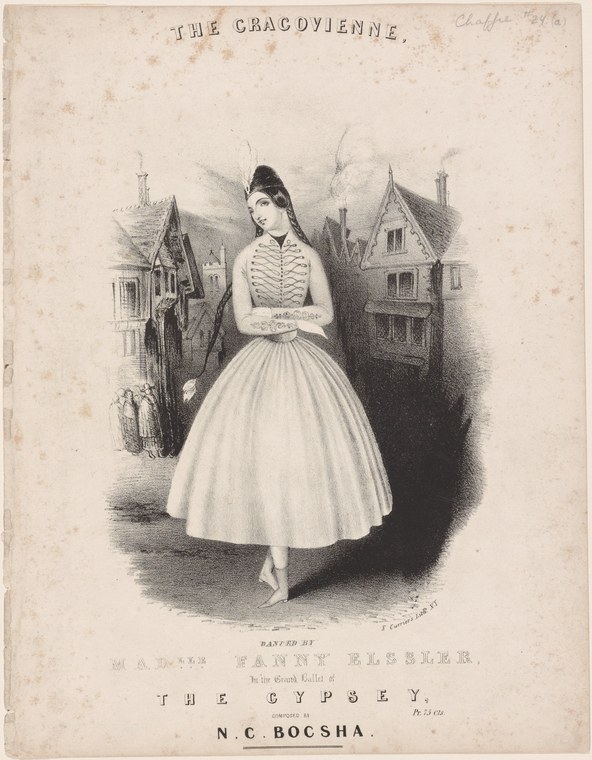
The cracovienne, danced by Madlle Fanny Elssler, in the grand ballet of the Gypsey, composed by N. C. Bocsha
Unknown artist
- Collection:
- Prints depicting dance
- Source:
- New York Public Library
- Rights:
- Public domain — free to use, share and adapt.
- Recorded as:
- Public Domain
This work documents the specific historical moment when European Romantic ballet began to systematically absorb folk and national dance idioms into the classical ballet vocabulary, converting lived traditions into picturesque theatrical spectacle. Fanny Elssler's career and the roles she championed—including the Cracovienne—represented an alternative to the weightless, ethereal aesthetic that dominated mid-nineteenth-century ballet and influenced how national character dances were understood and performed for centuries to come.
What you are looking at
A solitary female dancer stands posed in the foreground against an atmospheric architectural backdrop rendered in soft grays and shadows. The setting suggests a European town or castle courtyard, with steep-roofed buildings and towers rising behind her. The dancer wears a white tulle skirt of moderate length—well below the knee—and a corset-like bodice with tight vertical ribbing across the front, her dark hair arranged in a fashionable upswept style typical of the 1840s. Her posture is upright and composed, with arms held at waist level, one arm crossing her body; her weight appears to rest on her left leg while her right leg is extended in a supporting position rather than an extreme turnout. The engraving employs fine cross-hatching to create volume and depth in the fabric and figure, while the background dissolves into soft shadow, focusing all attention on the dancer's silhouette and costume.
The dancing
The dancer presents a single, static pose rather than a moment captured mid-movement. Her frame is upright with modest turnout—the legs are not hyperextended in the manner of later Romantic ballet. Her arms rest low, one hand touching the torso, suggesting either a moment of arrival or departure rather than the climactic extension that would define a classical arabesque or attitude. Her posture and the angle of her hips suggest weight distributed through the feet with the body held in controlled alignment. There is no visible partner or other dancers, and the pose reads as a portrait of a solo performer rather than a moment within an ensemble or corps sequence.
The dance depicted
The image is titled as the Cracovienne danced by Fanny Elssler in N. C. Bocsha's ballet *The Gypsey*. The Cracovienne—also known as the Krakowiak—is a Polish court dance of moderate tempo with characteristic rhythmic vitality and folk-inflected character. Though the engraving does not freeze a moment of obvious choreographic virtuosity, Elssler's reputation as a dancer of character roles (as opposed to the ethereal, balletic roles favored by her rival Marie Taglioni) suggests this would have been a showpiece for temperament and national character rather than ethereal elevation. The static pose may reflect the conventions of theatrical portraiture—freezing the dancer in costume rather than mid-phrase—or may indicate a moment of relative calm within a more energetic overall choreography. The work demonstrates how European Romantic ballet appropriated and theatricalized folk and national dance idioms.
How it was made
This is a finely executed engraving, likely made from a drawing, with careful use of fine parallel lines and cross-hatching to model form and create atmospheric depth. The crisp detail of the dress and the careful rendering of the figure's proportions suggest a skilled theatrical portraiture practice, possibly executed from a sketch made in the theater or from a posed study. The technique allows for the precise reproduction necessary to circulate the image as a souvenir or record of a celebrated performer and a notable theatrical production. Engravings of this quality and subject matter were typically produced for sale to the public as dance and theater memorabilia, accessible to a middle-class audience interested in following stage fashion and celebrity.
About this work
This engraving documents Fanny Elssler, one of the two most celebrated ballerinas of the Romantic era, in a character role as a Polish dancer in a ballet with music by N. C. Bocsha. The Cracovienne was a national dance that Romantic choreographers frequently incorporated into full-length ballets as a vivid contrast to the ethereal, weightless idiom of the classical vocabulary. Elssler, who built her reputation partly on her ability to dance character and national roles with conviction and verve, would have made this number a vehicle for her particular gifts. The engraving is a theatrical souvenir, capturing not the moment of greatest athleticism or speed but rather a composed, formal portrait of the performer in costume—the type of image that allowed theatergoers to own and recall a performance they had seen.
How to look at it
Observe the deliberate contrast between the full, elaborate white tulle skirt—the hallmark of Romantic ballet dress—and the bodice with its tight vertical ribbing, which recalls folk and historical costume rather than the neoclassical simplicity of early ballet. The modest turnout and upright posture differ markedly from the extreme extensions and épaulement that would dominate late-nineteenth-century academic ballet. The static pose is characteristic of theatrical portraiture of the era: the artist has not attempted to convey violent motion or extreme technical display, but rather to present the dancer as a fashionable, recognizable performer in character dress, frozen for scrutiny and memory.
The period
The Romantic ballet era (roughly 1830–1850) saw the development of the full-length narrative ballet with substantial roles for the prima ballerina. The two preeminent dancers of the time were Marie Taglioni, celebrated for ethereal, poetic roles in works like *La Sylphide*, and Fanny Elssler, celebrated for her technical brilliance and her mastery of character and national dances. Bocsha's *The Gypsey* (or *La Gypsy*) was one of many Romantic-era ballets that wove folk and national dance idioms—Polish, Spanish, Hungarian, Russian—into their narratives as a way to suggest exoticism, local color, and authenticity. The engraving dates to this same period and represents the theatrical print culture that made celebrity dancers into recognizable public figures and allowed performances to circulate as images and souvenirs.
Where it lives
This engraving is held in the New York Public Library's Prints collection, where it is catalogued as a theatrical print documenting a specific performance or production. Such engravings were commonly produced and sold as theatrical memorabilia during the nineteenth century, circulating to a wide public of theatergoers and dance enthusiasts.
Dance in this work
Questions about this work
What is the Cracovienne?
The Cracovienne (or Krakowiak) is a Polish folk dance of moderate tempo with a characteristic rhythmic vitality, often in 2/4 time with a lilting, slightly syncopated character. During the Romantic ballet era, choreographers frequently incorporated it into full-length ballets as a national dance number, giving principal dancers an opportunity to display temperament and character rather than ethereal weightlessness.
Why did Romantic ballet include national dances?
National and character dances allowed Romantic choreographers to suggest exotic or historical settings, local color, and authenticity. They also offered prima ballerinas like Fanny Elssler the chance to showcase different qualities—vivacity, wit, earthiness—than the ethereal, poetic roles that defined dancers like Marie Taglioni. Including folk dances also suggested that ballet could absorb and theatricalize all of human experience.
Who was Fanny Elssler?
Fanny Elssler (1810–1884) was an Austrian dancer and one of the two most celebrated ballerinas of the Romantic era, rivaled only by Marie Taglioni. She was celebrated for her technical brilliance, her ability to dance both classical and character roles, and her mastery of national dances. She performed throughout Europe and the Americas and became an international celebrity, partly through prints and engravings like this one.
More dance artwork





