49 works in this view — arrow keys or swipe to move between them.
Dance in Art
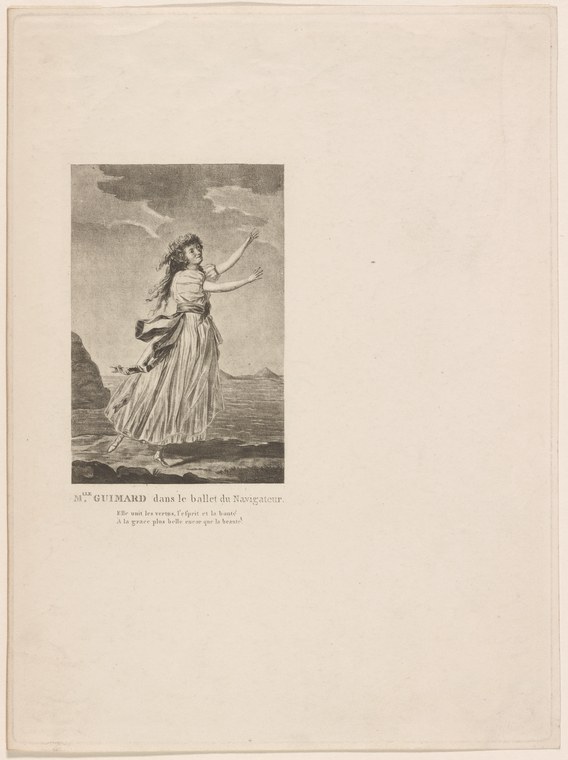
Mlle. Guimard dans le ballet du Navigateur
Unknown artist
- Collection:
- Prints depicting dance
- Source:
- New York Public Library
- Rights:
- Public domain — free to use, share and adapt.
- Recorded as:
- Public Domain
Mlle. Guimard was instrumental in establishing the role of the serious female dancer in narrative ballet, and this image captures her embodying an emotional, dramatic moment rather than displaying technique—a shift that presaged Romantic ballet. As one of the first widely circulated prints of a named female dancer in a specific role, it demonstrates how engraving became the medium through which dance history was recorded and disseminated in the 18th century, before photography.
What you are looking at
A woman in classical dress stands alone on a rocky shore, her body angled toward the sky in a gesture of yearning or invocation. She wears a high-waisted Empire silhouette gown with long sleeves and vertical pleating that falls to her ankles, the fabric catching the light as it folds around her form. Her right arm is raised and extended upward, fingers splayed, while her left arm curves across her body; her head tilts back, face turned upward. Dark storm clouds gather overhead, and the sea stretches behind her, creating a romantic, dramatic seascape. The composition is vertical and narrow, concentrating all focus on the solitary female figure and her emotional gesture against the natural elements. The print technique creates strong contrasts between the pale figure and the dark sky, heightening the sense of isolation and emotional intensity.
The dancing
The dancer stands in profile, weight appearing evenly distributed on both feet, her torso open to the viewer's left. Her right arm extends upward and back from the shoulder, fingers loosely spread in a classical pose; her left arm curves inward toward her body at approximately waist height. The head is thrown back, elongating the neck line and creating a sense of abandonment or supplication. The gesture reads as a single, sustained pose rather than a moment caught mid-step, suggesting the vocabulary of classical theatrical dance where meaning is conveyed through arm and upper-body placement rather than footwork.
The dance depicted
This appears to represent a moment from late 18th-century ballet d'action, likely from a role in an allegorical or mythological narrative ballet. Mlle. Guimard (Marie-Anne de Cupis de Camargo, known as Guimard, 1743–1816) was one of the most celebrated dancers of her era, famous for her technique in demi-caractère and serious roles. The title "Mlle. Guimard dans le ballet du Navigateur" (Mlle. Guimard in the Ballet of the Navigator) indicates a specific performance, possibly a dramatic or sentimental scene where a female character appeals to the heavens or the sea. The pose and setting—coastal, nocturnal, solitary—suggest a moment of pathos or supplication characteristic of pre-Romantic ballet, where dancers began to embody emotional narratives beyond pure technical display.
How it was made
This is an engraving, a print technique that produces fine tonal gradations through parallel and cross-hatched lines. The artist has used careful line work to model the fabric of the gown, create shadow on the figure's face and body, and render the turbulent sky and distant sea. Engraving allowed for wide distribution of images of celebrated performers; this print would have circulated in Paris as a souvenir of Guimard's celebrated performance, making her likeness and role known to audiences who may not have attended the theatre. The technique's precision also served to immortalize a specific moment of dramatic dance in a way that appealed to collectors and theatre-goers of the period.
About this work
This engraving documents a celebrated moment in the career of Mlle. Guimard, one of the 18th century's most influential dancers, captured in a role from a narrative ballet titled *Le Ballet du Navigateur*. It stands at a pivotal moment in dance history, when the form was transitioning from pure virtuosity toward dramatic storytelling, and when visual records of celebrated dancers became a form of publicity and cultural memory. The image preserves not a pose but a character—a figure in distress or supplication, caught in an emotionally charged theatrical moment. This is simultaneously a document of performance practice, a portrait of a celebrated artist, and an example of how engraving technology made dance visible and memorable to a reading public.
How to look at it
Attend to the pose itself: this is not a step or a sequence but a held, suspended moment—the upraised arm and tilted head read as appeals or invocation rather than as part of a movement phrase. The artist has chosen the moment of maximum emotional intensity rather than of technical display. Notice how the vertical format, the isolation of the figure, and the dramatic sky all work together to make this feel like a scene from a play rather than from a divertissement. The engraving technique, with its fine lines and controlled contrast, lends the image an almost sculptural quality, emphasizing the classical ideals of line and form that still governed late-18th-century dance.
The period
This engraving dates to the late 18th century, an era of profound transformation in ballet. The form was evolving from the formalized, geometric court dances of the Baroque toward ballet d'action—narrative ballets that told stories through movement and emotion. Mlle. Guimard danced during the careers of major choreographers including Jean-Georges Noverre, whose *Lettres sur la danse* (1760) called for ballet to abandon pure technique in favor of expressive storytelling. The rise of sentimental drama and proto-Romantic aesthetics in theatre found its parallel in dance, where the female dancer increasingly embodied pathos, desire, and moral complexity. Prints like this one circulated in Paris as affordable, portable records of celebrated performances, part of the emerging culture of celebrity and fan culture around theatre.
Where it lives
This engraving is held in the New York Public Library's collection of prints depicting dance. The inscription and title indicate it is a commemorative theatrical print, a category of popular visual culture that documented celebrated performances and made them available to readers and collectors who could not attend live performances.
Dance in this work
Questions about this work
Who was Mlle. Guimard?
Marie-Anne de Cupis de Camargo, known as Guimard (1743–1816), was one of the most celebrated dancers of the late 18th century. She was known for her technical mastery and her ability to embody dramatic roles, and she was a central figure in the transition of ballet from pure virtuosity toward narrative and emotional expression. She was also a notable patron of the arts and maintained a famous salon in Paris.
What is 'ballet du Navigateur'?
The Ballet of the Navigator is likely a narrative ballet, possibly with allegorical or mythological content, in which Guimard performed. The title suggests a maritime or romantic theme. While documentation of 18th-century ballets is often fragmentary, such works typically told stories through choreographed movement, music, and elaborate scenery, with female dancers increasingly cast in roles of emotional depth and dramatic significance.
Why is this image important?
This engraving is one of the first widely distributed visual records of a named female dancer performing in a specific theatrical role. It documents a moment when ballet was becoming a vehicle for dramatic storytelling rather than pure technical display, and it shows how prints allowed dance to be remembered and celebrated beyond the theatre itself. For historians, it is evidence of both performance practice and the culture of dance celebrity in the 18th century.
How was this image made?
This is an engraving, a printmaking technique in which an image is incised into the surface of a metal plate (usually copper) using a sharp tool. Ink is forced into the grooves and the plate is wiped clean; paper pressed onto the inked plate receives the image. The technique allowed for multiple copies to be printed from a single plate, making images affordable and widely available. Engravings of celebrated dancers were popular souvenirs and helped create the first culture of dance celebrity.
More dance artwork





