49 works in this view — arrow keys or swipe to move between them.
Dance in Art
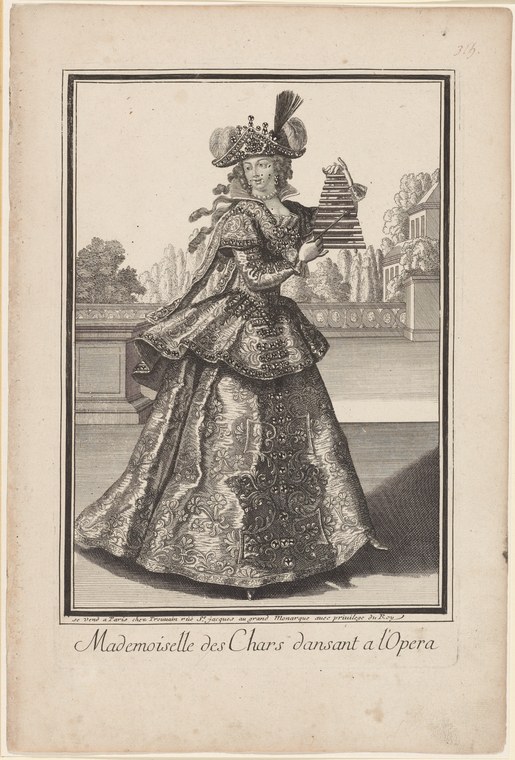
Mademoiselle des Chars dansant a l'Opera
Unknown artist
- Collection:
- Prints depicting dance
- Source:
- New York Public Library
- Rights:
- Public domain — free to use, share and adapt.
- Recorded as:
- Public Domain
This engraving documents the existence and celebrity of a named female performer at the Paris Opéra during a period when few women left any recorded trace in history. It reveals how theatrical performers were marketed and consumed as visual objects—circulated as prints for collectors who wished to own an image of the celebrated dancer in character. For historians, it is evidence of the commercial and visual infrastructure of early operatic theatre.
What you are looking at
A full-length portrait of a fashionably dressed woman stands center stage, facing the viewer with a composed expression. She wears an elaborate early 18th-century costume: a heavily brocaded or embroidered gown with a long train that sweeps behind her, a fitted bodice, and full skirt decorated with ornamental patterns. Over this she wears a flowing cape or robe with deep folds, lined and draped to suggest movement. Her headdress is tall and feathered—a towering coiffure with plumes—and she holds what appears to be a small prop or ornamental object (possibly a fan or pageboy figure) in her hand, visible against her body. The setting is a theatrical interior: behind her, a colonnade and formal gardens or parkland are faintly visible, with geometric hedges and a distant structure suggesting a palace or grand house. The composition is formally frontal and stationary, with emphasis on the grandeur and detail of the costume rather than the capture of active movement.
The dancing
The dancer stands in an upright, formal pose with weight evenly distributed—not in the dynamic contrapposto of active dancing. Her arms are positioned naturally at her sides, with one hand extended to hold or display the small object. Her body is presented frontally and symmetrically, creating a portrait rather than a study of movement in progress. The costume is the dominant visual element: the scale of the train, the drape of the cape, and the ornamental headpiece are all displayed to maximum effect, indicating that this is a figure study of theatrical dress and station rather than a representation of the kinetic moment of dance.
The dance depicted
This is a theatrical costume portrait, most likely a representation of a named performer—*Mademoiselle des Chars*—in character for a theatrical entertainment or opera performance at the Paris Opéra. The inscription identifies her as 'dansant à l'Opera' (dancing at the Opera), placing her within the world of court ballet and theatrical spectacle of the late 17th or early 18th century. However, the image captures not a moment of active dancing but rather a formal presentation of the performer in her stage costume and character. The small figurine or ornamental object in her hand may be a symbolic prop identifying her role or character. Without additional context, the specific style or genre of dance cannot be determined from the pose alone, though the setting and costume suggest this is operatic or court theatrical dance.
How it was made
This is an engraving, likely made in the French tradition of costume and theatrical portraiture. The fine cross-hatching, the precise line work defining fabric textures, and the clear linear border are characteristic of 18th-century French engravings. The technique allowed for wide circulation of images of celebrated performers and fashionable dress; such prints were collected as ephemeral records of theatrical spectacle and could be sold individually. The engraving medium enabled detailed rendering of ornament and drapery—essential for conveying the elaborate costume—while the white background isolates the figure and emphasizes its theatrical presentation. This would have been both a record of a performer and a document of fashion.
About this work
This is a theatrical costume portrait of a named performer at the Paris Opéra, rendered as an engraving and likely produced and distributed as a souvenir of her performance. The image presents not a captured moment of active dance but rather a formal portrait in which the performer displays her stage costume and character to the viewer. It belongs in a gallery of dance imagery as documentary evidence of operatic theatre, the performance of named women on the stage, and the relationship between costume, spectacle, and identity in early 18th-century France. The work is valuable precisely because it records not movement but the theatrical presentation and celebrity of a named female performer during a formative period in the history of European theatrical dance.
How to look at it
Look at the stillness of the pose: this is not a dancer caught mid-leap or mid-turn, but rather a figure presented formally for view, much like a portrait. Notice how the costume dominates the composition—the engraver has devoted meticulous attention to the brocade, the pleats of the cape, the feathered headdress. This is a record of fashion and theatrical dress as much as it is a record of performance. The formal palace setting in the background and the perfect frontality of the figure suggest that this is a document of professional identity and celebrity: here is who this performer was on stage, in full costume and character.
The period
The inscription dates this work to the period of Louis XIV and his immediate successors (late 17th–early 18th century), when the Paris Opéra had just been established (1671) and was the center of French theatrical and choreographic life. During this period, operatic spectacle was a court-sponsored art form, and female performers were becoming visible public figures. Costume prints of named performers became a form of popular merchandise, allowing people to own and display images of celebrated dancers and singers. The ornate style of dress and the architectural setting reflect the formal aesthetics of Baroque court culture, where spectacle, display, and the presentation of the body were central to both performance and social hierarchy.
Where it lives
The work is held in the New York Public Library as part of a collection of prints depicting dance. The collection includes similar costume portraits and theatrical imagery, suggesting that these prints were systematized and preserved as documents of performance history.
Dance in this work
Questions about this work
Is this image of an actual dance, or just a costume portrait?
It is a costume portrait of a performer in her stage character, not a representation of dance in motion. The pose is formal and stationary—designed to show the costume and the performer's identity rather than to capture active movement. These prints served as souvenirs and records of celebrity performers at the Opéra.
Who was Mademoiselle des Chars?
The inscription identifies her as a performer at the Paris Opéra, but her full identity, career dates, and roles are not recorded in the available catalogue information. Theatrical prints like this one are often our only evidence that these performers existed and were celebrated in their time.
Why would someone buy or keep a print like this?
Such prints were popular merchandise in the 17th and 18th centuries—people collected them as records of celebrated performers, as documents of fashionable dress, or as memorabilia of theatrical spectacles they had witnessed. They circulated widely and were affordable, making them accessible to a broad audience.
What does the small object in her hand represent?
It appears to be a symbolic prop or ornament associated with her theatrical role or character, but without additional context about her specific roles or performances, its exact meaning cannot be determined.
More dance artwork





