49 works in this view — arrow keys or swipe to move between them.
Dance in Art
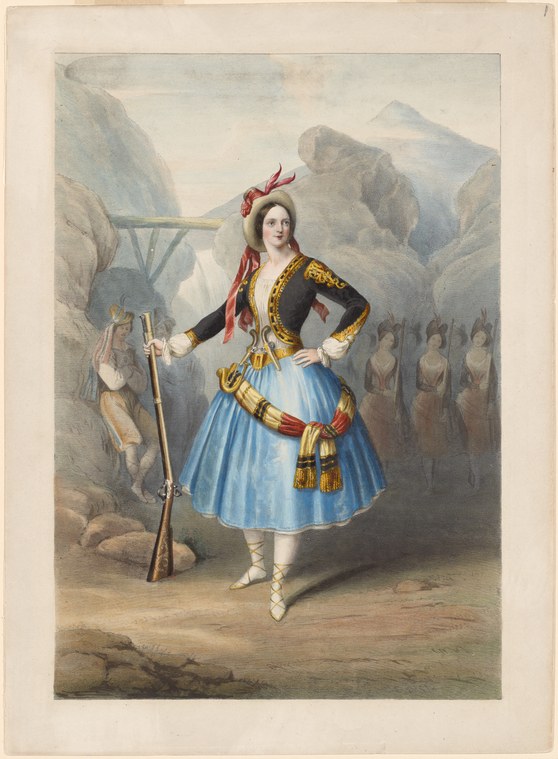
Lucile Grahn in Catarina; ou La fille du bandit
Unknown artist
- Collection:
- Prints depicting dance
- Source:
- New York Public Library
- Rights:
- Public domain — free to use, share and adapt.
- Recorded as:
- Public Domain
Lucile Grahn was one of the defining ballerinas of the Romantic era, and this image is a rare documentary record of her in a specific role, showing exactly how she was marketed and how she presented herself to the public. It demonstrates that Romantic ballet was not abstract or purely technical but narrative and theatrical, built on the dancer's ability to embody character while executing virtuoso movement.
What you are looking at
A young woman in romantic-era theatrical dress stands poised in a mountainous landscape, her weight lifted and balanced on her right leg in a graceful attitude. She wears a dark, heavily embroidered bolero jacket with ornate gold braid over a pale blue tulle skirt that falls to mid-calf, and her costume includes a red ribbon bow in her pale hair and a crimson sash at her waist. Her left leg is drawn up behind her body. In her right hand she holds a long rifle or musket; her left hand rests at her side with characteristic balletic port de bras. Behind her, the rocky canyon narrows into shadow, with what appears to be a fortified structure on a bridge or outcrop. A gathering of figures—soldiers or townspeople—stands indistinctly in the background. The light is diffuse and soft, characteristic of hand-coloured lithography, with warm tones in the foliage and cooler greys in the stone. The composition reads as a theatrical portrait moment rather than an action scene: the dancer is presented to the viewer, costumed for a dramatic role, in a posed attitude that balances the grace of dance with the masculine iconography of the gun.
The dancing
The principal figure demonstrates the technical vocabulary of early romantic ballet: the standing leg is straight and turned out, the elevated leg bent in attitude derrière, the torso held in perfect vertical alignment despite the theatrical asymmetry of the rifle. The port de bras is refined and controlled, with the non-weapon arm in a soft third or fifth position. The head is tilted gracefully, turned toward the viewer in the conventional three-quarter pose of romantic-era lithographs. She stands alone in the foreground; the background figures function as audience or narrative context rather than dancing partners.
The dance depicted
This is Lucile Grahn in a character role from the Romantic ballet *Catarina, ou La fille du bandit*, a vehicle for dancers to play heroine-outlaws or warrior-heroines in exotic mountain settings. The image captures a posed moment from a theatrical performance—not a moment of pure dance movement, but the kind of arrêt or presentational pose that punctuated dramatic ballet narratives. Grahn was one of Europe's leading ballerinas in the 1840s, and roles like this showcased the virtuosity of classical technique while allowing her to command a dramatic presence. The costume—bandit-girl in mountain fastness—was typical of the period's taste for picturesque danger and exoticism placed at a safe aesthetic distance.
How it was made
This is a hand-coloured lithograph, evident from the soft tonal washes of grey, green, and blue stone, the precision of the linear work defining the figure, and the flattened perspective and bold contours typical of the medium. Lithography allowed rapid reproduction and distribution of prints celebrating contemporary performers; this work was likely sold individually as a souvenir or collected in a series of famous dancers and roles. The hand-colouring elevates it above mass-market status—these were more expensive and aimed at wealthier collectors or at theatregoers who had seen the performance.
About this work
This hand-coloured lithograph documents Lucile Grahn, a celebrated Romantic-era ballerina, in a character role from *Catarina, ou La fille du bandit*. The print captures the convergence of classical ballet technique and nineteenth-century theatrical spectacle: Grahn's refined body demonstrates the vocabulary of romantic ballet—turned-out leg, lifted attitude, controlled port de bras—while her costume and pose express the period's fascination with exotic, dangerous heroines. The image is not a record of pure dance movement but a presenter's portrait of a star performer in a named role, the kind of commercial print that circulated to cement a dancer's fame and define how the public remembered her performances.
The work belongs in a gallery of dance in art because it shows how dance and drama were inseparable in the theatrical practices of the 1840s, and because it captures the Romantic ballet's specific aesthetic: technical refinement married to storytelling, classical form deployed in the service of Byronic fantasy. The print is also evidence of how dancers became celebrities whose images were marketed and consumed, and how lithography made that possible.
How to look at it
Attend to the pose: Grahn is neither in a moment of pure dance movement nor in a static standing position, but in an arrêt—a held attitude that closes or punctuates a movement phrase. The rifle is essential to the image's meaning: it transforms her from a generic romantic heroine into a specific theatrical character, one who defies the period's gendered expectations of female delicacy. Notice how the lithographer has used the landscape—the rocky gorge, the distant fortress—not as naturalistic setting but as a stage backdrop that frames and elevates the figure. The soft hand-colouring and the precision of the contour work together to make her both monumental and intimate, a star on display.
The artist
The lithographer is not recorded. Prints of this type were produced commercially by publishing houses in London, Paris, and other major theatrical centres, often without attribution to the artist who drew the stone. They were manufactured quickly to capitalize on the fame of visiting or resident performers, and quality and artistic ambition varied widely. The work belongs to the mid-nineteenth-century tradition of celebrity portraiture in the theatre.
The period
This work dates to the 1840s, the height of the Romantic ballet period in Europe. Dancers like Grahn, Marie Taglioni, and Fanny Cerito were the superstars of their age, celebrated across Europe in roles that combined technical virtuosity with dramatic presence and exotic settings. The period saw the consolidation of the pointe technique as the visual signature of ballet and the rise of the ballerina as a public figure whose image was as marketable as a singer's. Lithography had made theatrical prints affordable and widely circulating, turning performances into portable commodities. The taste for Romantic exoticism—bandits in mountains, odalisques in harems, sylphs in moonlit forests—shaped both the roles dancers performed and the way they were represented in prints.
Where it lives
This print is held in the New York Public Library's collection of prints depicting dance. The work is an example of the theatrical ephemera—playbills, prints, programs—that documented nineteenth-century performance and circulated among theatregoers and collectors.
Dance in this work
Questions about this work
Who was Lucile Grahn?
Lucile Grahn (1819–1907) was a Danish ballerina who achieved international fame during the Romantic ballet era of the 1840s and 1850s. She was known for her technical virtuosity, dramatic presence, and the range of character roles she created. She danced across Europe and was celebrated for her ability to blend refined classical technique with compelling theatrical storytelling.
What is *Catarina, ou La fille du bandit*?
A Romantic-era ballet, part of a tradition of dramatic narratives set in exotic or picturesque locations. These ballets gave leading ballerinas the chance to play heroines who transgressed social norms—bandits, outlaws, or dangerous women—while still allowing the display of classical technique. The specific ballet is now lost; what survives is the image of the role and the reputation of the dancers who performed it.
Why is she holding a gun?
The rifle identifies her character: she is not a sylph or naiad (the ethereal female types associated with Romantic ballet) but a bandit-heroine, a transgressive figure who defies gender norms. This costume detail was exotic and exciting to nineteenth-century audiences and allowed Grahn to embody power and agency alongside the refinement and grace of classical technique.
How do we know this is a lithograph?
The soft, luminous tonal washes; the characteristic way the hand-colouring sits atop the printed line; the broad, bold contours; and the flattened perspective are all signatures of lithographic printing. The medium allowed rapid reproduction and circulation of theatrical images, making this the nineteenth-century equivalent of a celebrity photograph.
More dance artwork





