49 works in this view — arrow keys or swipe to move between them.
Dance in Art
Fanny Elssler
Unknown artist
- Collection:
- Prints depicting dance
- Source:
- New York Public Library
- Rights:
- Public domain — free to use, share and adapt.
- Recorded as:
- Public Domain
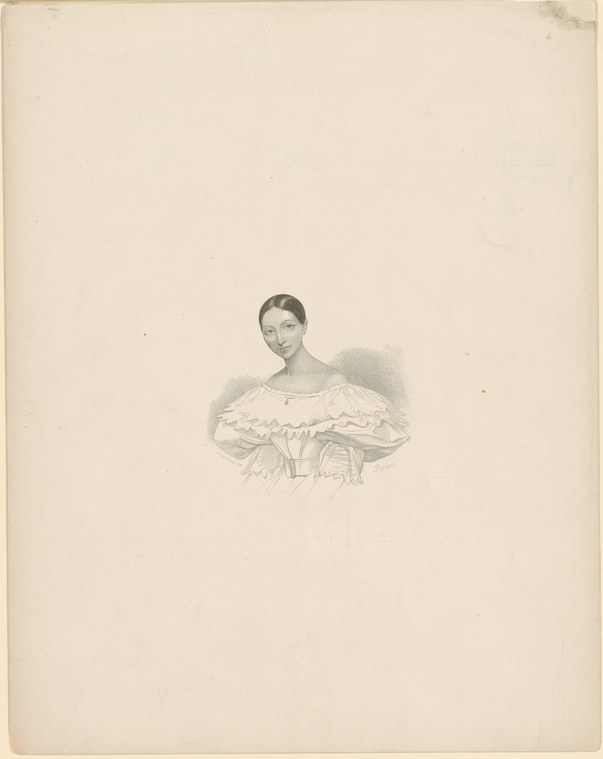
Fanny Elssler was one of the defining performers of Romantic ballet and the most internationally famous dancer of her era; this image is documentary evidence of how she was marketed and remembered. As a printed portrait rather than a performance image, it reveals the relationship between theatrical celebrity, fashion, and visual publicity in the 19th century, showing how dancers were sold to the public as much through their fashionable appearance as through their technique.
What you are looking at
A bust-length portrait of a young woman rendered in fine stippled engraving, positioned slightly off-center against a plain cream background. She is shown from the shoulders up, her head turned three-quarters toward the viewer with a composed, refined expression. She wears a dramatically voluminous off-shoulder dress with deep horizontal ruffles or pleating that frames her shoulders and upper body like an enormous collar or bertha, with the fabric gathered tightly at the waist. The style suggests early 19th-century theatrical or ballroom dress. Her dark hair is parted in the center and smoothed back, with minimal ornamentation. The technique creates a soft, diffuse quality through careful tonal gradation, particularly in the modeling of her face and the delicate rendering of the fabric's texture.
The dancing
A single standing figure shown as a portrait bust. Her body is angled slightly left, her gaze directed toward the viewer with dignified composure. The pose is static and formal rather than dynamic, presenting the subject as a person of status rather than caught in motion. The extreme proportions of the dress—particularly the enormous gathered sleeves or shoulder ruffle—dominate the composition and would severely restrict arm movement.
The dance depicted
This is a portrait of a dancer rather than a depiction of dance itself. The style of dress—a gossamer off-shoulder gown with voluminous ruffled sleeves—is characteristic of Romantic-era theatrical ballet, as worn on the operatic stage in the 1830s-1840s. The catalogue identifies this as Fanny Elssler, one of the most celebrated dancers of that period. Her costume here resembles the romantic tutus and theatrical gowns associated with romantic ballet and operatic dance roles. However, the image captures her as a fashionable celebrity in formal dress rather than performing a specific choreography.
How it was made
This is a fine engraving, likely a steel or copper engraving given the delicate stippling technique and the refinement of execution. The artist has used short parallel lines and dots to create tone and volume, a time-intensive method suited to portrait reproduction in the early 19th century. The technique allows for wide distribution—engravings like this were mass-produced and sold as individual prints, making theatrical celebrities accessible to the public as collectible images. This was the primary mode of circulating likenesses of famous performers before photography became widespread.
About this work
This is a formal celebrity portrait of Fanny Elssler, the most famous dancer of the Romantic ballet era, rendered as a fine engraving in the style typical of 1830s-1840s theatrical publicity. Elssler was known for both her classical ballet technique and her performances of national character dances, and this image presents her as a fashionable icon of her time rather than documenting a specific performance. The voluminous dress visible here is the theatrical costume of the Romantic ballet stage, where dancers began to wear the lighter, more ethereal gowns that would eventually evolve into the tutu.
As a print, this object belongs to the commercial circulation of theatrical celebrity in the 19th century. Such engravings were sold individually or in series, appearing in print shops, gift books, and private collections. They served the same function as photographic portraits later in the century—making famous performers available as images to own and display—but they were also artworks in their own right, requiring skilled engraving labor.
How to look at it
Note the extreme ratio between the size of the dress and the size of the figure—the ruffled sleeves dominate the composition and push the head toward the top of the frame. This is not accidental; the costume was as much a part of the celebrity image as the face. The stippled technique creates a soft, almost ethereal quality that was fashionable in romantic-era portraiture. The formal, frontal pose and the refined execution of the fabrics indicate that this is a prestigious theatrical portrait, not a casual or comic image; this was a famous woman being presented with dignity.
The artist
The artist is unrecorded in the catalogue, which was common for commercial engravers producing theatrical portraits. Fine engravings of this period were usually made by skilled reproductive engravers who translated paintings or drawings into printed form, often without receiving prominent credit. The quality of execution here suggests a well-established workshop. Dozens of such engravings of famous performers circulated in the 1830s-1840s, produced by anonymous artisans for the entertainment and fashion industries.
The period
This print dates to the height of the Romantic ballet era (approximately 1830-1850), when the ethereal, otherworldly aesthetic dominated European ballet. Dancers like Marie Taglioni and Fanny Elssler became international celebrities, their images reproduced in prints, lithographs, and paintings. Elssler was particularly celebrated for her performances of the *Cachucha*, a Spanish character dance that she brought into the ballet repertory. The 1830s saw the ascendancy of Romantic aesthetics in visual art—an emphasis on atmosphere, refinement, and the idealization of youth and beauty. In the world of commercial portraiture, fine engravings remained the dominant medium for mass-producing celebrity likenesses before the invention of lithography and photography.
Where it lives
Held in the New York Public Library's collection of prints depicting dance. This is a mass-produced single-sheet engraving from the early-to-mid 19th century, the kind of item that would have been sold in print shops and collected by theater-goers and fans of Romantic ballet.
Dance in this work
Questions about this work
Who was Fanny Elssler?
Fanny Elssler (1810–1884) was an Austrian dancer who became the most famous performer in Europe during the Romantic ballet era. She was celebrated for both her classical technique and her performances of national character dances, particularly the *Cachucha*, a Spanish dance she introduced to the ballet stage. Her rivalry with Marie Taglioni defined the period, and she toured internationally, appearing in Paris, London, and America. She was as much a fashion icon and celebrity as she was a dancer.
Why is this just a portrait and not a performance image?
By the 1830s, the demand for theatrical celebrity portraits far exceeded the demand for images of specific dances. Engravings of famous performers were sold as independent collectible items; fans wanted pictures to own, not documentation of choreography. This formal portrait style emphasizes Elssler's status as a celebrated public figure and fashionable woman, which was as important to her fame as her dancing skill.
What is the dress she's wearing?
This is the theatrical costume of Romantic ballet—a lightweight, off-shoulder gown with deep ruffles and gathered sleeves. The voluminous, ethereal quality was central to the Romantic aesthetic. This style of dress allowed for the elevated, weightless movements that defined Romantic ballet technique, and it created a striking visual silhouette on stage.
How were images like this distributed?
Fine engravings like this were sold as individual prints in print shops, often for a shilling or a few pence. They could also appear in theatrical gift books, annuals, or periodicals. A skilled engraver could produce many copies from a single plate, making the image affordable and widely available to middle-class theater-goers. This was the primary way that the public saw images of famous performers before photography.
More dance artwork





