49 works in this view — arrow keys or swipe to move between them.
Dance in Art
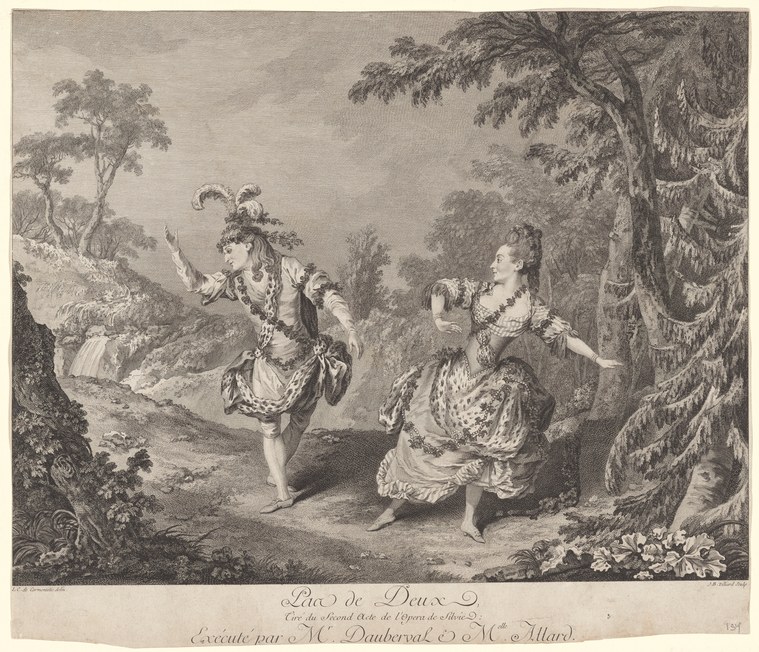
Pas de deux tiré du second acte de l'opéra de Silvie, exécuté par Mr. Dauberval & Melle. Allard
Unknown artist
- Collection:
- Prints depicting dance
- Source:
- New York Public Library
- Rights:
- Public domain — free to use, share and adapt.
- Recorded as:
- Public Domain
This print preserves the names and likenesses of two major historical dance figures and documents the style and content of a specific theatrical work, offering rare evidence of how dancers of Dauberval's stature actually performed and were presented to the public. It demonstrates that eighteenth-century ballet was understood as a narrative and expressive art, not merely a vehicle for technical display.
What you are looking at
Two female dancers occupy a woodland glade in this engraving, their bodies captured mid-movement in what appears to be an intimate theatrical moment. Both wear elaborate mid-eighteenth-century dress: fitted bodices with short sleeves, full skirts with decorative patterns (one spotted, one with floral or scroll work), and their hair is dressed high with ornaments. The dancer on the left gestures expressively toward her companion with one arm extended, her body angled in a three-quarter pose; the dancer on the right stands more upright, her gaze directed toward the first dancer. The setting is densely planted with mature trees—particularly a large trunk with hanging foliage on the right—and rough ground scattered with flowering plants. The composition is shallow and the figures dominate the foreground, with the woodland deepening into atmospheric shading behind them. The light is diffuse, typical of the engraving medium, creating soft modeling across the fabrics and flesh.
The dancing
Both dancers stand in an upright, balletic frame characteristic of serious dance of the period. The left dancer's raised arm and turned-out stance suggest a moment of appeal or expression; the right dancer maintains a composed, attentive posture facing her partner. Their legs are not dramatically extended and no prominent turnout of the feet is visible, which suggests this may not be a work of extreme technical virtuosity but rather of dramatic or narrative content. The spatial relationship between them—close but not touching—implies an interaction of character rather than a partnered hold.
The dance depicted
The title identifies this as a pas de deux from the second act of the opera *Silvie*, performed by the celebrated eighteenth-century dancers Jean Dauberval and Mlle. Allard. Dauberval (1742–1806) was a leading dancer and later choreographer of the period; Allard was a prominent ballerina. The engraving documents a specific theatrical moment, likely a scene of emotional exchange or courtship. The woodland setting and the expressive poses suggest this is a dramatic or pastoral episode rather than pure technique. The costume and style place it firmly in the French theatrical ballet tradition of the 1770s–1780s.
How it was made
This is an engraving, executed in the refined linear technique typical of late eighteenth-century theatrical prints. The artist's name is not recorded in the catalogue, but the inscription credits execution to M. Dauberval and Melle. Allard (the performers themselves, not the printmaker). The technique allows fine control of tone and texture, visible in the differentiation between the dancers' costumes, their skin, and the foliage. The print was produced for circulation among theater-goers and collectors, suggesting a well-known production of considerable prestige.
About this work
This engraving documents a moment from an eighteenth-century French opera-ballet, preserving the costume, posture, and spatial relationship of two celebrated dancers in a scene of theatrical interaction. It belongs to the rich tradition of dance prints that captured the ephemeral art of the stage for collectors and audiences who could not attend performances. The work is significant not as a record of pure technique but as evidence of how dramatic expression, landscape setting, and character were integrated into serious dance of the period.
The image reveals the sophistication of late eighteenth-century ballet: the dancers are costumed in fashionable dress, their bodies positioned with formality and grace, and the scene is framed as a moment of emotional or social consequence. This was not yet the romantic ballet of tutus and pointe work, but neither was it the court dances of the previous century. It represents a transitional moment when ballet was becoming a theatrical art form in its own right.
How to look at it
Observe the dancers' faces and upper bodies: the left dancer's raised arm and angled torso suggest she is speaking or appealing; the right dancer's attentive posture and gaze show she is receiving. This is not a moment of unison or parallel movement, but of dialogue. The engraver has frozen a gesture of emotional exchange, the kind of pantomimic clarity that Noverre advocated. Notice also the detailed rendering of their costume: the precision of the engraving allows us to see the exact cut and decoration of eighteenth-century theatrical dress, which differs from both street fashion and later ballet costume.
The artist
The artist (engraver) is not recorded. The work credits the performers, Dauberval and Allard, suggesting that the print's authority derived from their names and popularity rather than from the artist's signature. This was typical of theatrical prints of the period, which functioned as celebrity documentation.
The period
The late eighteenth century saw ballet transitioning from court spectacle to commercial theater. Jean-Georges Noverre's *Lettres sur la danse* (1760) had articulated a new aesthetic of meaningful movement and plot, moving away from pure ornamentation. Dauberval himself became one of the great reformers of ballet, later creating the pantomime-ballet *La Fille Mal Gardée*. This print documents the style of serious theatrical dance in the 1770s–1780s, when costumed performers still wore versions of contemporary dress (though modified for movement) and when dramatic expression was considered as important as technical skill.
Where it lives
The work is held in the New York Public Library's Prints collection. It is a theatrical print, one of many produced to commemorate and advertise significant productions and the dancers who performed in them. Such prints were sold to audiences and collectors and served as both souvenirs and publicity.
Dance in this work
Questions about this work
Who were Dauberval and Allard?
Jean Dauberval (1742–1806) was one of the most celebrated male dancers of his time and later became a major choreographer, famous for creating *La Fille Mal Gardée*. Mlle. Allard was a distinguished ballerina of the same era. Both were stars of the Opéra in Paris and were well-known to the theater-going public.
What opera was *Silvie*?
The catalogue record identifies the source as an opera called *Silvie*, and this print documents a pas de deux from its second act. We can infer from the style and the performers' dates that it was produced in the 1770s or early 1780s, but further details about the opera itself are not provided in the available documentation.
How is this different from ballet today?
The dancers are in street clothes (albeit theatrical versions), not tutus or tights. They use expressive pantomime and gesture as much as technical movement. There is no evidence of pointe work or the high extensions that became standard in the nineteenth century. The style is more closely related to the serious pantomime-ballet that Noverre advocated than to the romantic or classical ballet that followed.
Why is this a print and not a painting?
Prints were cheaper to produce and distribute than paintings, and they could reach a much larger audience. Theatrical prints were a standard form of publicity and souvenir, sold to audiences and collectors. An engraving also allowed for finer detail and wider circulation than a unique painted work could achieve.
More dance artwork





