49 works in this view — arrow keys or swipe to move between them.
Dance in Art
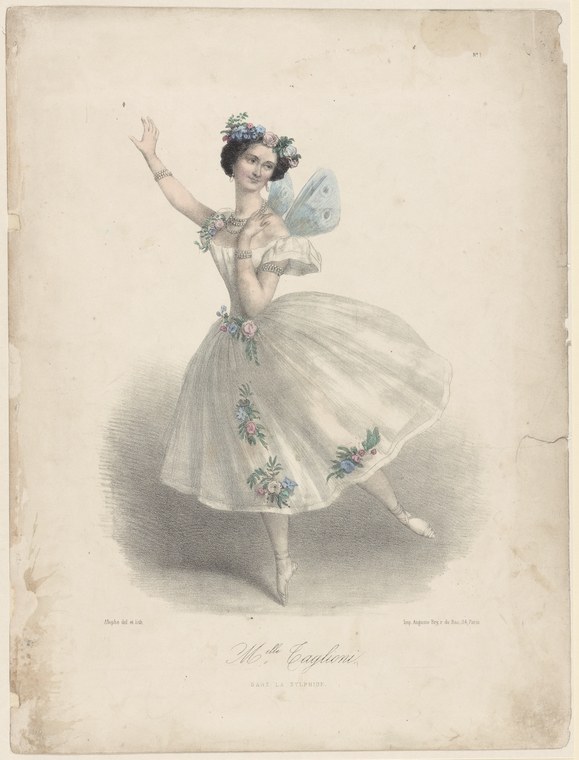
Melle. Taglioni dans La sylphide
Unknown artist
- Collection:
- Prints depicting dance
- Source:
- New York Public Library
- Rights:
- Public domain — free to use, share and adapt.
- Recorded as:
- Public Domain
This is one of the most influential dance images ever created. It defined the visual language of Romantic ballet and established the standard for the female ballet body that persists to the present day. For anyone studying nineteenth-century dance, Romantic aesthetics, or the history of ballet technique, this image is essential.
What you are looking at
A young woman in a gossamer white tutu stands alone against a plain background, captured mid-movement in a moment of weightless grace. She wears a fitted bodice with a low neckline and a full skirt of layered tulle decorated with small floral sprigs, and her dark hair is crowned with flowers and feathers. Her left arm is raised with the hand held at shoulder height in a gesture of classical elegance; her right arm extends more gently. She stands en pointe on her right leg, her left leg lifted high behind her in an arabesque or attitude position. The figure appears to be a moment of suspension—the kind of ethereal pose that defines the Romantic ballet aesthetic. The print is hand-colored, with delicate tinting applied to the flesh tones, hair, and the small flowers scattered across the skirt.
The dancing
A single female dancer, captured in a high arabesque or attitude derrière. Her weight is supported entirely on the right leg en pointe; the left leg extends behind at or above hip height with a straight line from hip to heel. The upper body maintains the upright carriage typical of classical ballet, with the shoulders level and the spine straight. The raised left arm holds a position just forward and to the side of the body; the right arm is lower and more relaxed. The overall frame shows control and verticality—the dancer appears weightless despite the physical demand of the position.
The dance depicted
This is almost certainly a portrait of Marie Taglioni in her most famous role, the Sylph in *La Sylphide* (first performed Paris 1832). The costume—white tutu, flowers in the hair, the airy tulle skirt with its simple floral decoration—is the iconic dress of that role. The arabesque pose and the ethereal quality of the image capture the essence of Romantic ballet, which valued the illusion of weightlessness and supernatural grace. Taglioni was the first dancer to master the technique of dancing continuously en pointe and became synonymous with the Romantic aesthetic; this print preserves the image that made her internationally famous.
How it was made
This is a hand-colored lithographic print, a medium that allowed rapid reproduction for commercial circulation. The lithography itself captures fine detail in the dancer's pose and costume; the hand-coloring (applied afterward, likely by a workshop team) adds luminosity to the tulle and delicate tints to the skin. The technique was perfect for theatrical publicity: lithographs could be printed in editions of hundreds and hand-colored versions sold at premium prices to admirers and collectors. The combination of crisp line-work and soft color creates the romantic mood the image seeks.
About this work
This is a portrait print of Marie Taglioni as the Sylph in *La Sylphide*, one of the defining images of Romantic ballet and one of the most widely reproduced dance images of the nineteenth century. The work captures not a performance moment but an iconic pose—the signature arabesque in the costume that defined both the role and Taglioni's career. Created as commercial theatrical merchandise in the decades after the ballet's 1832 premiere, it circulated across Europe and America, making Taglioni and her technique visible to audiences who might never see her dance in person. The print is a historical document of how Romantic ballet imagined itself: weightless, ethereal, supernatural, and utterly dependent on the illusion of effortlessness created by the dancer's technique.
For dancers and historians, this image is foundational. It shows what Romantic-era choreography looked like, how the body was positioned and valued, and how the tutu evolved as a garment specifically designed to enhance the illusion of flight. Taglioni's pose—the high arabesque, the upright carriage, the complete articulation of the pointed foot—became the template for Romantic ballerinas across Europe and remains core to classical ballet training today.
How to look at it
Notice the pose: the dancer is not mid-leap or mid-turn, but held in a position of apparent suspension. The high arabesque, the lifted chest, the flower crown all work together to create an image of something not entirely human—which is exactly the point. The Sylph is a spirit, not a mortal woman, and the image captures her through idealized, otherworldly grace. The hand-coloring is also worth attention: the delicate tinting of the flowers on the skirt, the soft modeling of the face, and the luminous white of the tulle all enhance the ethereal effect. The blank background serves the same purpose, isolating the figure from any earthly context. This is portraiture in service of fantasy.
The artist
The catalogue record does not identify the artist, which is typical for commercial prints of this era. The print is unsigned but carries publication marks indicating it was produced in Paris, the center of Romantic ballet culture. Many such portraits were issued by publishers like Benoist, Thierry, and others who specialized in theatrical prints. Taglioni's image was reproduced repeatedly by multiple artists and publishers throughout the 1830s and 1840s, each adaptation slightly different but all recognizable as the Sylph.
The period
This print belongs to the height of the Romantic ballet movement, roughly 1830–1850. The 1832 premiere of *La Sylphide* in Paris marked a watershed moment: it was the first ballet to place a supernatural female spirit at the center of the action and the first to use pointe work as an essential element of the choreography. Taglioni's performance created a sensation and made her the most celebrated dancer in Europe. The lithographic print industry, rapidly expanding in the 1830s, seized on her image as a highly marketable commodity. This period saw an explosion of theatrical portraits, many hand-colored and sold to admirers as affordable luxury goods. The aesthetic ideals visible here—the ethereal quality, the emphasis on weightlessness, the supernatural subject matter—reflect broader Romantic-era values in art and literature.
Where it lives
The print is held in the New York Public Library's collection of prints depicting dance. The library's designation suggests this is one of many such commercial theatrical portraits, collected as a visual archive of nineteenth-century performance.
Dance in this work
Questions about this work
Who was Marie Taglioni?
Taglioni (1804–1884) was an Italian-Swedish dancer who became the most celebrated performer of the Romantic era. She was the first dancer to master the technique of dancing continuously en pointe (on the tips of the toes) and became the international ideal of the Romantic ballerina. Her performance in *La Sylphide* in 1832 made her a superstar across Europe and America.
What is the Sylph?
*La Sylphide* (The Sylph) is a supernatural creature—a spirit of the air—in the 1832 ballet of the same name. The Sylph falls in love with a mortal man but cannot live in the human world. The ballet was revolutionary for centering the action on this female supernatural being rather than on a human love story, and for using pointe work to create the illusion that the Sylph was barely touching the ground.
Why was this image reproduced so many times?
Taglioni was the superstar of her day, and her image had enormous commercial value. Lithographic prints could be produced quickly and in large numbers, making them an affordable souvenir for theater-goers. Publishers throughout Europe and America issued versions of this portrait, each slightly different but all featuring the iconic costume and pose that made Taglioni recognizable.
What does the pose tell us about Romantic ballet technique?
The high arabesque, the upright carriage, and the pointed foot all show the technical demands placed on Romantic-era dancers. But the image also shows the goal: the illusion of weightlessness and supernatural grace. The pose is held and sustained, not caught mid-movement, which reflects how Romantic choreography valued the ability to create moments of apparent suspension.
More dance artwork





