49 works in this view — arrow keys or swipe to move between them.
Dance in Art
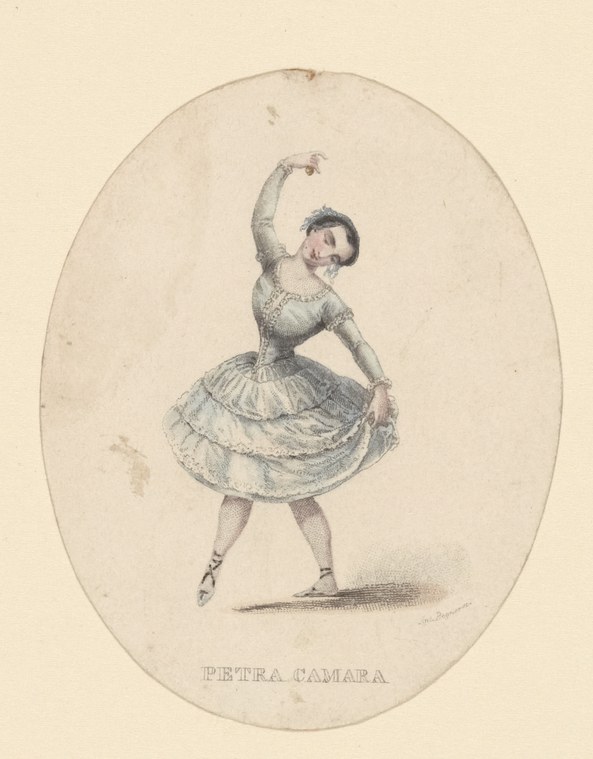
Petra Camara
Unknown artist
- Collection:
- Prints depicting dance
- Source:
- New York Public Library
- Rights:
- Public domain — free to use, share and adapt.
- Recorded as:
- Public Domain
Petra Camara is not a major documented figure in ballet history, but this portrait is nonetheless significant: it captures a mid-19th-century dancer at the height of the Romantic ballet era, when female dancers dominated the repertory and when their bodies were increasingly understood through the vocabulary of classical technique and ideal line. The work is a rare named record of a performer whose career would otherwise have left no trace, and it documents what counted as excellence in that moment—length, lightness, control, and grace.
What you are looking at
A young female dancer is shown in a single-figure portrait, posed in a moment of lyrical motion against a plain cream background. She wears a light, fitted bodice with short sleeves and a full skirt that billows outward, caught mid-swirl to show the volume of the fabric and the dynamics of the turn. Her posture is upright and elongated, with her right arm raised gracefully overhead in a curved line while her left arm extends to the side, gently gathering the skirt. Her head is turned slightly, her gaze directed downward with a serene expression. She stands en pointe on her left foot, her right leg extended behind her in a penché-like position, creating a diagonal line through the body. The composition is framed within an oval border, a convention of 19th-century portraiture that lends intimacy and focus to the figure. The print is rendered in delicate pencil and watercolour work, with subtle shading that suggests the weight and fall of the fabric and the musculature of the dancer's legs and arms.
The dancing
A single dancer occupies the frame, her body arranged in a classical ballet attitude: the standing leg en pointe, the working leg extended and raised behind the body, the torso lifted and rotated slightly to open the hip. The arm positions are softly rounded—the raised arm in a gentle curve overhead, the other arm holding the skirt and extended laterally. The dancer's frame is narrow and elongated; her neck is long and unmarked by tension, her shoulders low and relaxed. The skirt, rendered with careful attention to its layers and movement, dominates the lower half of the composition and speaks to both the technical skill required to manipulate such volume and the aesthetic priority given to the line of the body.
The dance depicted
This is a ballet dancer, and the style and costume—the pointe work, the tutu, the classical port de bras—identify her as a Romantic-era ballerina, likely from the 1830s–1850s. The name 'Petra Camara' below the image suggests this is a named portrait of a specific performer, one of whom there is no surviving major recorded history; the work captures her at a moment of controlled, elegant motion rather than dramatic spectacle. The pose itself—a penché with the arms held softly—was a signature position of the Romantic ballet aesthetic, prizing grace, length of line, and an almost effortless appearance of weightlessness. The artist has understood the technical requirements of the movement: the balance, the core control, the extension through the working leg.
How it was made
This is a lithograph or engraved print, hand-tinted with watercolour and pencil work to add tone and delicacy to the figure. The technique allowed for relatively inexpensive reproduction and wide circulation among theatre audiences and collectors of dance portraiture. The artist has used the fine lines of engraving to define the musculature and pose, then applied light wash to suggest depth, the fall of fabric, and the warmth of skin. This method was the standard for theatrical celebrity portraits in the 19th century and implies an audience of theatre-goers, collectors of performer memorabilia, and dance enthusiasts rather than a fine-art gallery audience.
About this work
This is a portrait print of a named ballet dancer, Petra Camara, rendered in the conventions of early 19th-century theatrical celebrity imagery. The work documents both a specific performer and the aesthetic of Romantic ballet: the pointe work, the light tutu, the elongated classical line, the serene focus. As a lithographed and hand-tinted portrait, it is one of hundreds produced during this era to capitalize on the fame of individual dancers and to circulate their image to a paying public. The work is valuable not as a unique artwork but as a historical document of how dancers were seen, named, and celebrated in their own time, and of what an accomplished ballerina of the period was expected to look like in performance.
The image sits at the intersection of theatre history, dance history, and print culture. It records a specific body, a specific moment of movement, and a specific name—and it does so through a medium designed to be reproduced and consumed. The care taken in rendering the dancer's anatomy and the precision of her pose suggest that the artist was familiar with ballet and valued technical accuracy alongside aesthetic appeal.
How to look at it
Attend to the arrested moment: the artist has chosen to freeze the dancer not at the height of a jump or the apex of a turn, but in a held pose—a moment that requires absolute control and balance. Notice how the skirt, caught mid-swirl, conveys motion even though the body is stationary; this is a technical choice that speaks to the dual demand of Romantic ballet, which required both visible technical mastery and an appearance of effortless grace. The elongation of the figure—the stretched neck, the extended working leg, the lifted ribcage—was an aesthetic ideal of the period. Look also at the care taken to render the structure of the foot en pointe, a detail that would have been of keen interest to a contemporary audience familiar with the technical demands of the form.
The period
This portrait dates to the height of the Romantic ballet era in Europe (c. 1830–1860), when ballet had become the dominant theatrical dance form and female dancers had become the principal performers. The tutu had recently shortened from the ankle-length skirt of the 1820s to the mid-calf length shown here, a change that allowed audiences to see the dancer's feet and legs and to verify her technical skill. The emphasis on pointework and ethereal, weightless movement was central to the Romantic aesthetic; dancers were increasingly celebrated as individuals, and their portraits were commodities. The lithographic process had only recently become affordable and widespread, making such images accessible to a middle-class audience. The oval framing and soft hand-tinting of this print are typical of the period's portraiture conventions.
Where it lives
The work is held in the New York Public Library's collection of prints depicting dance. It is a theatrical celebrity portrait of the kind produced in quantity during the 19th century and distributed to audiences, collectors, and dance enthusiasts.
Dance in this work
Questions about this work
Who was Petra Camara?
No substantial biographical record of Petra Camara survives in major dance historical sources, and the artist of this portrait is also unrecorded. She was likely a professional ballerina active in the mid-19th century, celebrated enough to warrant a portrait print. The work is now primarily valuable as a document of her existence and of what a skilled dancer of her era was understood to look like and to be able to do.
Why is she dancing en pointe?
Pointe work became a central requirement of ballet training and performance during the early Romantic era (1830s onward). The ability to balance on the very tips of the toes was understood as both a technical marvel and an aesthetic necessity, allowing dancers to appear weightless and ethereal. By the time this portrait was made, en pointe work was standard for all professional female dancers.
What dance is this?
This is not a depiction of a named choreographic work, but rather a posed portrait that showcases the dancer's technique and the classical ballet aesthetic. The position—a penché or attitude—was a standard classical position shown in many ballet variations and would have been familiar to audiences of the period as a marker of technical skill and elegance.
How was this print made and distributed?
This is a lithograph or engraving, hand-tinted with watercolour and pencil. Such prints were produced in multiple copies and sold to theatre audiences, collectors, and dance enthusiasts. They were the primary way that dancers' images circulated beyond the theatre and reached a wide public; they functioned much as theatre lobby cards and promotional photographs do today.
More dance artwork





