49 works in this view — arrow keys or swipe to move between them.
Dance in Art
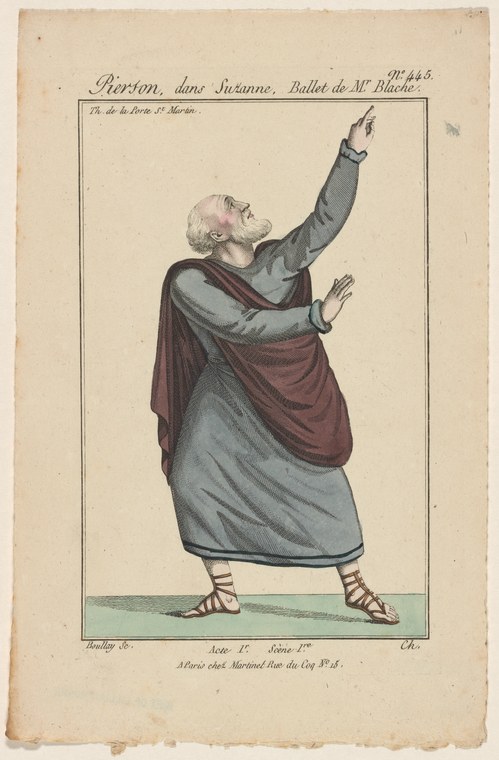
Pierson dans Suzanne, ballet de M'r Blache. Acte 1r., scène 1re, Th. de la Porte St. Martin
Unknown artist
- Collection:
- Prints depicting dance
- Source:
- New York Public Library
- Rights:
- Public domain — free to use, share and adapt.
- Recorded as:
- Public Domain
Prints like this are primary documents of how specific roles were danced and presented before photography or film existed. They show us not just what dancers wore, but how they moved through emotional and narrative moments, and they allow us to trace how particular roles were interpreted across different performers and decades. This image is evidence of Pierson's interpretation of Suzanne, and by extension, of what the choreographer and audience expected from that character at that moment in the scene.
What you are looking at
A single male figure dominates this hand-colored engraving, shown in three-quarter view against a plain background. He is an older man with white or grey hair, dressed in early 19th-century theatrical costume: a pale blue-grey tunic or undertunic with a deep burgundy-red draped cloak or shawl across one shoulder and arm. His legs are bare below mid-thigh, and he wears strapped sandals or soft shoes with cross-garterings in dark thread. His posture is emphatic and devotional: his right arm is raised high and extended upward in a gesture of supplication or prayer, while his left arm is bent with the hand open at chest height. His head is tilted back, gaze directed upward, his whole frame suggesting an emotional peak—plea, invocation, or ecstatic address. The ground plane is indicated by a thin green line at his feet. This is a moment of intense theatrical feeling, frozen mid-gesture.
The dancing
The dancer's weight appears to rest evenly on both feet, the stance grounded and stable despite the upward emotional trajectory of the arms. The raised right arm is fully extended, the shoulder open, the gesture one of reaching or yearning; the left arm remains close to the body with the palm open and facing upward. The head is thrown back, the face and neck fully exposed. There is no partnership, no hold, no interaction with another body—this is a solo moment of private or devotional emotion made visible through the extreme verticality and openness of the frame.
The dance depicted
This is a scene from the ballet *Suzanne* (also known as *Suzanna*), choreographed by Jean-Louis Aumer or Pierre Gardel, which premiered at the Théâtre de la Porte Saint-Martin in Paris in the early 19th century. The figure is identified as Pierson, presumably the dancer who performed this role. The raised arms and tilted head suggest a moment of Romantic theatrical gesture typical of early 19th-century ballet pantomime—a narrative gesture expressing emotional states rather than pure dance movement. The image documents a specific scene (Act 1, Scene 1) and a specific performer, anchoring it as evidence of how a canonical role was physically interpreted and presented.
How it was made
This is a hand-colored engraving, recognizable from the fine linear hatching that builds form and shadow, overlaid with watercolor or gouache to indicate the costume colors—the pale blue tunic, burgundy cloak, and flesh tones. The engraving technique allowed precise definition of the figure and facial features, while the hand-coloring brought the theatrical costume to life and made the work suitable for sale as a theatrical souvenir or record. This was a standard commercial practice in early 19th-century Paris: engravings and colored prints of celebrated dancers in famous roles were sold to audiences and collectors as documents of performance.
About this work
This is a theatrical souvenir print documenting a specific performer, Pierson, in a celebrated early 19th-century ballet at a major Paris venue. It belongs to a significant body of printed evidence about how Romantic-era ballet was choreographed, costumed, and performed—a period when ballet was transitioning from courtly spectacle toward dramatic narrative and emotional expression. The image captures not a step or a pattern, but a moment of pantomimic intensity: the language of early 19th-century theatrical dance was as much about the body's emotional declaration as about technique. This print preserves both the costume record and the gestural vocabulary of that moment.
How to look at it
Observe the extremity of the gesture: the arm is not merely raised, but fully extended and straining upward, the whole upper body participates in the emotional trajectory. The tilted head and upturned gaze complete the picture of supplication or ecstasy. Note how the engraver has rendered the musculature and strain in the arm and shoulder—this was a technical and emotional feat, not a delicate or restrained moment. The costume is equally important: the flowing cloak and bare legs were theatrical conventions that allowed the body to be read clearly, and the colors (as rendered in the hand-coloring) would have created a vivid stage presence.
The artist
The artist is not identified in the catalogue record. The print bears the notations 'Houlvier Sc.' (likely the engraver's signature) and 'Ch.' (possibly the colorist's initial). The work was almost certainly produced by a commercial printshop in Paris, part of the infrastructure that supplied theatrical prints to audiences and enthusiasts. Such prints were often unsigned or credited only to the engraver; they were functional objects rather than artist statements.
The period
This print belongs to the height of French Romantic ballet, roughly 1830–1850, when Paris was the unchallenged center of European dance innovation. Ballets of this period—*La Sylphide* (1832), *Giselle* (1841)—combined technical virtuosity with dramatic narrative and emotional intensity. The male dancer's role was evolving: no longer merely a partner, he was becoming a vehicle for heroic, devotional, or tragic emotion. The costume here—the tunic and cloak—evokes classical or orientalist theatrical tradition, common in ballets of this era that drew on literary or historical subjects. Hand-colored theatrical prints were a vital form of fan culture and professional documentation.
Where it lives
This print is held in the New York Public Library's collection of prints depicting dance. It is catalogued as a theatrical souvenir of the Paris stage, part of the Library's documentation of 19th-century performance culture.
Dance in this work
Questions about this work
What ballet is this from?
This is Act 1, Scene 1 of *Suzanne* (also known as *Suzanna*), a ballet that premiered at the Théâtre de la Porte Saint-Martin in Paris. The exact choreographer is not certain from the print alone, but the ballet is attributed to either Jean-Louis Aumer or Pierre Gardel. The print documents how this scene was staged and danced.
Who was Pierson?
Pierson is identified only as the performer of this role in the print's title. Without additional theatrical records, we cannot say more about his career or prominence, but the fact that he merited a printed souvenir suggests he was a recognized dancer at this important Paris venue.
Why is the dancer's arm raised like that?
This is pantomimic gesture, the physical language early 19th-century ballet used to convey emotion and narrative. The raised arm and tilted head express supplication, prayer, yearning, or ecstatic emotion—internal states made visible through the body. Ballet of this period alternated between passages of pure movement (steps, turns, jumps) and passages of dramatic gesture (held poses and meaningful arm positions).
How reliable is this print as a record of how the ballet was actually danced?
It is reliable as a record of costume and the general emotional content of the scene. The specific step or movement leading into or out of this pose might be different; the print freezes a single moment. However, the gesture itself—raised arm, tilted head, the emotional weight of the position—would have been rehearsed and repeated, part of the role as taught and performed.
More dance artwork





