49 works in this view — arrow keys or swipe to move between them.
Dance in Art
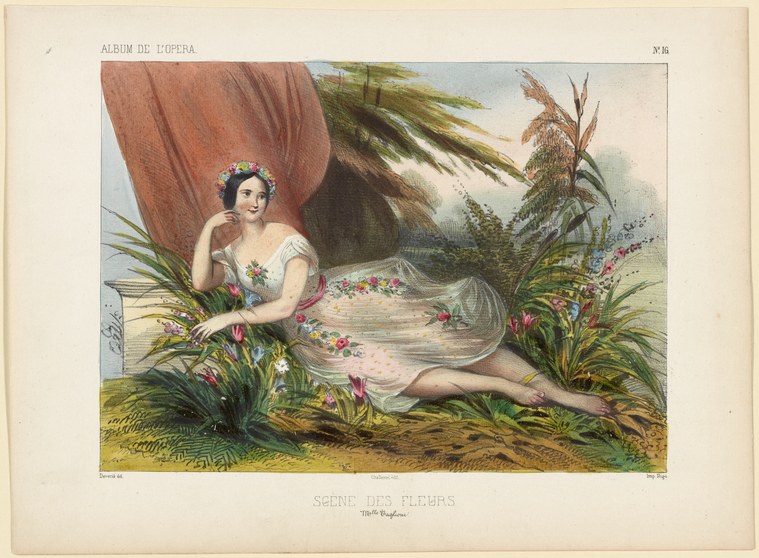
Scène des fleurs: Mlle. Taglioni
Unknown artist
- Collection:
- Prints depicting dance
- Source:
- New York Public Library
- Rights:
- Public domain — free to use, share and adapt.
- Recorded as:
- Public Domain
Marie Taglioni was the defining ballerina of the Romantic era, and images of her circulated widely as cultural artifacts. This print documents both her celebrity and the visual vocabulary of Romantic ballet design—the emphasis on lightness, ethereality, and integration with natural or supernatural settings that shaped ballet's identity for generations. For historians of dance representation, it shows how the female ballet dancer was presented to the public: not as an athlete or technical virtuoso, but as a muse or allegorical figure at rest.
What you are looking at
A woman reclines in a languorous pose on sylvan ground, her weight supported on one elbow, her body arranged in a composition of studied ease. She wears a white muslin dress with a fitted bodice and full skirt scattered with pink and red flowers; her dark hair is crowned with a wreath of white flowers. Behind her, a deep red or brownish drapery—possibly a tent or pavilion—rises as a theatrical backdrop. The foreground is densely planted with exotic flora: tall grasses, flowering plants with prominent pink blooms, and what appears to be corn or maize stalks rise to either side of the figure. The lighting is soft and romantic, suggesting late afternoon or evening. The overall composition is pastoral and Arcadian, with the human figure integrated into an idealized natural setting rather than dominating it. The print is hand-colored, with delicate watercolor washes rendering the vegetation and fabric with considerable botanical and textile detail.
The dancing
The single figure is posed in a reclining attitude on the ground, her body angled to present the maximum visual surface to the viewer. Her right arm is raised, the elbow bent, supporting her head in a gesture of contemplation or repose. Her left arm rests across her body. The legs extend downward at an angle; one foot is visible, bare or in a light slipper. The posture is that of complete ease and abandonment, the weight distributed through the hip and elbow. There is no active movement or dancing visible in the body; the figure is stationary and posed rather than captured mid-gesture.
The dance depicted
This does not depict active dancing. The titled reference to 'Scène des fleurs' (Flower Scene) and the attribution to 'Mlle. Taglioni' indicate this is a costume design or theatrical scene study related to the celebrated ballerina Marie Taglioni, likely from a romantic-era ballet involving pastoral or supernatural themes such as *La Sylphide* (1832) or *La Gitana* (1838). The reclining pose and floral dress suggest an allegory or interlude rather than a choreographic moment. The image functions as a souvenir of a specific dancer and theatrical production rather than as a record of movement itself.
How it was made
This is a hand-colored engraving or lithograph, executed with fine linear detail and finished with watercolor or gouache. The technique of lithography was ideally suited to such work in the 1830s–1850s, allowing for layered color printing combined with hand-finishing. The delicate rendering of the vegetation and the precision of the costume detail suggest a commercial print made for a theater-going public as a souvenir or portrait of a celebrated performer. The level of finish and artisanal hand-coloring indicates this was a mid-market luxury print, circulated to opera-goers and ballet enthusiasts of means.
About this work
This is a theatrical souvenir print depicting or commemorating the famous Romantic-era ballerina Marie Taglioni in a floral costume from what is likely a scene in one of her celebrated vehicles. The image is not a record of choreography but a romanticized portrait of the dancer in a moment of repose, dressed as a character from a ballet. It belongs in a dance gallery as evidence of how Romantic ballet was marketed and memorialized to its public, and as a document of the costume and aesthetic ideal of the period. The print shows the dancer not in motion but in the contemplative, ethereal repose that characterized the Romantic ballet heroine—a figure suspended between nature and artifice.
How to look at it
The viewer should attend to the studied composition of the figure: the way the artist has posed the dancer to display both the costume and the ideal of Romantic femininity—a figure in repose rather than in motion, integrated into a landscape rather than dominating it. The hand resting on the cheek, the gaze averted, the full skirt arranged on the ground—these are all deliberate choices that evoke a mood of contemplation and reverie. The density and variety of the floral surround is not naturalistic but symbolic; the flowers are arranged and positioned to frame and idealize the human figure. This is not a snapshot of a ballet moment but a composed portrait of an idea of what a Romantic ballet dancer embodied.
The artist
The artist is not recorded in the catalogue. The style and quality suggest a professional theatrical print-maker working in Paris or London in the 1830s–1850s, likely associated with the operatic and balletic print trade that flourished around the Théâtre de l'Académie Royale de Musique (the Paris Opéra) and comparable British venues. The signature or attribution line visible in the print may provide identification, but is not legible in the digital image provided.
The period
This print dates to the height of Romantic ballet in Europe, a period (roughly 1830–1850) in which ballet was thoroughly feminized and infused with the aesthetic values of literary Romanticism: an emphasis on the supernatural, the exotic, the melancholic, and the ethereal. Marie Taglioni's debut in *La Sylphide* (1832) established a new standard for the ballet dancer as a weightless, otherworldly being. Theater prints and lithographs were a major form of celebrity culture and artistic distribution in this period, rivaling photography in circulation among the middle and upper classes. The floral setting and costume design reflect both the influence of Romantic literature and painting and the ballet's debt to the pantomime and féerie traditions of the French stage.
Where it lives
This is part of the New York Public Library's collection of dance-related prints, catalogued under its generic 'Prints depicting dance' heading. The object is a commercial theatrical souvenir, likely sold to audiences after performances or distributed as part of the performer's celebrity apparatus. Such prints were common and widely circulated in the 19th century, and many examples survive in public collections.
Dance in this work
Questions about this work
Did Marie Taglioni actually perform in a scene like this?
Possibly. Several of her ballets included floral or pastoral scenes, and Taglioni was known to rest or pose between movements. However, this print is not a record of actual choreography but rather an idealized portrait or costume study. It shows how the Romantic ballet was imagined and sold to its public—as a vision of weightless, ethereal femininity in a natural setting—rather than how it was necessarily danced.
What is the dance style shown here?
No active dancing is depicted. The figure is in repose, posed rather than moving. However, the costume, setting, and attribution to Taglioni place this squarely within Romantic ballet of the 1830s–1850s. The image is valuable not as a record of movement but as evidence of how Romantic ballet was understood and represented—as a vision of supernatural or natural grace rather than as visible technique.
Why is the figure surrounded by flowers and plants?
The floral surround is both decorative and symbolic. Romanticism prized nature as a source of truth and feeling; flowers and pastoral settings were standard properties of Romantic ballet. The abundance of botanical detail suggests allegory or fantasy—a world in which the human and the natural merge. The artist is positioning the dancer as a part of nature, not separate from it, which was central to how Romantic ballet imagined the female dancer.
What was the role of prints like this in ballet culture?
In the 19th century, before photography became standard and moving images did not exist, theatrical prints were the primary way audiences could own and circulate images of celebrated dancers. These were sold as souvenirs after performances, given as gifts, and collected by enthusiasts. They functioned as celebrity portraits and as visual records of costume, design, and the aesthetic ideals of the period.
More dance artwork





