49 works in this view — arrow keys or swipe to move between them.
Dance in Art
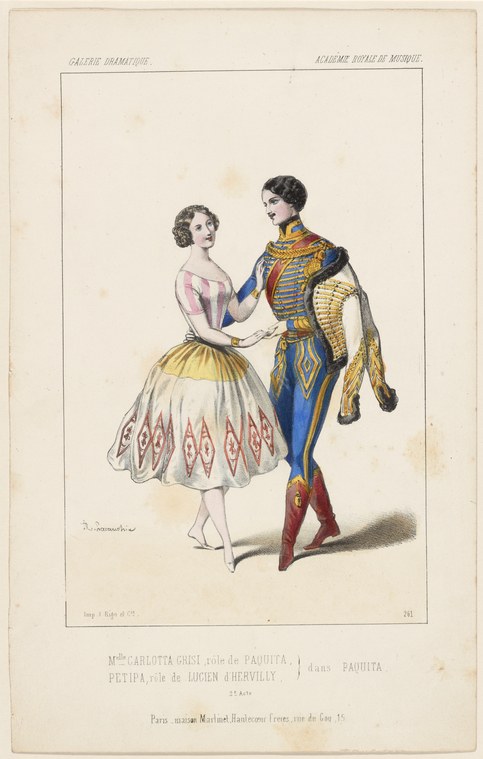
Academie Royale de Musique. Melle Carlotta Grisi, rôle de Paquita, Petipa, rôle de Lucien d'Hervilly, dans Paquita 2e acte
Unknown artist
- Collection:
- Prints depicting dance
- Source:
- New York Public Library
- Rights:
- Public domain — free to use, share and adapt.
- Recorded as:
- Public Domain
Carlotta Grisi was the original Giselle and one of the defining interpreters of Romantic ballet; this print captures her in a major role at the height of her fame. The record also documents Marius Petipa during his formative years in Paris, before his move to Russia where he would shape ballet for a generation. As a lithograph, the print is evidence of how 19th-century dance was mediated to the public through inexpensive, mass-produced theatrical imagery.
What you are looking at
A hand-colored theatrical print shows a moment of courtship or romantic encounter between two principal dancers from the Académie Royale de Musique. The male dancer, identified as Petipa in the role of Lucien d'Hervilly, stands at right in an ornate military dress uniform: a dark blue coat with gold embroidery, gold-trimmed collar and cuffs, and burgundy breeches with a gold stripe. His posture is upright and formal, his gaze directed toward his partner. The female dancer, Carlotta Grisi in the title role of Paquita, stands at left in a pale yellow tulle skirt decorated with red or pink ornamental designs arranged in symmetrical patterns across the skirt. Her bodice is pink, and her hair is styled in the ringlets characteristic of the Romantic era. She wears pale silk tights and pointe shoes. The two dancers are positioned close together, their right hands meeting in a gesture suggesting intimate conversation or flirtation rather than an active dance step. The background is plain, focusing all attention on the figures and their fashionable dress. The composition is frontal and theatrical, as if viewed from the audience of the Opéra.
The dancing
The male dancer stands in a formal, nearly vertical alignment with one arm extended toward his partner in a gesture of courtship. The female dancer is in a relaxed standing position on pointe, her silhouette graceful and elongated in the manner of Romantic ballet. Their hands meet at chest height in a moment that reads as intimate rather than balletic—this is an off-step moment, likely from a dramatic or character dance passage rather than pure classical ballet vocabulary. The proximity and hand contact suggest a narrative interaction between the characters rather than a formal partnered figure.
The dance depicted
This is a scene from *Paquita*, a ballet created by Joseph Mazilier and Marius Petipa that premiered at the Opéra in 1846. The inscription identifies this as Act II, featuring the roles of Paquita and Lucien d'Hervilly, the Spanish heroine and French officer. The ballet was famous as a vehicle for brilliant female technique, though this particular moment emphasizes character and dramatic presence over virtuosity. The uniform worn by Petipa and the romantic staging suggest the influence of the French opéra comique tradition: military dress and cross-national romance were stock elements of the mid-19th-century French stage.
How it was made
This is a hand-colored lithograph, a print technique that allowed rapid, inexpensive reproduction and wide circulation to theater-going publics. The delicate coloring—pink, yellow, gold, and blue—is applied by hand to the printed stone image, evident in the slight variations of tone and the painterly quality of the costume details. Lithographic prints of dancers were the principal visual record available to 19th-century audiences outside the theater itself and served as souvenirs and publicity. The technique allowed the printer to capture theatrical lighting and fabric texture in a way that engraving alone could not.
About this work
This is a theatrical souvenir print documenting the performance of Carlotta Grisi and Marius Petipa in the second act of *Paquita* at the Paris Opéra. The image preserves a moment of dramatic interaction between two celebrated dancers of the Romantic era, capturing both their roles and the theatrical presentation expected by the opera house audience. Grisi was one of the most celebrated ballerinas of her time, and Petipa would become the dominant figure in Russian imperial ballet; this print records them at a shared moment in European dance history. The work belongs in a gallery of dance imagery as a primary document of mid-19th-century theatrical performance, costume, and the visual language of Romantic ballet as seen by contemporary audiences.
How to look at it
Notice the precise detail of the embroidery and trim on Petipa's uniform—the lithographer and colorist took care to convey the theatrical splendor expected of the male dancer. Observe that Grisi is en pointe and her weight is clearly supported by her feet despite the close proximity to her partner; there is no theatrical embrace, only a gesture of intimate conversation. The plain background focuses the eye entirely on costume and bearing, which tells us this is a souvenir meant to preserve the memory of these two performers in their roles, not to document a particular choreographic moment.
The period
This print dates to the mid-1840s, the zenith of Romantic ballet in France. *Paquita* premiered in 1846 at the Opéra during the period when ballets featuring exotic or foreign heroines in dramatic narratives were the standard form. The military dress uniform and the romantic encounter between characters of different nations reflect the popular taste for historical and pseudo-historical subjects on the lyric stage. Lithographic theater prints were at their height of circulation during this period, serving middle-class audiences who could not afford opera boxes but wanted visual mementos of celebrated performers.
Where it lives
This work is held in the New York Public Library's prints collection depicting dance, a major repository of 19th-century theatrical imagery. Such prints were typically sold at the theater or by print shops in the neighborhood of the Opéra and reached a broad urban audience.
Dance in this work
Questions about this work
Who was Carlotta Grisi?
Carlotta Grisi (1819–1899) was an Italian-born ballerina who became one of the most celebrated dancers of the Romantic era. She is best known as the original Giselle (1841) and created many roles in major ballets at the Paris Opéra. She danced extensively across Europe and was known for her technical brilliance and dramatic presence.
What is the significance of Paquita?
*Paquita* (1846) was a major ballet success at the Paris Opéra, choreographed by Joseph Mazilier and later revised by Marius Petipa. It was designed as a vehicle for the ballerina, featuring not only solo variations but also grand ensemble scenes. It remained in the ballet repertory through the 19th century and influenced the structure of later balletic narratives.
Why was Marius Petipa dancing in Paris?
Marius Petipa (1818–1910) began his career in France and performed and choreographed at the Paris Opéra before moving to Russia in 1847. His time in Paris exposed him to French Romantic ballet aesthetics; he would later combine these with Russian imperial training to create the classical ballet vocabulary of the Vaganova method.
What does the military costume tell us?
The ornate military dress identifies Petipa's character as a French officer and reflects the conventions of mid-19th-century French opéra comique. Military dress was a standard costume type for male leads in dramatic ballets and operas, signaling heroism, authority, and often cross-national or exotic romance plots.
More dance artwork





