49 works in this view — arrow keys or swipe to move between them.
Dance in Art
Scottish dancing
Unknown artist
- Medium:
- Source:
- New York Public Library
- Rights:
- Public domain — free to use, share and adapt.
- Recorded as:
- public_domain
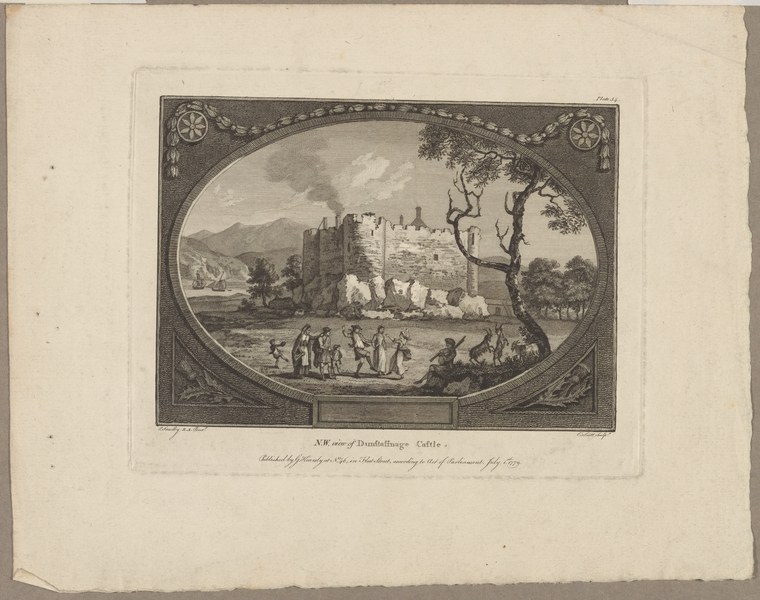
This print documents the cultural value placed on Scottish dancing in the 18th century and its integration into social and ceremonial life at landowning estates. For historians of Scottish vernacular dance, it provides evidence of how these practices were publicly marked and commemorated—not as theatrical spectacle, but as local custom worthy of antiquarian record.
What you are looking at
An eighteenth-century engraving depicts a fortified castle or manor house beside a river, with mountains visible in the distance under a clouded sky. In the foreground, a group of figures in period dress gathers on a grassy bank. The composition is framed by an ornamental border typical of antiquarian prints, with decorative cartouches in the corners. The scene appears to document a social gathering or celebration at a specific location, with the architecture and landscape rendered in careful detail characteristic of topographical illustration.
The dancing
The figures in the foreground are small in scale relative to the architectural subject, making precise analysis of hold or frame difficult. Several appear to stand in loose groupings rather than formal ranks or couples. The dress—long coats and breeches for men, long gowns for women—is consistent with mid-to-late 18th-century fashion. No clear evidence of a specific dance hold, closed position, or unified choreographic formation is visible; the gathering reads more as social assembly than choreographed movement.
The dance depicted
The catalogue title 'Scottish dancing' identifies this as a record of Scottish social dance, likely a reel or country dance associated with a particular location. The inscription beneath the print (which is partially legible) may provide dating and context. However, the small scale of the figures and the emphasis on the fortification as subject rather than the dancers make it impossible to identify the specific dance style with confidence from visual evidence alone. The scene appears to document a real or imagined celebration at a named place, typical of antiquarian prints that combined topography with local custom.
How it was made
This is an engraving, identifiable by the fine parallel lines (hatching and cross-hatching) used to render tone and shadow, particularly visible in the sky and foliage. The ornamental border and cartouches are characteristic of mid-to-late 18th-century print culture. Engravings of this type were relatively expensive to produce and circulated among educated and prosperous audiences—antiquarians, landowners, and those with interest in natural history, architecture, or regional culture. The technique allowed precise topographical detail and wide distribution beyond original commission.
About this work
This engraving records a social gathering identified as Scottish dancing at a fortified location, combining topographical and ethnographic interests typical of 18th-century antiquarian print culture. The work belongs to a tradition of illustrated local histories and regional descriptions that documented both landscape and custom. As a dance image, it is valuable not for what it shows of movement or technique, but for what it attests to about the social status and visibility of Scottish country dance in the period, and its association with specific places and occasions.
How to look at it
Look first at the title and inscription, which carry essential information about the location and occasion. The fortification dominates the composition deliberately—the dancers are incidental figures within a landscape and architectural record. Notice the distance from which the scene is drawn: we see the gathering as part of the place, not the movement itself. The engraver has chosen to document that dancing occurred here, at this moment, rather than to analyse or illustrate the dance technique.
The artist
The catalogue record does not identify an artist. The print carries no visible signature. Attribution would require comparison with other prints from the period and examination of the original plate, if it survives.
The period
Scottish country dance and reels experienced significant documentation and codification in the 18th century as part of broader antiquarian interest in regional custom and local history. Printed records of dances, musical notation, and illustrated scenes of dancers became more common in this period. The combination of topographical precision with social documentation reflects Enlightenment-era interest in natural history, geography, and ethnographic observation.
Where it lives
The work is held in the New York Public Library collection. It is part of the library's holdings of antiquarian prints, likely acquired as part of broader collections of 18th-century topographical and cultural documentation.
Dance in this work
Questions about this work
What dance is being shown?
The print is titled 'Scottish dancing,' which in the 18th century typically referred to reels or country dances. However, the scale and distance of the figures make it impossible to identify the specific dance from the image alone. The inscription beneath the print may provide more information.
Why is the castle the main subject if this is about dancing?
This print combines topographical documentation with social record. The fortification or manor house is the primary subject; the dancing figures mark an occasion at this place. This reflects 18th-century antiquarian practice of recording both landscape and local custom in a single image.
How do I read the inscription?
The text beneath the image is partially legible in this reproduction. It likely identifies the location, the occasion, and possibly the date of the gathering. Close examination of the original print or a higher-resolution scan would be necessary for full transcription.
More dance artwork