49 works in this view — arrow keys or swipe to move between them.
Dance in Art
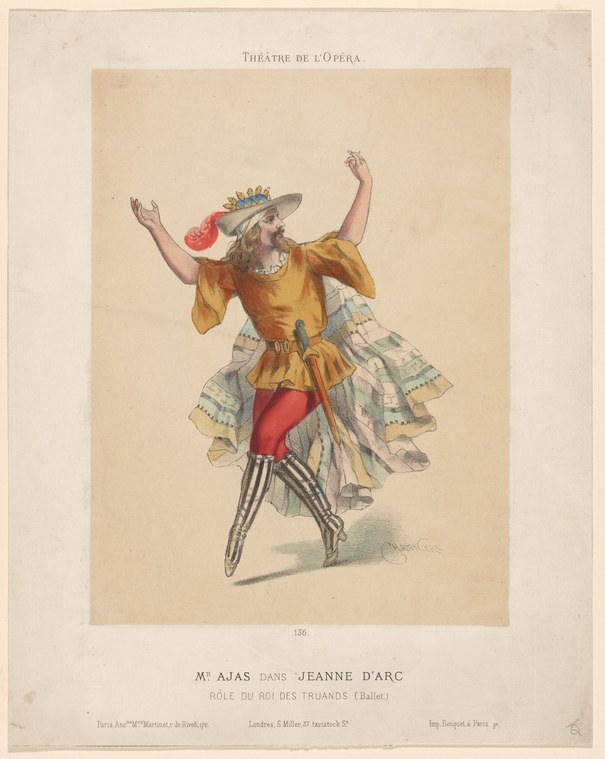
M. Ajas dans Jeanne d'Arc, rôle du roi des truands (ballet)
Unknown artist
- Collection:
- Prints depicting dance
- Source:
- New York Public Library
- Rights:
- Public domain — free to use, share and adapt.
- Recorded as:
- Public Domain
This print provides rare visual evidence of how 19th-century ballet dancers actually moved in character roles—the kinds of roles often omitted from the historical record, which has tended to focus on the principal romantic dancers and their ethereal, pointe-based technique. The leap captured here, with its full-bodied energy and open gesture, shows that ballet virtuosity extended beyond the restrained refinement of classical technique. Second, it documents a specific production and performer at a moment when detailed theatrical costume documentation was becoming a mass-produced consumer commodity, revealing how ballet companies marketed themselves and maintained public interest between performances.
What you are looking at
A male dancer in fantastical costume leaps with arms raised in exuberant celebration. He wears a golden-yellow doublet with exaggerated puffed sleeves, red stockings with black striping, and a small crowned hat. Over the doublet hangs a layered overskirt of pale gauze or silk, gathered at the sides to create a distinctive silhouette—reminiscent of a fool's costume. His body is captured mid-jump, weight lifted, torso arched backward slightly with both arms extended upward in a gesture of triumph or joy. The figure is rendered against a plain cream background with a shadow beneath the feet suggesting the ground plane. The composition isolates the dancer, emphasizing the dynamism and theatrical abandon of the pose. The costume and the inscription below identify this as M. Ajas (the male dancer) performing the role of the King of Beggars in the ballet *Jeanne d'Arc*.
The dancing
A single male dancer, captured at the height of a vertical jump with both feet off the ground. Both arms are raised above the shoulder line in an open, celebratory gesture. The torso is upright but slightly arched backward, the neck extended. The head is held high and turned slightly upward. The pose conveys unrestrained energy and joy rather than the controlled precision of classical ballet technique. The artist has rendered the figure with anatomical attention to musculature and weight distribution, showing clear understanding of the mechanics of elevation.
The dance depicted
This is a character role from a late-19th-century theatrical ballet. The role of the King of Beggars (or King of Truands) in *Jeanne d'Arc* was a comic or grotesque character part, not a classical leading role. The costume—fool-like, exaggerated, fantastical—and the uninhibited gestural language of the leap suggest this was a comedic or character dance moment, likely performed with more pantomimic expressiveness and broader physicality than the refined technique demanded of principal dancers. The pose itself—the full-bodied jump with arms wide—is characteristic of 19th-century ballet's treatment of comic or peasant roles, where grotesque and naturalistic gestures contrasted with the ethereal otherworldly movement of the romantic principals.
How it was made
This is a color lithograph or hand-colored engraving—the delicate line work, the flat color application, and the tonal modeling typical of 19th-century costume plate production. The technique allowed for rapid circulation as affordable theatrical documentation; such prints were sold to the public as souvenirs of performances and as a form of theatrical advertising. The artist's signature (partially visible) and the precise costume rendering suggest this was an official or licensed documentation of an actual performance, circulated among theater-goers and collectors of theatrical imagery. The print quality and coloring process indicate this was a professional commercial product, not a unique work.
About this work
This is a theater souvenir document from a production of the ballet *Jeanne d'Arc*, likely from the 1880s or 1890s, showing the celebrated male dancer M. Ajas in the character role of the King of Beggars. It exemplifies 19th-century ballet's convention of character roles—parts that required a different physical vocabulary and social meaning from the classical line. The costume is deliberately grotesque and comedic: the puffed sleeves, the layered gauze skirt, the fool's crown, and the striped stockings mark this as a part played for humor and visual spectacle. This was not a role for the refined, ethereal movement of Romantic or classical ballet, but rather for the kind of exaggerated, earthy physicality that grounded the fantastic narratives of 19th-century ballet in recognizable social types—beggars, peasants, commoners, or demons. The print documents a specific moment in theatrical history when ballet was moving toward more naturalistic and character-driven narratives.
How to look at it
Pay attention to the moment of elevation the artist chose—not the preparatory crouch or the landing, but the peak of the jump when the dancer is fully weightless. This choice emphasizes the physical skill and the exuberance of the role. Notice how the costume works with the body: the layered skirts catch the air differently than a tutu would, creating a different visual effect. The open arm gesture and the uplifted face are telling—they convey joy and freedom rather than technical precision. This is a character moment, not a technical showcase. Compare this to contemporary images of the principal female dancers in the same period to see how differently the body is used and dressed for romantic versus comic roles.
The period
This lithograph dates from the era of full-length narrative ballets, when ballet was moving away from pure abstraction toward dramatic storytelling. *Jeanne d'Arc* (Joan of Arc) was a popular subject for late-19th-century ballet, aligning with broader cultural interest in nationalist and historical narratives. The period saw the rise of the theatrical character dance and the grotesque or comic role as distinct from classical ballet—a trend that would influence early 20th-century ballet reform. M. Ajas appears to have been a specialist in character roles, and the quality of this print suggests he was a celebrated performer whose parts were considered worth documenting and marketing to the theater-going public. The print production method itself reflects the democratization of theatrical documentation in the late 19th century—such colored lithographs were affordable ephemera, widely collected, and a significant part of how audiences engaged with dance outside the theater.
Where it lives
This print is held in the New York Public Library's collection of dance-related prints and ephemera. It is one of thousands of 19th-century theatrical costume plates—documentation of actual performances, circulated to the public as souvenirs and marketing materials. Such prints are valuable primary sources for understanding not only what dancers wore, but how they moved and what kinds of roles existed in the ballet repertory of the period.
Dance in this work
Questions about this work
Who was M. Ajas?
M. Ajas was a male ballet dancer celebrated for character and grotesque roles in late-19th-century Paris. He is documented here in a role as the King of Beggars in *Jeanne d'Arc*. Beyond this print and other costume documentation, little is widely recorded about his career, but the quality and circulation of his image suggests he was a notable performer.
What is a character role in 19th-century ballet?
Character roles were parts that required a distinct physical vocabulary from classical ballet—broader gestures, more naturalistic or grotesque movement, and often social comedy. They were played by specialist dancers and contrasted sharply with the ethereal, technically demanding roles of the romantic principals. These roles grounded the fantastical narratives of full-length ballets in recognizable social types.
Why does this costume look so unusual?
The fool-like costume—the puffed sleeves, the layered gauze overskirt, the crowned hat, the striped stockings—was designed to signal comedy and social marginality. The King of Beggars is a grotesque, comic character, not a noble or supernatural one. The exaggerated silhouette and bright colors made the character visually distinct and memorable to audiences at a distance.
How do we know this was a real performance?
This is a lithograph produced for commercial circulation as a theatrical souvenir. The naming of the specific dancer, the specific role, the specific ballet, and the professional quality of the print all indicate this documents an actual historical performance. Such prints were sold to theater-goers and are now primary sources for reconstructing what 19th-century ballet actually looked like in practice.
More dance artwork





