49 works in this view — arrow keys or swipe to move between them.
Dance in Art
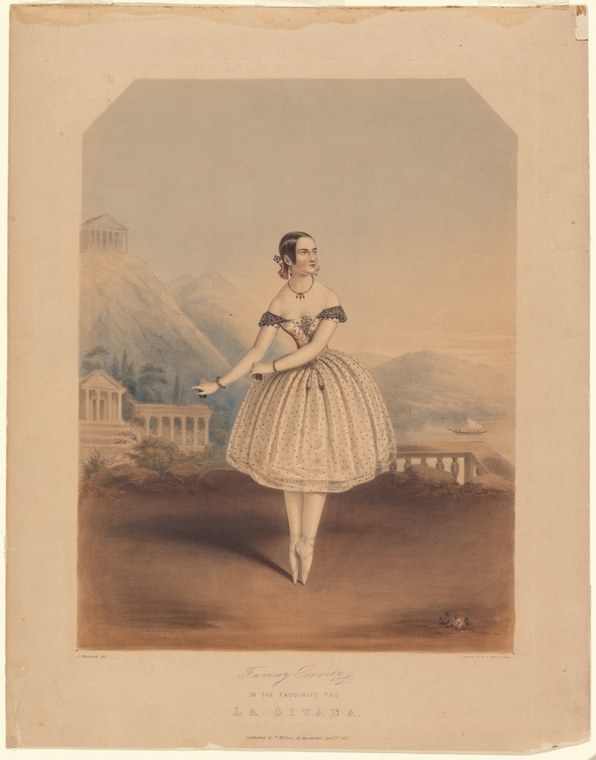
Fanny Cerrito [facsimile signature] in the favourite pas La gitana
Unknown artist
- Collection:
- Prints depicting dance
- Source:
- New York Public Library
- Rights:
- Public domain — free to use, share and adapt.
- Recorded as:
- Public Domain
Fanny Cerrito was a major creative force in Romantic ballet, known not only as a performer but as a choreographer—one of the very few women to hold that role in her era. This image preserves her in one of her signature roles, offering a window into the visual culture of mid-nineteenth-century ballet and the way in which dancers' fame and artistic identity were constructed and circulated through mass-market portraiture. The print is also evidence of the Spanish and Orientalist themes that pervaded Romantic ballet, revealing the period's fascination with exotic 'national' identity as theatrical material.
What you are looking at
A young woman in mid-nineteenth-century theatrical dress stands alone on a stage, posed in an attitude of graceful stillness. She wears a pale, voluminous skirt of the kind worn by Romantic-era ballerinas—gathered, knee-length, and full enough to move with fluid motion—paired with a dark off-shoulder bodice trimmed in lace. A choker encircles her neck. Her dark hair is swept up and back in the fashion of the period. She stands in three-quarter view, her body angled leftward, her right arm extended before her in a gesture of elegant presentation or invitation. Behind her, rendered in lighter tone and softer focus, stands a Mediterranean or Southern European landscape: ruined classical architecture (a temple or ruin with columns), rocky cliffs, and calm water with a distant boat. The whole composition suggests a theatrical set or romantic backdrop, emphasizing the theatrical rather than the quotidian world. The woman's pose and the languorous quality of the image suggest a moment of stillness rather than active movement—the frozen moment between phrases of movement, or a preparatory stance.
The dancing
A single female figure, centrally placed but in three-quarter profile. Her weight appears evenly distributed, her stance upright and formal rather than in motion. Her right arm is extended at shoulder height in a gesture of presentation; her left arm rests at her side. Her head is slightly turned toward the viewer, her gaze directed outward. The stance is controlled and theatrical rather than naturalistic—this is the posture of display, the attitude adopted for the stage. There is no visible partner or ensemble; the figure commands the entire compositional space, suggesting a solo, a feature, or a moment of solo prominence within a larger work.
The dance depicted
This depicts Fanny Cerrito, one of the most celebrated and innovative ballerinas of the Romantic era (1817–1909), in the role for which she was known: *La gitana*, or 'The Gypsy'. This was a Spanish-themed divertissement or pas that showcased the dancer's technical facility and dramatic presence. The Spanish subject matter—and the title's reference to Andalusian identity—placed the work within the nineteenth-century fashion for exotic and national subject matter in ballet. Cerrito was known for her ability to combine technical brilliance with expressive drama; *La gitana* allowed her to display both. The pose here captures the theatrical presentation mode rather than a moment of technical display; it emphasizes the character and presence of the dancer rather than the virtuosity of the step.
How it was made
This is a hand-colored lithograph or engraving, printed as a theatrical souvenir or promotional image—a common form of dance documentation in the nineteenth century, distributed to audiences and collectors to commemorate performances and celebrate famous dancers. The soft coloration, the careful rendering of fabrics and flesh tones, and the idealized beauty of the composition suggest hand-coloring applied to a lithographic base. The print has been executed with considerable refinement: the face shows careful attention to likeness (reinforced by the facsimile signature), the fabric textures are rendered convincingly, and the background landscape is suggested rather than fully detailed, in the manner of theatrical scene painting. This was an object of mass (or at least wide theatrical) circulation, meant to be affordable and displayable, a form through which dancers and their images reached the public.
About this work
This is a portrait of Fanny Cerrito as the Gypsy in her signature role *La gitana*, rendered as a hand-colored lithographic print—likely dating to the 1840s or 1850s, when Cerrito was at the height of her fame. It is both an artwork and a historical document: a record of a specific role danced by a specific artist, preserved in a medium designed for theatrical circulation and fame-making. The image captures the theatrical ideal of Romantic ballet—the solitary, elegant, exotic heroine—rather than the kinetic reality of performance. It belongs in a dance collection as evidence of how nineteenth-century ballet was marketed, remembered, and consumed: not primarily through notation or description, but through celebrity portraiture that celebrated the dancer's beauty, presence, and theatrical command.
How to look at it
Attend to the stillness of the pose: this is not a moment of visible movement but a moment of theatrical presence—the dancer presenting herself, her character, and her readiness to dance. Note the gesture of the extended arm, which frames and displays the body; this is an attitude of invitation or dramatic readiness, familiar from the poses struck at the end of variations or at the opening of a solo. The Mediterranean setting, rendered softly in the background, is theatrical backdrop—not a real place but a painted illusion, which places the figure firmly in the world of the stage. The print's refinement and care in rendering suggest that this image was meant to be treasured and displayed, a keepsake of a theatrical experience and a record of a star.
The artist
The artist is not recorded, which was common for theatrical prints of this era. These images were typically produced by commercial printmakers and lithographers working for theatrical publishers, often in Paris or London—the centers of ballet culture in the nineteenth century. The facsimile signature of Cerrito herself appears on the print, a marketing convention that asserted authenticity and the dancer's own endorsement or involvement in the image's creation. The print belongs to a large body of theatrical souvenir art produced during the height of the Romantic ballet boom.
The period
This work dates to the height of the Romantic ballet era, roughly the 1840s–1850s, when ballet was the dominant theatrical dance form in Europe and America. Dancers like Marie Taglioni, Carlotta Grisi, and Fanny Cerrito were international stars, and their images circulated widely as prints, lithographs, and photographs. The medium and style place the work within the conventions of theatrical portraiture of this period: the idealized likeness, the exotic costume and setting, the emphasis on beauty and theatrical presence rather than kinetic analysis. The Spanish theme of *La gitana* reflects the contemporary taste for national and exotic subjects in ballet—a fascination with flamenco and Spanish dance that would persist through the nineteenth century. The print also predates photography as the dominant form of theatrical documentation, belonging to the final era of hand-produced and hand-colored prints as the primary means of circulating dancers' images.
Where it lives
This work is held in the New York Public Library's collection of prints depicting dance. It is a commercial theatrical print, a category of mass-produced or semi-mass-produced souvenir art designed for circulation among theater-goers and ballet enthusiasts. The collection records it as part of a broader visual archive of dance performance and celebrity in the nineteenth and early twentieth centuries.
Dance in this work
Questions about this work
Who was Fanny Cerrito?
Fanny Cerrito (1817–1909) was an Italian-French ballerina and choreographer, one of the greatest dancers of the Romantic era. She was celebrated for her technical brilliance, expressive power, and her ability to create new roles and choreograph works for herself. She performed across Europe and was a rival and colleague of other Romantic stars like Marie Taglioni. She was one of the few women choreographers in nineteenth-century ballet.
What was *La gitana*?
*La gitana* ('The Gypsy') was a solo role or divertissement created for and performed by Cerrito, showcasing a Spanish or Andalusian character. It allowed her to display both technical virtuosity and dramatic characterization, and reflected the nineteenth-century taste for exotic and national subjects in ballet. The role became one of her signature pieces.
What is a hand-colored lithograph?
A hand-colored lithograph is a print made by drawing on a stone or metal plate treated with chemicals, then printing the image onto paper and hand-coloring it with watercolor or similar media. In the nineteenth century, this was a common and relatively affordable way to produce theatrical and celebrity portraits in multiple copies, reaching a wide audience. Each print was individually colored, so colors could vary slightly between copies.
Why would someone collect an image like this?
Theater-goers collected prints of their favorite dancers as mementos of performances they had seen or admired. These images circulated like modern celebrity photographs, allowing fans to display images of their favorite stars at home. They were also collected by theaters, dance teachers, and aficionados as records of celebrated roles and performances.
More dance artwork





