49 works in this view — arrow keys or swipe to move between them.
Dance in Art
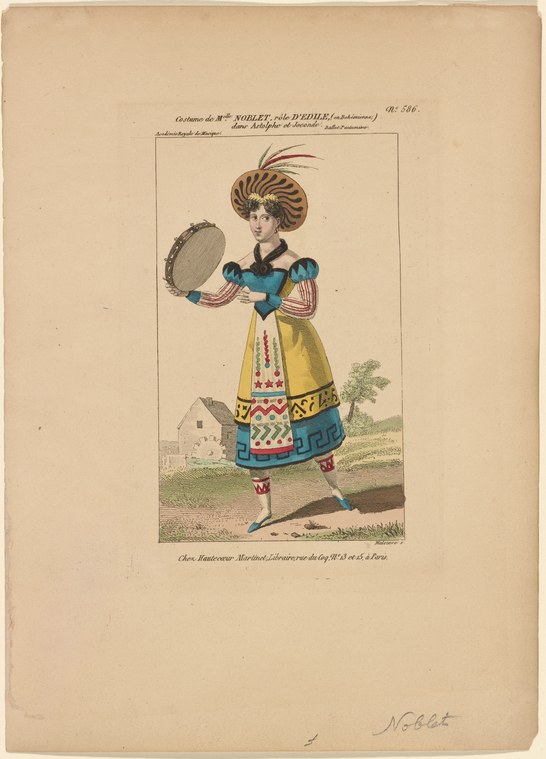
Costume de Melle. Noblet, rôle d'Edile (en Bohémienne) dans Astolphe et Joconde, ballet pantomime, Académie royale de musique
Unknown artist
- Collection:
- Prints depicting dance
- Source:
- New York Public Library
- Rights:
- Public domain — free to use, share and adapt.
- Recorded as:
- Public Domain
Costume documentation is one of the primary sources for understanding how dance roles were visually coded and understood in the Romantic ballet era, when narrative and character were central. This sheet shows exactly how a specific exotic female role was dressed and presented, offering insight into the visual language through which ballet told stories of foreigners and outsiders. For dancers and historians, such prints are invaluable records of what was actually worn on stage — more reliable than written description and more detailed than most surviving costumes.
What you are looking at
A young woman stands alone in a landscape against a cottage or rural building, holding a large round tambourine or similar percussion instrument in her left hand. She wears an elaborate costume with a high-crowned headdress decorated with feathers or plumes, a short dark blue or teal bodice with puffed sleeves trimmed in red or gold, and a yellow skirt with complex geometric patterning in red, white, and blue — notably including checkerboard, diamond shapes, and what appears to be Greek key or meander motifs. Her legs are bare or in flesh-coloured stockings, and she wears flat shoes. The figure is posed in a standing attitude of display rather than active motion, one arm extended to show the instrument, suggesting this is a costume study or character documentation rather than a moment of dance in progress. The watercolour technique and hand-colouration create soft tonal transitions, and the rural setting is sketched in with minimal detail, keeping focus on the figure.
The dancing
The dancer stands upright with a frontal pose, weight evenly distributed, the body at ease rather than in motion. Her left arm extends outward at roughly hip height, presenting the tambourine horizontally. The right arm hangs loose at her side. Her head is held high, turning very slightly toward the viewer. The pose is a presentation rather than a capture of movement — this is costume and character documentation, not a frozen action phrase. The stillness and frontal orientation suggest this was made as a reference or record of what the role looked like when worn.
The dance depicted
The catalogue identifies this as the costume for the role of Edile (described as 'en Bohémienne' — in Bohemian dress) from the ballet pantomime *Astolphe et Joconde* performed at the Académie royale de musique. The work depicts an exotic or foreign female character, marked as Bohemian or Romani by the costume and the tambourine, which were the standard visual codes for such roles in early 19th-century ballet. No specific dance style is frozen in the image; this is a costume study made to document how the role was dressed. The date and performer remain unknown, but the style of the engraving and the character of the costume suggest a work from the 1820s–1830s, the heyday of Romantic ballet.
How it was made
This is a hand-coloured engraving or aquatint, a hybrid print technique that allowed for fine linear detail (the engraving or etched lines) combined with soft, layered colour washes (the aquatint). The technique was standard for theatrical costume documentation in the early 19th century and allowed a single design to be reproduced and circulated widely to other theatres, designers, and performers. The combination of precise line work for the costume details and looser wash for the background and skin creates a document that is both specific and quickly readable — an actor or designer could understand the garment from this single sheet. Such prints were collected in portfolios and sold to the public, making them an important channel for the dissemination of theatrical fashion.
About this work
This is a costume study for a female character role in a Romantic-era ballet performed at the Paris Opéra. It documents not a moment of dance but the visual presentation of an exotic female character — a Bohemian or Romani woman — through her dress, headdress, and the attribute of a tambourine. The character type was common in early 19th-century ballet, appearing in roles that called for foreignness, mystery, or sensuality. The print preserves both the specific design of the costume and the conventions of how such roles were visualized on stage. As a hand-coloured engraving, it is one of hundreds such sheets made to circulate theatrical designs to audiences, performers, and fellow theatres across Europe.
How to look at it
Attend to the costume in its parts: note the high, feathered headdress (a marker of exoticism), the contrast between the dark bodice and bright yellow skirt, and the complex geometric patterning that makes the costume readable even at a distance across a theatre. Observe that the figure is presented frontally and at ease, not caught mid-gesture — this is a display format typical of costume documentation, meant to show the full design. The tambourine, held at mid-height, is the character's defining attribute and props were essential to character coding in ballet pantomime. The rural landscape background, sketched lightly, suggests this Bohemian character belongs outside civilization — a common framing for such roles.
The artist
The artist is not recorded in the catalogue. The engraving is in the style typical of Parisian theatrical print-makers of the 1820s–1830s, a period when the Opéra's costume designs were regularly engraved and hand-coloured for public sale. Such work was often collaborative — a designer would create the costume, an engraver would translate it to a copper plate, and a workshop of colourists would hand-colour each impression. The anonymity of the engraver is typical for commercial theatrical prints of this era, where the focus was on the costume and role rather than the maker's signature.
The period
This work belongs to the Romantic ballet period (roughly 1820–1870), when full-length narrative ballets set in exotic, medieval, or supernatural worlds dominated the Paris Opéra and influenced European dance broadly. The ballet pantomime was the dominant form, combining mime, dance, and spectacle to tell stories without singing. Exotic female characters — Gypsies, Moors, Orientals, peasants — were stock roles, often danced by prominent ballerinas and used to showcase technical skill and expressive range. The visual codes were strict: bare arms, short skirts (compared to street dress), specific headdresses and accessories that signalled the character's nationality or class. Costume studies like this one were both practical documents for artists and theatrical entrepreneurs and consumer goods for the growing middle-class audience for ballet.
Where it lives
The work is held in the New York Public Library's collection of prints depicting dance. The catalogue identifies it as part of the Library's holdings of theatrical prints and designs, many of which came from major European collections dispersed in the 19th and 20th centuries. Such prints were produced in editions and sold both as individual sheets and as bound volumes documenting the costumes and characters of famous productions.
Dance in this work
Questions about this work
What ballet is this costume from?
The costume is from *Astolphe et Joconde*, a ballet pantomime performed at the Académie royale de musique (the Paris Opéra). The character is named Edile and is described as dressed 'en Bohémienne' — in Bohemian or Romani style. No further details about the premiere or performers are recorded on this print.
Why is she holding a tambourine?
The tambourine is a prop that identifies the character as Bohemian or Romani. In early 19th-century ballet, such attributes (fan, dagger, cymbals, etc.) were essential to character coding and helped the audience identify who the character was meant to be, especially from a distance in a large theatre.
What is this object — is it a painting or a print?
This is a hand-coloured engraving or aquatint, a print technique that combines fine engraved or etched lines with soft watercolour washes. It is a reproductive print, meaning it was made to be reproduced in multiples and sold, rather than a unique artwork. Hundreds of such costume studies were made in the early 19th century.
Who made this print?
The artist is not recorded. It was produced in Paris in the early 19th century (likely 1820s–1830s), when such prints were made by collaborative workshops: a costume designer created the original design, an engraver translated it to a copper plate, and colourists hand-coloured each print. The maker's identity was often not recorded.
More dance artwork





