49 works in this view — arrow keys or swipe to move between them.
Dance in Art
Folk and ethnic dancing in wood engravings
Unknown artist
- Collection:
- Prints depicting dance
- Source:
- New York Public Library
- Rights:
- Public domain — free to use, share and adapt.
- Recorded as:
- Public Domain
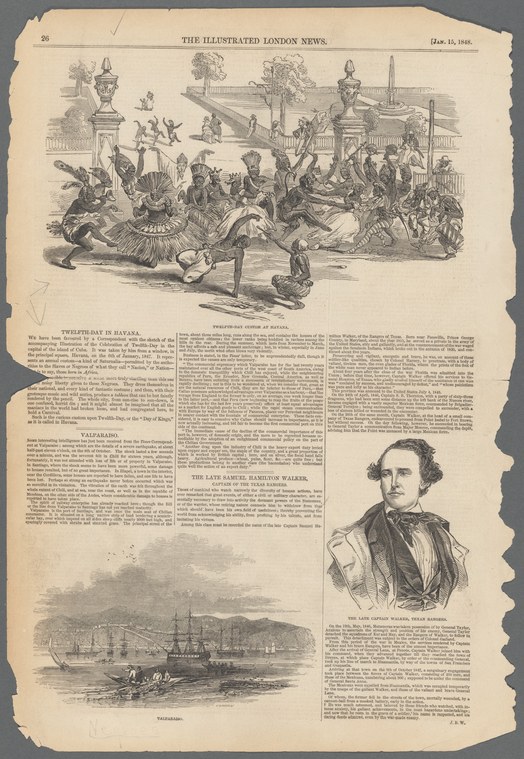
This image preserves evidence of acrobatic and folk performance practices that often left no written record and survive only through visual documentation. It shows that acrobatics and partnered tumbling were organized, skilled, and widely practiced forms of public spectacle in 19th-century urban culture, worthy of illustrative attention in popular media.
What you are looking at
This wood engraving depicts a crowded public square or festival ground filled with acrobats, dancers, and performers in mid-action. The composition is dense and chaotic, with figures stacked vertically across the frame—some tumbling, some in partnered holds, some elevated on shoulders or in contorted positions. The architectural background includes classical buildings with columns and a prominent obelisk or monument, suggesting a European public space, perhaps a carnival or fair. The costumes appear to be simple and varied, some suggesting exoticism or folk dress. The artistic technique emphasizes movement through dynamic postures and overlapping figures; the engraver has used cross-hatching and fine lines to create depth and shadow, giving the scene theatrical energy despite the static medium.
The dancing
Bodies are arranged in multiple overlapping planes and in extreme positions of flexibility and acrobatic skill. Several pairs are shown in close physical contact—lifted positions, shouldering, and partner-dependent contortions dominate. Individual acrobats are captured mid-tumble, with legs extended or bent sharply, torsos twisted. Some figures stand as spectators or musicians; others are clearly performing. The poses suggest strength, control, and trained physicality rather than ballroom or social dance technique. Arms are often raised or extended for balance or in exuberant gesture. The sheer number of bodies and the overlapping compositions suggest this is a moment of maximum activity, not a formal or linear formation.
The dance depicted
This image documents acrobatic and gymnastic performance rather than a specific codified dance style. The work depicts folk or carnival acrobatics—tumbling, partner lifting, contortion, and display work of the type seen at fairs, festivals, and street performance. The heterogeneous mixture of acts (solo tumbling, partner acrobatics, possible contortionists) and the public setting suggest this is a documentation of vernacular performance culture rather than theatrical dance. The acrobats' training is evident in their control and extreme positions, but without musical instruments clearly visible or formal dance frames, this is more acrobatic display than choreographed dance proper.
How it was made
This is a wood engraving, a relief-printing technique that allows for fine detail and tonal subtlety through dense parallel lines and careful cross-hatching. The medium permitted wide circulation as a printed illustration in a periodical or book; the large amount of intricate figure work compressed into a single frame speaks to the skill of the engraver in managing complex compositions. Wood engraving was the dominant technique for illustrated journalism and popular literature in the 19th century, making this likely a record of a specific event or a generic illustration of carnival entertainment for a newspaper or illustrated magazine.
About this work
This is a dense, energetic wood engraving of acrobatic and gymnastic performance set in a public square with classical architecture. The work captures the raw physicality and spectacle of folk carnival acrobatics—the partnering, lifting, contortion, and tumbling that characterized street and fair performance. As a printed illustration, it served to document and circulate images of popular performance culture to a broad audience, making visible the skilled athleticism of itinerant performers. The work belongs in a dance gallery not as an example of choreographed dance, but as a historical record of acrobatic and physical performance as a form of public entertainment and as a form of bodily expression.
How to look at it
Scan the composition from left to right and top to bottom to locate the different acrobatic acts. Notice how the engraver uses overlapping and stacking to convey the press and multiplicity of performers. Watch how individual bodies are twisted and extended—the artist has frozen moments of extreme physical extension and partnered support that would be impossible to hold for long, capturing the momentary peaks of acrobatic skill. The architectural frame anchors the chaos and gives scale; the monument or obelisk grounds the action in a real, named place.
The period
This engraving likely dates to the mid-to-late 19th century, when illustrated periodicals such as the Illustrated London News made visual documentation of contemporary life and entertainment a central editorial practice. Acrobatic performance and carnival entertainment were thriving in European cities; such spectacles drew large crowds and were considered newsworthy enough to merit illustration. The style and density of the composition reflect the engraver's effort to capture the bustle and simultaneity of a crowded public event.
Where it lives
This work comes from the New York Public Library's collection of prints depicting dance. It is catalogued as a wood engraving but carries minimal identifying information; the title suggests it documents folk and ethnic acrobatic performance, and the style points to mid-Victorian illustrated journalism.
Dance in this work
Questions about this work
Is this a record of a specific event?
The image may document a particular carnival, fair, or street performance that was noteworthy enough to be illustrated in a London newspaper or periodical. However, without a caption or accompanying article, it cannot be tied to a specific date or location. It may also be a generic or composite illustration meant to represent 'folk acrobatics' as a type.
What is the difference between the acrobatics shown here and theatrical circus performance?
Both involve trained physicality and partnership, but circus was increasingly professionalized and staged indoors with orchestration and narrative. This image appears to show street or carnival performance in public, with multiple simultaneous acts competing for attention, suggesting less formal organization and lower barrier to entry for performers.
Why are so many performers crammed into one image?
The engraver has chosen to show the abundance and simultaneity of a crowded fair or carnival—the sense that multiple acts and attractions are happening at once, fighting for space and spectators. This compositional choice conveys the chaos and energy of the event rather than any single polished performance.
More dance artwork





